by tradespeopleinsights | Jun 1, 2010 | Marketing Tips, Traditional Marketing
 I recently interviewed Jim Lucy, the Chief Editor of Electrical Wholesaling Magazine on the state of the industry. Jim has been with Electrical Wholesaling for 28 years and has a good pulse on what’s happening in the industry. You can listen to the entire interview here.
Highlights include:
- Is there light at the end of the tunnel?
- How progressive companies weathered the storm?
- Which market niches offer the most opportunity over the next few years?
- Will M&A activity increase as the economy improves?
If you like what you listened to, pass it on to a friend.

by tradespeopleinsights | May 27, 2010 | Marketing Tips, Traditional Marketing
E-mails are still a good “go to” strategy whether you’re a B-to-B or B-to-C marketer. When going after the professional tradesmen or contractor, we have found that timing is probably one of the most critical components to a successful campaign.
We have found that the time of day is usually a key factor in the open rate. We usually either have them sent at 6-7 in the morning or after 5 as these are the times contractors usually have time to spend on their e-mails.
Silverpop‘s recent poll ranked tactics that both groups thought to be important.

B-to-B marketers were highly focused on moving prospects through the sales pipeline, while B-to-C respondents were looking to increase customer loyalty.

What are some of the tactics that you find get better results?
Other posts you might find interesting:
Will E-mail Be Replaced by Social Media?
E-mail and Social Media are Tools B-to-B Marketers Plan on Using More of in 2010
E-mail Marketing for Industrial Markets: Common Mistakes to Avoid
E-mail: Still an Effective Method to Reach the Professional Tradesmen
by tradespeopleinsights | May 26, 2010 | Marketing Trends, Traditional Marketing
When looking at what marketing tools to use, you have to look at your target and find out how they like to receive info. For the contractor that’s on the go, e-mail is still a viable option especially for the over-30 crowd. For the under-30 crowd, texting was the preferred method.
In a recent survey by eMarketer.com, they found 70% would rather talk to their friends and family via e-mail as opposed to social sites.

ExactTarget’s “2009 Channel Preference Study” also found e-mail on top, with 57% of U.S. Internet users preferring it for written communications versus 24% for texting and just 10% for social.
Texting was preferred by almost half of the respondents.

So, the bottom line is, don’t give up on a tool that has become part of our daily lives.
Other posts you might find interesting:
Will E-mail Be Replaced By Social Media?
E-mail and Social Media are Tools B-to-B Marketers Plan on Using More of in 2010
E-mail Marketing for Industrial Markets: Common Mistakes to Avoid
E-mail: Still an Effective Method to Reach the Professional Tradesmen
If you like this post, please share it with a friend.
by tradespeopleinsights | May 25, 2010 | Marketing Tips, Social Marketing
 B-to-B marketers, to be successful in the world of blogging, you must truly be focused on your target market.
A blog should be central to your company’s social media strategy for new business. What fuels the engine to this strategy is good content.
You must consistently feed your inbound marketing machine with rich content or you will see a slow-down in traffic, search engine results and prospective client leads.
Here are my 6 tips to be more effective with your blogging:
- To be successful, you need to write a lot. The more posts you add to your blog, the more traffic you’ll get. The more content can also fuel repurposing content through other social media platforms such as Twitter, Facebook and LinkedIn. No content = no fuel = no traffic = no new business leads.
- Be consistent. To keep writing, I visualize someone walking to the end of their driveway to pick up the morning paper, only to discover there’s nothing there. That helps me to stay motivated to write 2 to 3 posts per week. My readers know what to expect. I want to give them a reason to consistently come back.
- Write concisely. People are busy. They need your content to be easy to digest. Provide them with the Readers Digest version. Make your content easy to scan, provide bullet points and numbered lists. People will be much more interested in what you have to say if you don’t try and fluff it up.
- Use your analytics. Know what your readers care about and what they respond to. It will help you to connect with your audience. They’re the judge and jury of whether your content is relevant or not. I know daily where my readers are coming from, what post titles and content generates the most traffic and what search terms they are using.
- Use your writing to learn. When I first started blogging, I was reminded of the old saying, “you don’t know what you know until you write it down.” It’s true. Writing strategizes and invigorates my learning. It can get me ahead of the learning curve and provide me with a system to stay there.
- Keep focused. If your blog is broad, you will not generate any significant traffic. Narrow your focus. Think narrow and deep rather than wide and shallow. Know who you are writing to, what you are writing about, know the categories you will be writing to, the key words that you want to dominate for search.
If you like this post, please pass it on.
Here are some other posts that might be of interest:
5 Quick Tips to Promote Your Posts.
How to Find Readers for Your Blog.
Forrester Report: Most B-to-B Blogs Fail.
by tradespeopleinsights | May 20, 2010 | Marketing Trends, Traditional Marketing
 Sonnhalter is deeply involved with the professional tradesman. We recently completed an overview of the Industrial/MRO market. The purpose of the document is to give the reader a quick snapshot of the industry, its players and trends for 2010.
Highlights include interviews with editors of the top two trade publications. Also included are association and buying group contacts, trade shows/meetings, industry trends and media publications.
A free copy for viewing/download is available by signing up here.
by tradespeopleinsights | May 19, 2010 | Marketing Tools, Traditional Marketing
 If you’re a manufacturer who sells through a distribution channel, you need to think about training. A recent survey by BlueVolt indicates that distributors who are trained online recommend and sell more.
It makes sense – most distributors stock over 20,000 items and it’s impossible for them to know about each one of them. It stands to reason if they feel comfortable about a product, it makes it easy for them to recommend it.
Think beyond new product launches as well. Look at some of your core product that might be considered by the end user as a commodity. What better way to differentiate your product from the pack than by training the people who have influence over what users buy?
And what’s more interesting is that these folks are requesting online training mentioning manufacturers by name. Talk about an opportunity! You need to think of training as a selling tool, not a marketing expense.
About the study:
BlueVolt, starting in the fall of 2009, sent out a survey to employees of distributors who took online training within the major buying groups and associations. Among the industries covered were Electrical, Plumbing, HVAC, PVC, Construction, Industrial and Flooring. Job titles included sales (inside and out), counter people and CSRs, to name a few. A total of 1291 surveys were sent out and 1210 were returned for a 94% return rate. The respondents were given the opportunity beyond just answering the questionnarie to identify, by name, those manufacturers they wanted more training from.
Regarding increasing sales and improving customer service:
– 81% said that they sell more as a result of learning through BlueVolt
– 94% said their customers rely on them to recommend products or manufacturers
– 89% said that they service their customers better as a result of online training from BlueVolt
– 63% said they recommend products at least once a day
– 57% said they recommend products 2-5 plus times a day
If you like this post, please pass it on.
Here are other posts that might be of interest to you:
Use Online Training to Educate Tradesmen Part 1
Use Online Training to Educate Tradesmen Part 2
by tradespeopleinsights | May 18, 2010 | Marketing Tips, Marketing Trends, Traditional Marketing
 The iPad has some great applications when it comes to calling on Contractors and Distributors alike.
Its size for one and ease of use are the first two that come to mind. I have an iPhone and I sure wouldn’t want to watch a presentation on it and it has one of the bigger screens for the smart phones.
Here are a few ways you as manufacturers can utilize this tool:
- CRM Tool – You can keep your sales leads and calls for today on it. As you make the calls, you can be writing in your newest promotion/contest, and if it requires signing up, they can do it right on the iPad.
- Meetings/Presentations – Whether you’re making a pitch at a distributor, or if you’re on a job site showing the latest video or testimonial from a contractor on the new product you’ve just rolled out. This could be an easy and convenient way to utilize the iPad.
- Note Taking – I used to use my iPhone to jot down notes or thoughts as I’m out on the road. It can be done, but it’s not the easiest thing in the world to do.
The iPads are relatively inexpensive and are a good tool to help in closing the sale.
Those are my ideas on how to use the iPad. I’d like to hear how you might be using it .
by tradespeopleinsights | May 13, 2010 | Marketing Tips, Social Marketing
Facebook fan pages are the current rage. That’s all well and good as long as you have purpose other than “everybody has one.” Just because you build it, it doesn’t mean they will come. You need to have a plan just like everything else!
I was reminded recently of that very fact when I read a post by Amy Porterfield, How to Create a Facebook Fan Page Editorial Guide, in which she outlines both defining a purpose and a guide to developing editorial.
Here are some highlights:
Defining your purpose:
- Don’t do it because everyone else is.
- How will your page be different from your web site? The more interactive, the better it will be.
- What sets you apart from your competition?
Suggestions for creating editorial guidelines:
- What’s your strategy? Is it going to be daily? Will it be in the morning?
- What’s your content? Are they all going to be original posts or will some be guest posts?
- Formatting – what will they look like?
- Engagement – what’s your plan to respond to those who come back with comments?
- Set rules – make a policy on what will and what will not be posted in regards to comments.
 One of my favorite fan pages in the B-to-B space where we play is that on Snap-on Tools. They have over 44,000 fans and they do it right. They promote new products, upcoming events and even offer incentives for fans to buy their tools. Wouldn’t it be nice that every time you posted something on your fan page, all your fans were notified?
Can you share some other B-to-B pages that are doing it right?
If you like this post please pass it along.
by tradespeopleinsights | May 12, 2010 | Marketing Tools, Social Marketing
I’ve been saying for some time now that the most overlooked social media tool for the B-to-B market is LinkedIn. It makes sense to join groups on LinkedIn, whether it’s buying groups like A-D or Netplus Alliance, or associations like STAFDA or AHMA. Take advantage and participate in the arenas you sell to and through.
With sales cycles getting longer, social media is a good way to start building those relationships. They are by no means the only way to nurture a prospect, but according to a recent “B-to-B Sales Pulse Survey” from OneSource, LinkedIn usage has increased significantly. Nearly 50% of the respondents said they were using LinkedIn more than a year ago.

Hubspot, in their January 2010 data report, showed that 45% of North American B-to-B companies used LinkedIn for marketing and have acquired customers through the site.
So how are you using LinkedIn to identify new prospects and build relationships?
If you like this post, please pass it on.
by tradespeopleinsights | May 11, 2010 | Marketing Tips, Social Marketing
If you want to be a serious blogger, there are some things you need to follow to be successful. It’s not as easy as it might appear, and here are some tips I’ve learned over the last year in doing my blog.
- Be Committed – Committed to write 2 or 3 posts a week no matter what. You need to read and research and plan you editorial. You need to be persistent in that you won’t become an overnight success. It takes time to build an audience, and once you do, it takes more time to develop a relationship.
- Be Focused – Choose a topic or niche and stick to it. Be consistent in your voice and approach. Also be consistent in the number of times a week you post.
- Be Concise – You’ve got between 2-5 seconds to get their attention, and once you have it, make sure you deliver content that’s on the mark.
- Be Analytical – You need you watch which posts are drawing attention. This will help when developing topics for future posts. Where are your readers coming from – other sites, search engines? What search terms are the engines picking up?
- Never Stop Learning – Stay ahead of the curve in your area of expertise. This is especially true in social media where things seem to change daily. Just think, a few months ago, mobile marketing certainly wouldn’t have been on the top of my radar screen, but today it’s a hot topic.
Those are my suggestions. I’d like to hear from you and have you add to the list.
If you like this post, please pass it on.
Here are some other posts you might find interesting:
5 Quick tips to promote your posts
Posts should be like missles:powerful and to the point
by tradespeopleinsights | May 6, 2010 | Marketing Tips, Social Marketing
For those of you who haven’t yet dove in to the social media arena, whether it’s because of fear of the unknown or the fear of it’s going to be too time-consuming, I have some friendly advice.
I can’t force you to try it, but I can tell you it won’t hurt and you can’t break anything. For those who are willing to give it a try but are worried about the amount of time it will take, I have some suggestions for you to consider.
Social media is about building relationships and becoming thought leaders in your category. So a rule of thumb would be to automate or delegate everything except the interaction portion.
Susan Baronini-Moe in a recent post on Social Media Examiner, What You Need to Know About Outsourcing Social Media, outlines her ideas on what should be done, and I think it would be a good read for you.
Here are some highlights:
What you shouldn’t outsource:
- Anything that engages the user you should be a part of. You should be the voice of the company. Any conversation should be started or answered by you. Reply to your tweets, Facebook and LinkedIn comments from the groups you belong to.
What to outsource:
- Profile Set-ups – on Facebook, Twitter and Linkedin. These contain some pretty basic things and doesn’t require your personal involvement.
- Listings – setting up listings on Twitter directories, groups on LinkedIn and Facebook can be handled by someone else.
- Automated Updates – on Twitter, your blog or RSS feeds.
These are some of my thoughts, what are yours?
If you like this post, please pass it on.
by tradespeopleinsights | May 5, 2010 | Marketing Tips, Traditional Marketing
 All of us are getting inundated with e-mail, but studies show it’s still one of the best ways to reach out to people.
It does have its challenges with spam filters and internal firewalls. But I’ve found that by using some of the techniques for writing blog posts have come in handy in writing e-mails.
So here are some tips on how to more effectively use this tool:
- Subject line – This is probably the most important part of the message. Make sure you grab their attention.
- Preview pane – Preview panes shows a few lines of content. It’s important that you deliver on the subject line quickly. Let them know what’s in it for them if they continue reading.
- Make it scannable – I learned this from doing posts here on the blog. Use short paragraphs, highlight important parts of the message. The average time spent on an e-mail is somewhere between 2-5 seconds, so you don’t have much time to stop them.
- Go for quality not quantity – Put out fewer e-mails, but make them more impactful. If I know when I get an e-mail from you I usually get some good info, I’ll open it.
- Timing – It’s all about the timing. I’ve found that Tuesday, Wednesday and Thursday are the best for me. You need to test out what might be the best time to hit your audience. For contractors, the best time I’ve found is between 6:30 – 7 in the morning or later in the evening about that same time.
Those are some tips on how I try to make e-mails more effective.
What are some things you do?
If you like this post, please pass it on.
Other posts you might find interesting:
Will e-mail be replaced by social media?
E-mail and Social media are tools B to B marketers plan on using more of in 2010
E-mail marketing for Industrial Markets: Common mistakes to avoid
by tradespeopleinsights | May 4, 2010 | Marketing Tools, Social Marketing
 LinkedIn has a new tool, “Follow Company,” which, like it says, lets you follow companies. What a great way to get current activity levels at your customers or competitors. Learn what the latest competitive promo is or what the customers are talking about.
It’s simple to use.
- You can either go the search box at the top right and scroll down to company and enter who you want to follow. Once the company profile comes up, there will be a place for you to click the box and you’re done. To unfollow is just as easy.
- The other option is go to a member’s profile and where it talks about who he’s working for, you can scroll and click “Follow Company” and you’re done.
I can’t believe it took them as long as it did to put this feature up there. The “Follow Company” function has truly made LinkedIn social.
by tradespeopleinsights | Apr 29, 2010 | Marketing Trends, Social Marketing
That’s the $64,000 question. Marketers are split on whether social media will deliver measurability according to a recent study by Datran Media’s 4th Annual Marketing and Media Survey. 87% of those surveyed said that accurate online measurement was at least somewhat important for driving increased brand awareness, revenues or performance.

According to eMarketers’ CEO and co-founder, Geoff Ramsey, in his insight brief, Seven Guidelines for Achieving Social Media ROI, most marketers today do not invest sufficient time, effort or money on social media measurement.
The leading metrics used to measure social success focus on increased site traffic, but on its own, it cannot justify heavier investments in social media.

Of those respondents, those who are heavily invested in Facebook and Twitter were most likely to track online.
For the B-to-B sector, they are having a tough enough time finding justifications and budgets to do social media. After they cross that hurdle, then they’ll have to start monitoring their activities.
If you like this post you might like:
Why Do People Ignore Social Media Metrics?
B-to-B Marketers: Analytics Key To Your Internet Success.
by tradespeopleinsights | Apr 28, 2010 | Marketing Tips, Marketing Trends, Social Marketing
Those of us who have been blogging for sometime may be under the assumption that once someone finds our blog they become a groupie and read every one of our posts. Well, here’s a wake up call.
Would you believe that 80% of the people who come to your site are first-timers?
This is true for most bloggers. Even the big boys like Jay Baer and Jason Falls have 65% plus who come to their sites for the first time. Jay Baer wrote a recent post, 5 Ways to Make Friends with Strangers on your Blog, where he outlines his suggestions on how to capitalize on your blog.
This comes from new research from Compendium Blogware (I recently attended a webinar from them) that shows that for more than two-thirds of corporate blogs, new visitors comprise more than 80% of blog traffic. So once your ego gets over the fact that the number of groupies following may not be as large as you thought, what do you plan on doing?
I’m a believer that the glass is half full and that this provides all of us with an opportunity to convert those first-timers to regulars. Here are some things you should consider doing:
- Make your site easy to navigate – 80-95% of all clicks to your blog are organic which means they didn’t come directly to your URL.
- Make sure your blog is focused – so the new reader can easily identify what it is you are focusing on and make it personal (put up your photo).
- Keep talking about your key ideas over and over – Just because you wrote something last week, it doesn’t mean they see it especially with 80% plus being first-timers.
- Keep them on your site by referring them back to other posts you have written on the same subject – this helps you build thought leadership quickly.
- Make it easy to subscribe to your RSS feed – if they like what they’ve read, make it easy for them to read you regularly.
These are my thoughts. Do you have any to add?
Here are some other posts you might find interesting:
10 Engagement Tactics That Will Help B-to-B Marketers
Forrester Report: Most B-to-B Blogs Fail.
If you like this post, please pass it on.
by tradespeopleinsights | Apr 27, 2010 | Marketing Tips, Social Marketing
“Build it and they will come,” is not the answer to generate traffic to your agency’s blog. You must employ proactive tactics to create awareness and interest among prospective tradesmen. The more traffic that you can generate from among your target audience, the more inbound new business leads that will follow.
Denise Wakeman, Online Marketing Advisor and Founder of The Blog Squad, has created an excellent list of tips to generate traffic to your blog. I would encourage you to create a list of “to dos” from her suggestions. For more details, be sure to check out her article, “19 Tips for Driving Traffic to Your Blog.”
Here are 6 suggestions:
- Make your target audience crystal clear. If you can’t clearly and narrowly define your audience, you won’t build significant traffic.
- Optimize your posts’ content for search. Identify and dominate a few key words that your target audience will most likely use to find you. Use these words consistently in your posts’ titles and copy.
- Knowledge is power. Get in the habit of checking your blog’s analytics frequently. Keep it simple, but know at least daily the number of unique visitors, page views, top posts, how people got to your blog, search terms and incoming links.
- Don’t be afraid to re-purpose older blog content through multiple social media channels. Posts that I’ve written a year ago are still pertinent and continue to generate traffic to my blog.
- One thing to not do that will impact traffic. Don’t sell! The moment you start to sell on your blog is when you will most likely LOSE your audience.
- Identify who your audience is in your post titles. This is especially helpful when you re-purpose your content on Twitter and an important part of SEO for your blog.
These are some of my ways. What do you do to make the most out of your blog? I’d like to hear from you.
If you like this post please, pass it on.
Here are some other posts that might be of interest:
5 Quick Tips to Promote your Posts
How do you Find Readers for your Blog
by tradespeopleinsights | Apr 22, 2010 | Marketing Trends, Traditional Marketing
 This is the second part of a two-part article on the plant engineer. Here’s a link to the first part (Part 1). For those of you who are targeting the plant engineering function, you should read a new study that was just released in April from Plant Engineering magazine, called, “The Changing World of the Plant Engineer.” From the study, you’ll gain insight on the changing role of the plant engineer, what they’re thinking about for 2010 and beyond. So next time you’re talking to a plant engineer, think about what’s on his mind.
The second part has to deal with 7 changes they would make about the manufacturing operation:
- Decrease Outsourcing/Keep Manufacturing in this Country – They want to not only keep what’s left of manufacturing in this country, but want to bring back what’s offshore. They don’t believe this country can survive as a consumer society.
- Increase/Improve Automation – Replace aging equipment with automated machines with vision inspection to reduce costs and improve productivity.
- Educate/Train Employees – More operator training and involvement in predictive/preventative maintenance. Training of future techicans and engineers. Keep up-to-date on new technology.
- Aging Equipment/Facilities – Invest in systems that would help reduce costs and improve quality.
- Decrease Regulations – Reduce tight environmental and OSHA Regulations. This will help level the playing field with China.
- More Efficient/Lean – Increase improvement and LEAN culture for all employees.
- Tax Incentive/Tariffs – Make the playing field level so we can compete. There should be tax breaks for companies that keep their manufacturing here in the States.
These are interesting insights as to what’s on their minds.
by tradespeopleinsights | Apr 21, 2010 | Marketing Trends, Traditional Marketing
 For those of you who are targeting the plant engineering function, you should read a new study that was just released in April from Plant Engineering magazine called, “The Changing World of the Plant Engineer.” From the study, you’ll gain insight on the changing role of the plant engineer, what they’re thinking about for 2010 and beyond. So next time you’re talking to a plant engineer, think about what’s on his mind.
Part 1 – We’re going to review the highlights of their top 10 biggest job related concerns:
- The Economy – No big surprise on this one, but beyond what’s happening in Washington, they are worried about economic factors they have no control over like global competition, currency fluctuation and environmental issues.
- Job Security – Will my plant close, will I be asked to retire early, will I get fired. A lot to think about when they’re trying to do their job on a daily basis.
- Knowledgeable Employees/Aging Workforce – They’re concerned that most of the experienced workforce will retire in the next 5 years leaving them with less skilled replacements.
- Aging Equipment/Facilities – How do they keep the facility running at or above production targets with a reduced workforce and aging equipment that will need more mainteinance.
- Safety – Not a priority with upper management. They are more concerned with increased productivity.
- Plant Closings – Will their plant survive 3-5 years? Will they lose production to India or China?
- Budget – Meeting cost targets in a downturned economy. Where to best spend their limited budgets so they don’t have a major failure.
- Doing more with Less – Increased workload, reduced budgets and limited resources on all fronts.
- Government/Environmental Regulations – A growing government with more burdensome regulations.
- Outsourcing – of jobs overseas and the shrinking importance of manufacturing to our economy.
These are interesting insights as to what’s on their minds. Next up, changes they would make about their manufacturing operation.
by tradespeopleinsights | Apr 20, 2010 | Marketing Tips, Social Marketing
 We’re all trying to keep ahead of the curve, and social media is one way of doing that. Lots of people are afraid of social as if it’s something scary. I think the unknown plays a big part in the uncertainty. You can break social so why not dive in and try. The water is just fine.
I read a post recently by a friend of mine and fellow blogger Nicky Jameson, 19 Things I’ve Learned About Social Media, and it made me start to think about what I’ve learned and here are my 5 observations:
- Don’t ignore social media – Just because you may not understand it, don’t look the other way. This is not a flash in the pan. It will affect all of us in one way or another so you’re better off facing it. There’s lot of good business potential out there.
- Social media isn’t a silver bullet – I’ve said this several times before, social media isn’t the answer, it’s just more tools you can use in your marketing tool box.
- Have a plan – If you’re going to do social media, then have a plan. What are you trying to accomplish and how does it fit into your other current marketing programs.
- Content is still king – if you’re going to do social media. You need to give something of value. That’s part of the program. The more you give, the more you are considered a thought leader in that category.
- Face-to-face – is still the best for contact. As humans, we need to interact and as I say, belly button to belly button is still the best in my book. Social media is one way to identify potentials and start building a relationship that hopefully one day will end in a face-to-face meeting.
These are my top 5. What are yours?
If you like this post, please pass it on.
Here are a few other posts that might be of interest:
3 Ways Tradespeople Can Use Social Media to Boost Credibility and Business.
Why Do People Ignore Social Media Metrics?
Social Media: Who Uses It and Why.
by tradespeopleinsights | Apr 15, 2010 | Marketing Tips, Social Marketing, Traditional Marketing
If you’re putting social in its own silo, you’re not going to have the impact you had hoped for. We need to realize that social media by itself really isn’t very useful if it’s not used in conjunction with other marketing tools. Integrated programs are the key to maximizing social media.
According to research by Unica, the proportion of marketers integrating their social campaigns with other channels varies widely depending on the tactic. Unica said in its report that the main ways marketers are integrating their social campaigns are in regard to timing, creative themes and branding.

What are you doing to integrate social into your marketing programs?
by tradespeopleinsights | Apr 14, 2010 | Marketing Trends, Social Marketing
Social media is continuing to expand its reach (an estimated 940 million people worldwide), and businesses and their brands should look to social media as a place to build their brand. Granted, a majority of the activity is on a personal level, but interactions involving information about products and services have increased significantly according to a recent article in eMarketer.com as brands encourage word of mouth.
A recent study conducted in January of 2010 from InSites Consulting reveals some interesting points.
When asked what was the most believable source when it came to info found on the Internet, the most likely answer was their peers. That’s not surprising, but what is is that “the brand itself” came in a close second, far ahead of journalists which are traditionally considered an objective source.

InSites also found that, while brands were not at the top when users became fans, they did show up very well.
What’s this mean to you and your brand? Keep on connecting and conversing. There’s a big audience out there that can and will use your product (or your competitors). Let’s make sure it’s yours.
by tradespeopleinsights | Apr 13, 2010 | Marketing Tips, Social Marketing, Traditional Marketing
Although everyone is focusing on social media, let’s not forget an old friend, e-mail marketing. Using social media as a partner, it will provide new avenues for engaging and sharing both current customers as well as prospects. Professional tradesmen are used to being contacted via e-mail, and more and more are getting into the social media arena. Let’s not let an opportunity go by to make your marketing message more impactful.
According to Debra Aho Williamson, eMarketer senior analyst and author of a new report, Maximizing the E-mail/Social Media Connection, “Even though people are spending more time using social media, they are not abandoning e-mail.” According to Williamson, marketers must integrate efforts to maximize both social media and e-mail marketing. Here are 4 items for consideration:
- Multiply the sharing opportunities by linking e-mail messaging with social media messaging.
- Provide a broader platform for brand advocates; encourage the best customers to share with friends via social media.
- Shift the control to the consumer by providing multiple avenues to interact with a company.
- Use e-mail metrics such as response rate and conversions to enhance social ROI.

This trend seems to be already catching on according to a recent survey by StrongMail that stated 40% of business executives are already integrating these two and consider it one of their most important initiatives for 2010.

How are you planning on using these two marketing tools in your business?
If you like what you’ve read, pass it on to a friend.
by tradespeopleinsights | Apr 8, 2010 | Marketing Tips, Marketing Tools, Social Marketing, Twitter
In our world of B-to-B and especially the world of manufacturing, Twitter, of all the social media tools, is probably the most misunderstood and therefore the most under utilized.
75 million people visited Twitter in January alone, over 23 million were from the US. According to Twitter, over 50 million tweets are sent daily.
Twitter is being talked about everywhere. People are drawn to it because of the buzz of its popularity, but the majority of people don’t understand its potential.
My primary objective for using Twitter has been to increase traffic to my blog. Twitter is now the leading traffic generator for Tradesmeninsights.
There are hundreds of tools that have been developed to enhance Twitter’s usefulness for marketing. The tool that is most helpful to me and the one I use most often to generate new business is called Social Oomph.
These are some of the Social Oomph features that I like and use:
- Manage multiple accounts from one dashboard (our agency’s as well as client’s Twitter accounts)
- Manage an unlimited number of blogs
- Upload your agency’s blog posts and URLs from an Excel spread sheet, in bulk, to Social Oomph
- Pre-set the date/time range for each post in minutes
- Automatically shorten post URLs through Bit.ly and track clicks
- Automate – follow those who follow you in Twitter
- Automate – unfollow those who don’t follow you in Twitter
- Purge and filter your Twitter account’s DM box
- Small monthly fee that is month-to-month, cancellable at any time (more than pays for itself for the time that it saves)
- Junior level people/interns can be easily trained to use this tool on behalf of the marketing departments
- You can also schedule your company’s blog posts to Facebook, just keep the repurpose level to only a few per day
For Twitter to have real value from a new business perspective for manufacturers, you must have a clear objective and follow a simple formula for use.
To reach my objective to my blog’s traffic and exposing it to a new but targeted audience, I’ve followed Angela Maiers 70-20-10 Twitter Engagement Formula.
70 to 80% of my “Twitter time” is spent sharing helpful information for manufacturers on how they can use social media as part of their overall marketing strategy… I do this in two ways:
First, I share lots of information from my online reading that I think will be of help to my audience. I’m able to use some tools such as TwitThis that I’ve placed in my browser bar. When I come across a good article that I think will be of help, all I have to do is click on TwitThis and automatically post the article title and tiny URL into my Twitter account.
Secondly, I also share the content from my Tradesmeninsights blog. I now have over 180 of my own blog posts regarding ways manufacturers can use social media. I’m able to use Social Oomph to expose these posts to new audiences.
I can easily schedule the date, time and recurrence of each post. With the volume of posts that I now have, I can publish a different post on Twitter every hour, seven days a week twenty-four hours a day without repetition. Older posts, that are still useful, have new life. The best posts are often re-tweeted and exposed to new networks of people.
Your Company’s Blog Posts: Don’t make the mistake of thinking that if you’ve written it, everybody has read it.
Twitter is more than a fad. It is a valuable marketing tool. Twitter tools such as Social Oomph make it priceless for generating traffic and new business leads.
by tradespeopleinsights | Apr 7, 2010 | Marketing Tips, Social Marketing, Traditional Marketing
 When you have lemons, make lemonade! I know most of the manufacturers that read me regularly pulled in their horns last year to ride out the uncertainty. There are a few, though, that have continued on and have made an impact on both the economy and their bottom line.
I’ve been trying to showcase some of these leaders over the past several months, and here is another one. Molex (Disclaimer: they are a client of ours), through its Woodhead brand, offers the broadest range of code-compliant electrical products designed to perform in harsh environments.
When the Government last year introduced the (ARRA) American Recovery and Reinvestment Act to focus on rebuilding roads, bridges and other infrastructures of the country, Molex came out with their own program, Rebuilding America Together. The target audiences were distributors and contractors in the commercial construction and utilities industries.
Their integrated plan included :
The good news is that they had the insight to do something when everything was tanking. The better news is it’s working. It created buzz at the distributor level and gave them something to talk about with the contractors. It gave the contractors incentives as well as fostering a theme of patriotism. It gave Molex increased sales.
That’s one more example of someone doing it right. I’d love to hear from you if you have other examples.
by tradespeopleinsights | Apr 6, 2010 | Marketing Trends, Social Marketing
We in the B-to-B world realize that digital is fast becoming a very acceptable vehicle which none of us a few years ago would have thought that it would have grown at such a fast pace. In our space, digital will have a role but I don’t believe it will catch up to the consumer side of things. While the enclosed study is primarily focused at the B-to-C side of things, it should be a gauge for us as to things come.
Outsell, which provides research and advisory services to the publishing and information industries, surveyed more than 1,000 US advertisers in December 2009 for its annual “Marketing and Advertising Study 2010.”
This marketing and ad spending study forecasts spending, share, and growth for five media types—online, events, print, TV/radio, and PR/other—and methods used within each, from social networking to mobile/wireless marketing.
In what it calls “an industry milestone crossover event,” US companies will spend more this year on digital and online advertising and marketing than on print for the first time ever.
“Advertisers are directing dollars toward the channels which generate the most qualified leads and most effective branding. As they emerge from the recession, they need more accountability, and they’re spreading their spending over a widening set of options,” said Chuck Richard, Vice President and Lead Analyst, Outsell.
Some nuggets from this report:
- Companies will spend 119.6 billion dollars on online and digital strategies and 111.5 billion dollars on newspaper and magazine advertisements and other print campaigns
- US spending on advertising and marketing projected to increase by 1.2 percent in 2010 to 368 billion dollars
- Spending on newspaper advertising expected to drop 8.2 percent to 27 billion dollars
- Spending on direct mail marketing campaigns could rise 2.7 percent to 24.4 billion dollars and spending on custom print publications would be 3.0 percent higher at 19.3 billion dollars
- Spending on print directories would fall 8.3 percent to 11.6 billion dollars
- Spending on print newsletters would be flat at 11.4 billion dollars
- Spending on television advertising was forecast to drop 6.5 percent to 59.6 billion dollars
- Print magazine advertising could be up 1.9 percent to $9.4 billion
- Methods generating the highest B2B ROI are topped by advertisers’ own websites, followed by conferences, exhibitions and trade shows; direct mail; search engine keywords; and e-marketing/e-newsletters
- B2B advertisers see cross-media marketing as most effective; 78% combine three or more major marketing methods
- 51 percent of B2B marketers rate Facebook as extremely or somewhat effective, followed by LinkedIn (45 percent), Twitter (35 percent) and MySpace (25 percent)
“2010 will not suddenly erase the painful memory of crumbling ad spending in 2009, but it will provide much closer to a flat year for several of the traditional media types,” Outsell said.
The entire 33 page report is available for download for a fee by clicking here
Other posts that might be of interest:
Social Media: Will be Focus of B-to-B Marketers in 2010
B-to-B Marketers: Social Networks Top Priority for 2010
by tradespeopleinsights | Apr 1, 2010 | Marketing Tools, Social Marketing
Guest post from Aylie Fifer, a Relationship Architect at Sonnhalter.
 There is a revolution starting in the world of mobile marketing and it isn’t just for B2C – it is for everyone, including B2B. According to a recent article in Mobile Marketer, B-to-B mobile marketing will go from 26 million in 2009 to 106 million in 2014 according to Forrester Research.
Every now and again a technology comes along that is a total game changer for humanity and shifts the paradigm of the world we live in. Harnessing electricity. The Assembly line. The Internet. The iPhone. With the recent influx of smart phones and smart phone technology, we are seeing a whole new world – the world of mobile marketing.
Two-thirds of the world’s population has a mobile phone subscription—4 billion people—and by the end of 2010 there will be 5 billion wireless subscribers worldwide, according to some estimates. And a majority of these phones are now moving to the smart phone platform. From the Apple iPhone to the Motorola Droid to Blackberrys…the trend for mobile is to go to a smart phone or lose market share.
As a result of this new use by consumers, no longer are we capturing people in context – the trade magazine, the TV show – not to say that these mediums are dead, but we now are faced with thinking differently. With smart phone usage on the rise, people check it at different parts of their day – not just at work or at home – but several different parts of their day. This has shifted the traditional approach to marketing as now we are faced with catching people’s attention throughout the day.
I would argue that advertising to your target and catching them at a time of day when they might not being thinking about work makes the message resonate even stronger because it IS out of context. For instance, if a carpenter goes out over the weekend and sees an ad through his phone about a certain type of tool, this stands out to him because it is unexpected – he is out socially and may not be in “work mode.”
People have become more immune to advertising, so one way to catch their attention – and make your brand stand out in their minds – is to catch them when they AREN’T thinking about work, and to do it in an entertaining way.
Mobile advertising has furthered this push and while I am a firm believer in a good segmentation strategy, it is also true that everyone is a consumer. When people hang up their clothes at the end of a hard day, they turn off their work mode and begin the “home” mode. Thus, I would argue that you can’t just segment into demographics or ethnographics, you now need an added dimension – what I call parallel-ographics.
You live your life in parallels – you may talk to your husband (or your wife) during the day and realize that you need to pick up diapers so you pick up your smart phone and you search for a coupon. In your work day, you are a plant manager, but through the use of mobile, you just dipped into your parallel life – that of mother and wife. And while you are at the store after work hours picking up those diapers, you get an email from work and you are instantly transferred into your parallel life – that of plant manager. Your context shifts constantly and instead of having separate times for work and home, this use of mobile and smart phones has made us increasingly blur that line and we run our work and home lives as parallels instead of separate.
As a salesperson for a B2B company, you may be able to show a product demo from your phone when you are out socializing and happen to meet a potential customer. The lines between social and work life have become even more blurred with the onset of mobile. Think of mobile as your portal to the Internet and the beyond – where you might have in the past only done on a laptop computer, you can now access – at any time – on a smart phone.
The onset of mobile marketing means that you never fully turn off your roles throughout your day, which changes the way a marketer catches you and keeps your interest. And as a marketer, to attack this new paradigm of living, you have to approach it from a parallel-ographic standpoint – knowing that the message needs to appear in multiple places, at multiple times and that yes, everyone is a consumer.
What are your thoughts on mobile marketing? Do you think it will be the next big thing?
by tradespeopleinsights | Mar 31, 2010 | Marketing Tips, Social Marketing
Unless you live under a rock, everyone knows about social media at least in broad terms. Social media holds a tremendous amount of potential for businesses looking to grow. Many companies, in an effort to get started, jump right in, and while that’s not the end of the world, I think if they really want social media to have a positive impact on their business, they should consider the following:
- Set clear goals – Too many people are ready, fire, aim! They are so interested in the “how” of social instead of the “why.” What are you trying to do, brand build, increase the number of leads, use as a customer service tool? Just like any other marketing exercise, you need to have a plan.
- Human capital – Once the goals are in writing, do you have the people power needed to accomplish the task?
- Content – Do we or can we produce enough “good” content to sustain a social media program?
- Current web site – Is it social media ready? I don’t mean putting up logos saying follow me on Twitter or Facebook. Is there a reason for customers or potentials to return to your site? Have you set up a forum or industry update button?
- Incorporate it throughout the buying process – Remember where these new leads came from (social) and that they expect the same type of access and interaction throughout the process. Besides, you as a marketer would probably like to know which leads you handed off to sales were actually converted into new business.
If you follow these five steps, you’ll be off on the right direction.
What things could you add to the list?
by tradespeopleinsights | Mar 30, 2010 | Marketing Tips, Social Marketing
Webinars are a way to leverage the Internet and are becoming a more acceptable way of communicating to both existing as well as new customers. We use them to promote new products and services, as well as present industry events and overviews. Many of our clients also use them for training.
When doing webinars, make sure you capitalize on using e-mails to get your message out. Here are a few tips:
- Invitation – Make it easy for people to opt-in and link to register. Make sure you don’t forget the basics like date and time.
- KIS-Keep It Simple – Tell them what’s in it for them up front. Highlight the speaker(s) credentials.
- Testimonials – If you’ve done the webinar before, get a quote from an attendee that can be used in the invite.
- Send reminders – It usually takes several touches to get people to sign up. Change the subject line and first paragraph.
- Capture webinar – Turn it into a webcast on your site.
- Follow up – Make sure you send attendees a follow-up survey to see how you did. This is a great way to improve for the next time.
What are some things you do to make sure your webinars are a success?
by tradespeopleinsights | Mar 26, 2010 | Uncategorized
 Today is name your own holiday. Since we focus on manufacturers who want to reach the tradesmen, we thought it would be appropriate to declare March 26 National Tradesmen Day.
Where would we be without them? The unsung heroes of American Industry.
At Sonnhalter, we know tradesmen well. They are the customers of the clients we serve. They’re construction workers and maintenance professionals. Electricians and plumbers.
We can think of no better way to honor the people who work with their hands than by declaring today National Tradesmen Day.
Please join us by thanking the men and women in the trades. It’s truly a day to celebrate.
by tradespeopleinsights | Mar 25, 2010 | Marketing Tips, Social Marketing, Traditional Marketing
From time to time I post some of the more popular posts to refresh the ideas for those who might have read them and for those who haven’t had a chance to look at some of the more popular ones. Enjoy.
- Many tradespeople feel they don’t really need to have anything to do with social media. Perhaps because their business comes mostly through referrals, or they don’t see immediate value in social media, or they feel it may take up too much time and they need to be out getting new business. And many tradespeople feel intimidated by social media. Read more...
- Would it surprise you to learn that the biggest gains in who’s using social media are among older users? According to a report in eMarketer, “Consumer Internet Barometer” U.S. Internet users who visited a social site in the second quarter of ‘09 rose 16% over last year. Females still lead males in usage and 70% of users were under the age of 35. The most popular sites in order were: Facebook, MySpace, LinkedIn and Twitter. Read more...
- Engagement marketing is developing a two-way conversation with a customer or prospect. Engagement happens when people look forward to hearing from you and find your communications meaningful and helpful. Engagement marketing creates a common purpose between a manufacturer and its customers. It’s not a “Push” or “Pull” strategy, rather a collaborative one. Read more…
- We all have limits on our time and those of us who have dived into social media have to find time in our schedules if we want these marketing tools to work. The key, like anything, is organization and setting priorities so you optimize your time spent. Read more…
- Whether you’re using traditional marketing tools or social media, one of your key objectives should be to become the thought leader in your market or category. Read more…
by tradespeopleinsights | Mar 24, 2010 | Marketing Tips, Marketing Trends, Social Marketing
We all want to come up on page one of Google, Yahoo, Bing and all the other search engines. There’s a good reason that we need to strive for that. According to a recent article in emarketer data from an icrossing study shows only a small amount of people go beyond the first page.

Across the big three search engines, 95% of traffic came from first page results. That should make us all sit up and take notice. If you haven’t taken search seriously, maybe now would be a good time to do so. Don’t do all the hard work and have less than positive results because you’ve not taken organic search seriously.
A report from Econsultancy and ExactTarget indicated search spending would increase…nearly two-thirds of the marketers interviewed said they plan on increasing spending in this area.
by tradespeopleinsights | Mar 23, 2010 | Marketing Trends, Social Marketing
Marketers across the board are realizing that social media is here to stay and those that have jumped in have found that they are making new friends.
How does that translate though into spending out of your marketing budget? With budgets shrinking over the last 18 months, marketers have had to do more with less and find social as a viable option.
A recent article in eMarketer, Marketing Budgets Spiral Towards Social, they cite recent surveys from both Duke University’s Fuqua School of Business and American Marketing Association that indicate that upwards of 20% of marketing dollars will be going to social in the next five years.

B-to-B marketers are catching up with their counterparts in B-to-C. Part of the reason B-to-B marketers are spending more on social is because it lines up with their marketing goals of brand building and CRM.

What are your goals moving forward in 2010 and beyond?
by tradespeopleinsights | Mar 18, 2010 | Marketing Tips, Social Marketing
I’m an Evangelist when it comes to using LinkedIn as a networking tool in the B-to-B arena, and I try to get all my clients to see the benefit. I think LinkedIn is one of the most under-utilized tools in a B-to-B marketers tool bag, but like anything else, you need to work at it.
One way I use LinkedIn is to promote my blog posts on a weekly basis. I normally do at least 3 posts a week, and on Tuesday, I put it up as a news item on all the groups that I belong to. It’s a great referral resource.
There are many other ways you can use LinkedIn. Here are just a few:
- Reach those prospective contractors and Professional Tradesmen by being active in groups
- Introduce and sell products
- Generate leads for possible demos of your product
- Become a thought leader in your market
- Get press coverage
I recently read a post by Darren Rowse on one of my favorite sites, Problogger, where he was interviewing Lewis Howe , titled Top 10 ways to drive traffic to your blog using LinkedIn. Here is a summary of some of the top ways to use LinkedIn to drive traffic to your blog:
- Complete your profile 100% – and add a nice photo.
- Increase your connections – the more the connections, the more people have access to your profile.
- Customize your web link – instead of the links saying my blog, make it relevant to what you do, i.e., blogging for plumbers.
- Join niche groups – it’s your best source for new business leads.
- Post comments on Niche groups – a great way to build your credibility and thought leadership.
- Answer questions – the more questions you answer, the better the chance that person will click over to your blog.
- Update status – it’s the first thing that pops up on the home profile of all your connections.
These are some points we all should consider to get the most out of our efforts.
What are you doing to best utilize LinkedIn? I’d love to hear from you.
by tradespeopleinsights | Mar 17, 2010 | Marketing Trends, Social Marketing
Online marketers usually focus on three key major objectives: Customer Retention, Brand Awareness and Lead Generation. Not surprising given the state of the economy, lead generation is getting more attention according to a recent study by AMR International.

AMR International interviewed 1000 marketers and here are highlights of their findings:
• Annual growth in US B2B online marketing spend is forecast at 8% in 2010 and is set to reach 14% by 2012
• B2B advertising spend on social media and lead generation sites is forecast to grow at an annualized rate of 21% and 17% respectively to 2013
• Online accounted for 7% of the B2B marketing mix in 2008. This is set to reach 12% by 2013
• Two thirds of B2B marketers believe that online must be complemented by traditional marketing activities
• Only 50% of B2B marketers formally analyze metrics to judge ROI – but those that do find online marketing more effective
What’s the focus of your online marketing program for 2010?
by tradespeopleinsights | Mar 16, 2010 | Marketing Tips, Social Marketing

For those of you who haven’t “bought into social media,” or haven’t gotten around to implementing programs, here’s an example of a traditional manufacturing company that’s “doing it right.”
The name of the company is RIDGID and they are a manufacturer of hand and power tools for several industries including Plumbing, HVAC/R, Utility, Industrial and Electrical markets. (Disclaimer: We have been the Ad Agency for RIDGID for almost 25 years and other than helping them with a few back-end details, they have done all this in-house under the guidance of the brand director.) By the way, they’re doing a great job.
RIDGID is a traditional manufacturer that realized that social media was allowing them to have another avenue to reach current and potential customers worldwide. They entered social media gradually and are getting good feedback from existing customers and potential ones.
Web site – When they redesigned their site, they made sure that as social elements were added, they included links to Twitter and Facebook, and to view their latest video, they added a link to YouTube, or to look at their product photos, they added the link to Flickr.
Forum – One of the first things they did was to introduce a forum to begin building a strong online community. They have several threads including plumbing and construction.
RIDGID not only promotes new products like RIDGIDConnect with social media, they promote industry events as well as their annual Reputation Roadshow. Tactics they use to engage their audience are elements such as catchy contests on Twitter or giving incentives to those who join their Facebook Fan page.
They’re doing everything right. But it was a process. They, like the rest of us, when entering the social space, had to re-think how to approach the medium because it’s different from “traditional marketing.” Whether it was Facebook or Twitter, they walked before jumping in with both feet.
I’d suggest that if you’re still on the fence about diving in, click onto some of the links I’ve supplied and follow them to see how RIDGID is doing it. It’s not rocket science, just good old fashioned marketing using a different medium to reach their core audience.
I’d like to hear from you if you have any other examples of manufacturers doing it right.
by tradespeopleinsights | Mar 11, 2010 | Marketing Tips, Social Marketing
 If you use your Facebook account for strictly business, then what I’m about to share won’t be as important.
Facebook, one of the fastest growing social networks, has become one of the fastest growing forums for embarrassing photos, awkward wall posts and uncomfortable sharing. Would you show your boss those pictures from last weekend or your opinion about the new office policy? Probably not, so why have it open to everyone on Facebook? Employers and schools are now monitoring Facebook and most people aren’t protecting themselves correctly.
Below are 3 basic privacy setting tips that will help you protect yourself on Facebook:
1. Use Facebook Friend Lists
Lists are by far the most important and coolest compliment to privacy settings on Facebook, and surprisingly, most people don’t use them. Friend lists allow you to group your friends together by category. For example, I have a Work, Professional Associations, Close Friends, Family and Other lists. These lists allow you to view friends by their list category on your feed and allow you to specify different privacy policies. For example, I want my close friends to see my wall posts, but I do not want my work or associations to.
To create lists:
- Go to the “Friend tab” on the left side of your home page
- On the next page, there will be a “Create List” tab in the top right corner
- You simply decide on a name and select the friends you wish to be in that list
To hide an element of your profile from a specific list:
- Go to Facebook privacy settings and choice which element you wish to conceal (make sure you go through each element).
For example, in the Profile Information there is “About me,” “Personal Info,” “Birthday,” etc.
- In the tabs on the right, pick “Custom”
- Type the name of this list in “Hide From” section
2. Protect Your Photos/Videos
Photos/videos can be some of the most incriminating elements on Facebook. Photos/videos are also something you don’t want to share with just anyone. For safety as well as avoiding embarrassing moments, you need to protect your photos/videos.
First, you want to make sure you protect the photos/videos you upload. On the upload page there is a privacy box. You can again choose “Custom” and select who to “Hide From” the album.
Second, you want to protect yourself from photos/videos others upload of you.
You cannot control someone tagging you in an album. You can detag yourself, but there is no way to prevent it initially. One way to ensure you do not have to explain a video or photo to a boss is to just ensure they cannot see any of your photos/videos.
- Go into privacy settings
- Under profile information, go to photos and videos of me
- Hit “Custom” and select who to “Hide From” the album
3. Search For Me On Facebook
When someone types in your name, what do you want them to be able to see? Facebook’s default search settings may surprise you and you definitely want to go in and modify them for your own personal preferences.
To change who can search for you:
- Go to Facebook privacy settings
- Go to the “Search” tab and choose who can find you
On the same page, there is a box “Public Search Results.” Having this checked allows search engines to access your publicly available information and any information you sent to everyone. By unchecking this, your Facebook page will not show up in search engines. Search engines can be a great tool to direct people to your page and another way for people to contact you, but if you are using Facebook as a private site used just to connect to friends, I would advise you to uncheck the box.
Conclusion
By going through each element of these tips, you can protect yourself from hackers or just embarrassing, awkward moments with co-workers. One of the most important things to remember though, is that to avoid embarrassing things being broadcast about you is to avoid doing the embarrassing thing!
If you can’t avoid that, at least make yourself aware of the settings available on all social sites to protect your privacy.
by tradespeopleinsights | Mar 10, 2010 | Marketing Tips, Marketing Tools, Social Marketing
Manufacturers are missing the boat if they are not incorporating videos into their Web sites. According to Forrester Research, videos properly submitted are 53 times more likely to generate first page Google rankings. You heard me right, 53 times more likely. Other advantages are that results appear in days because Google is pushing video to the top. This is a great opportunity for B-to-B marketers.
Benjamin Wayne in a recent post, Search Engine Success: Getting Video SEO Right, outlines what needs to be done in order to get that first page placement. The key is submitting videos and pages in parallel and successfully indexing for each individual search engine.
Search engines can’t find video content on their own, so you need to get your submissions right in order to capitalize on this. Because the video search engine is complex, Benjamin offers these questions to your video platform provider:
- Will you index both the permalink pages as well as the videos?
- Will the links point back to my site?
- How often will feeds be updated?
- In which search engines will the results appear?
- How do I track click-throughs?
If you do this right, you can get great results in a relatively short period of time. If you’re going to do it, you may as well do it right.
by tradespeopleinsights | Mar 9, 2010 | Marketing Tips, Social Marketing
 Your company’s blog can become the “Gateway” to introduce your company and its products/services to prospective customers. Here are some best practice tips that will help you generate serious traffic to your blog:
- Post titles – Choose key phrases that you can dominate in Google by using them consistently.
- Posts need to be scannable – Tradesmen, like everyone else, will scan a post if the headline catches their attention to see if they should spend the time reading it. Highlight quotes, break up paragraphs, bold key phrases and use bullet points or numbered lists.
- Two kinds of posts – Original content and resources content. Try to do at least one original content a week. The balance can be resources you’ve found. You want your blog to be the “go-to” resource for info and that doesn’t mean it all has to be original.
- Lead with a benefit – Always provide a “benefit” or as I call it, a “golden nugget.” This helps engage the reader to continue on.
- Make your posts look good – You don’t have to be a graphic artist, but posts should look appealing to read. Try when possible to put in an interesting graphic.
- Engage your audience – Ask for feedback on what they are doing.
- Write from a position of expertise – Share info, but remember one of your primary objectives in doing a blog is to become known as a thought leader.
- Post on a regular basis – Do posts at least 3 times a week and ideally 5. You want to continually engage and inform your target audience. But don’t write for the sake of writing. Make sure there’s something of value to share.
What other ways are you making sure you get the most out of your posts?
by tradespeopleinsights | Mar 4, 2010 | Marketing Tips, Marketing Tools, Traditional Marketing
We’re all focused on generating more leads these days, but I find it ironic that most companies don’t do much with them once they get them. Simply fulfilling a request is not the answer, but yet many companies do just that. According to a recent survey of people who have requested info suggests that 80% of all sales are made on or after the third contact. The survey conducted by Marketing Best Practices, Inc. polled over 700 respondents with only 8% buying after the first call.
David Frey, the senior content editor of www.MarketingBestPractices.com and author of several marketing books advises, “An educated prospect is your best prospect, and if they haven’t become a customer it’s because you haven’t fully educated them on value of your product and developed a relationship of trust.”
Why do many businesses have a problem following up with their prospective customers? Mr. Frey explained, “The problem is not that small businesses don’t have the capacity to follow up with prospects, it’s that they don’t have the systems in place to do it well.” In his recent newsletter, “Follow-Up Marketing: How To Win More Sales With Less Effort,” Mr. Frey advised, “A good follow-up marketing system should have three attributes:
1. It should be systematic.
2. It should generate consistent, predictable results.
3. It should require minimal physical interaction to make it run.
This leads to a more pressing issue and that is, what is the difference between sales lead management and a CRM tool? According to Russ Hill, President of Ultimate Lead Systems:
Sales lead management is a sub-function within an overall CRM strategy. Traditional CRM programs like Salesforce.com, SalesLogix, ACT, Goldmine, Maximizer and others focus on the sales person entering and managing his own data and pushing it “up” to management.
Sales lead management starts with management generating and capturing leads from all sources, fulfilling information requests and delivering them to the sales channel and tracking follow-up and sales results to measure marketing return-on-investment.
Here are some other interesting facts:
INQUIRIES MEAN NEW BUSINESS!
67% of all inquiries are from legitimate prospects with real needs.
34% have current needs that must be satisfied within 6 months!
70% did not know the company made the product before seeing their ad
. . . making them NEW PROSPECTS!
A six year study* of nearly 60,000 inquiries conducted by Penton Media Company also found that:
43% of inquirers receive literature and information too late to be of use.
72% of inquirers are NEVER CONTACTED by a salesman.
25% of sales contacts are made at the inquirer’s request.
40% of inquirers purchase the advertised product, a competitive product or change their suppliers.
* NED Reader Action Reports
The key is to get a lead management system in place that can help your CRM convert those leads into sales.
by tradespeopleinsights | Mar 3, 2010 | Social Marketing, Twitter
People use Twitter for different reasons. From a B-to-B perspective, why do you? For those of us who are trying to use Twitter as a marketing tool, you normally have a reason for using it. Twitter is a conversational platform. What kinds of conversations are you having?
I read a post recently from Jason Falls (a social media guy who I admire), Four styles of marketing on Twitter, and thought he hit it right on the head. Here are highlights of the Twitter styles:
Twitter Marketing Styles

- Conversationalists – Want to use Twitter for business, but will participate in the daily conversations.
- Conversational Marketer – Participate but with a stated purpose. They remind you of their newsletter or link you back to their blog.
- The Salesman – Less conversational and more to the point of why they are here. These folks, even though they put sales first, still contribute good info and links to their followers.
- The Broadcaster – Self promotion is the only reason they are there. They don’t participate in conversations and don’t contribute to the group.
So the question arises, what kind of Twitterer are you?
by tradespeopleinsights | Mar 2, 2010 | Marketing Trends, Social Marketing
Unless you’ve been living under a rock, you must know that social media, even in the B-to-B space, is gaining traction on a daily basis. Top marketers worldwide agree that digital will increase in 2010. A recent article in eMarketer, Engagement on social networks top priority for marketers, substantiated these trends.
81% of the brand executives surveyed expected an increase in digital projects in 2010. Social networks and applications were among their biggest priority.

B-to-B marketers are evaluating traditional media investments and are reallocating dollars to paid digital spending. Digital allows marketers to measure engagement whether it be time spent on a site, page views or click-through rates.
What are you doing to capitalize on the digital age? I’d love to hear from you.
by tradespeopleinsights | Feb 25, 2010 | Marketing Tips, Social Marketing
 Trade associations, by design, are supposed to be the “official spokesperson” for their constituency. Most though have missed the opportunity to harness the power of the Internet and social media. This is especially true of the more conservative manufacturing-type groups.
One such group that has done a great job in using the Internet and the social media tools is The Precision Machined Products Association (PMPA). They have a blog (Speaking of Precision) and are active on LinkedIn, Facebook and Twitter.
Miles Free, Director of Technology and Industry Research (also Chief Blogger) says: “Our members value the PMPA for the ability to network. Using our blog to provide thought leadership, technical resources, advocacy, another channel for communication, and recruitment helps us help our members and the industry stay connected. We use social media to help us provide connection, effective advocacy, and keep our members and the industry apprised of critical issues. At virtually no cost. For PMPA, social media is key to effective associating.”
Here are 5 reasons they are using social media :
- Thought leadership – They want to be known as the “Experts” in their space and their blog.
- Technical resource – To keep the industry updated on issues ranging from the latest OSHA requirements to new specs for a certain quality program, as well as to promote knowledge retention.
- Advocacy – All associations need representation in Government whether it’s national, state or local. Their position on issues are vital and social is a great place to rally the troops.
- Communicate with members – Most associations have several ways to touch their members, but blogs let them focus on one key subject and communicate with them on a regular basis, but in a different format that they are used to.
- Recruitment tool for new members – All associations are looking for new members, and this is a way for new potentials to see what they are doing and identify themselves as potential new members.
So, if you belong to an association and they aren’t using social media, tell them they are missing a great opportunity.
by tradespeopleinsights | Feb 24, 2010 | Marketing Trends, Social Marketing
According to a recent study completed by Alterian in their 2009 annual survey (get the full report here), social media will become the focus of marketers in 2010. This should come as no surprise to us in the B-to-B marketplace where budgets are still tight and management is continuing to demand accountability for marketing efforts.
The survey covered 1068 marketing professionals. The respondents came from Europe (36%), from North America (62%) and from Asia Pacific (2%). Here are the highlights:
- 66% will be investing in social media in the next 12 months.
- Of those investing in social media, 40%will be shifting more than 20% of their traditional direct marketing budget towards social activities.
- 67% feel social media is either critical or increasingly important to their success.
- 36% are investigating social media monitoring tools.
- 51% are moving from a campaign-centric direct marketing to a model of multichannel customer engagement.
Commenting on the survey results, Alterian CEO, David Eldridge, said, “2010 marks the start of the digital decade for marketing. Untargeted and irrelevant marketing techniques are now redundant and the results of this survey show many in the industry recognise this. The one thing to remember, however, is that investment in Social Media Marketing is futile without adequate measurement.”
Eldridge concludes, “Engaging with customers is becoming paramount and the yardstick by which we measure those brands that survive and those that don’t. Marketers now need to appeal to the individual and engage with customers on a one-to-one basis. The easiest way to achieve this is by investing in Social Media Marketing and Social Media Monitoring, and by embracing the web.”
So what are your plans for 2010? Are you going to embrace social media? I’d like to hear what you’re planning on doing.
by tradespeopleinsights | Feb 23, 2010 | Marketing Tips, Marketing Tools, Social Marketing
B-to-B marketers, especially those in the manufacturing sector who are targeting the professional tradesmen, are slow to adapt to new things and social media is one of them. I’ve seen it in our business that clients (manufacturers) are aware of social media, but don’t know how to use it to get business. Yes, social isn’t about getting business (short-term), it’s about branding and thought leadership roles, but in the real world and especially in this economic climate, companies are also identifying new potential customers and taking them through the selling cycle to see if they can be converted to a sale. If B2B folks would have a better understanding of how to use social, then it would be easier for them to incorporate it into their other marketing efforts.
I recently read a post by Kipp Bodnar from Social Media B2B, 7 steps to building a B2B social media lead generation pipeline. Kipp outlines ways to identify and take leads through a system just like any other lead. Here are some highlights from his post:
- Understanding online analytics – You need to understand what the data is so you know what to do with it. There are several tools available, both free and paid. Google Analytics is probably the most popular free one. But it’s important to have analytics across social platforms and a simple data collection tool like Bit.ly would work just fine for Twitter and the built-in Facebook Fan pages.
- Develop a strategy – I’ve said over and over that content is king. So you need to develop a strategy to communicate the type of information your target audience wants and then overlap its content distribution platforms like Twitter, LinkedIn, Facebook, Blogs and Forums.
- Build a mechanism to gather leads – What good is it to generate leads if there is no place to identify next steps? What do they want—literature, demo, a salesman to follow-up?
- Integrate leads into a CRM system – Leads don’t matter if you don’t get the right info to the right person. There are several out there and the one we use is called Ultimate Lead Systems. It can track leads by source, type of product or service they are interested in, and track any kind of correspondence you have. It also helps you monitor your sales forces activities as it relates to new business.
- Set up a social sales follow-up program – You need to find where a potential lead is in the selling cycle and then nurture them down the sales funnel. I wrote a post, Where do your prospects fall in the sales cycle, that will shed more light on the different stages.
A social media lead generation program isn’t really different from a traditional one other than the issue of speed. Responses can be immediate and you need to be able to support them appropriately.
These, by no means, are all the steps. What are ways you’re dealing with this issue?
by tradespeopleinsights | Feb 18, 2010 | Marketing Tips, Marketing Trends, Social Marketing
One of the biggest challenges I face with our B2B clients is trying to convince them that Social Media has a place in their overall marketing plan.
B2B an B2C are more aligned than you think. And in most cases in my opinion, B2B companies have an advantage because they have a well-defined audience, (e.g. Plumbing Contractors), where they can focus their energy and expertise.
Jay Baer in a recent post, Crushing the Myth of B2B Social Media, agrees with my premise, and he cites a recent study by MarketingProfs, State of Social Media Marketing Report, (which surveyed more than 5000 marketers) that both B2B and B2C marketers basically used the same tools… Facebook, LinkedIn, Twitter, YouTube and MySpace.

In that study, both use the same basic tools, but how they use them differentiates the two groups. Jay reinforces the fact that no matter who you are, you should have a plan and process in place to implement and monitor your progress.
So B2B marketers should get on the band wagon and start utilizing these tools.
by tradespeopleinsights | Feb 17, 2010 | Marketing Trends, Social Marketing
Even though social media will not replace search marketing, it is still a strong contender when it comes to both traffic and brand loyalty. According to Chris Crum, WebProNews recently covered a study from Chitika which found that Facebook was the most valuable social media tool for driving repeat readers to content sites. The study considered you a loyal user if you went to a site 4 or more times a week, and Facebook led the pack with 20% of all visitors. While the likes of Google will certainly outpace you in sheer numbers, Facebook’s popularity offers you the value added of them probably seeing your info on that page because of the frequency of them checking it. Chris’s insights and suggestions are worth the read.

by tradespeopleinsights | Feb 16, 2010 | Marketing Tips, Social Marketing
Social media isn’t like other traditional methods of marketing like direct mail or e-mail campaigns. These have set objectives and ways to track response mechanisms to check open and response rates.
Social media, on the other hand because of the nature of the beast, doesn’t have those types of metrics in place. Social media isn’t like other traditional methods of marketing like direct mail or e-mail campaigns…and please don’t do it because everyone else is!
Thomas McMahon in a recent post, 7 considerations for tracking social media success, outlines some great suggestions on how you may want to evaluate your social media tracking.
Here are some highlights:
- Quality over Quantity – The only really important numbers are the ones that are following you that are truly engaged and interested in what you’re saying.
- Hearing vs. Listening – You need to realize that not everyone is always hearing you. You want to connect with your listeners and hopefully get them engaged.
- Participate and Engage – Social media is about involved. You just can’t post articles…you need to participate in conversations.
- Be Where Your Action Is – Define your niche market and then find out where like-minded people hang out. Those are the forums, blogs and communities you need to be active in.
Remember, social media is a long-term investment with no short-term ROI. Be patient, build your network and trust within your target audience and social will pay off in the long run.
What other considerations should be on this list? I’d love to hear from you.
by tradespeopleinsights | Feb 11, 2010 | Marketing Tips, Social Marketing
If you’re reading this post, I’m preaching to the choir, but it’s amazing the number of people who still don’t understand social media. If they have an idea of what it is they have, they don’t have a clue on how to use it in the B-to-B world.
I recently did a webinar for our clients and prospect list that is now housed as a webcast. If you know of someone struggling with the social media scene, this is a 35-minute overview of how to use Facebook, LinkedIn, Twitter, YouTube and Flickr from a B-to-B perspective. I showed practical examples of how real world companies are taking advantage of social. It’s my way of trying to spread the good news about social media.
by tradespeopleinsights | Feb 10, 2010 | Marketing Tips, Social Marketing, Traditional Marketing
With all the hype about social media, some marketers are going too far and have started ignoring traditional tools that have served them over the years, primarily PRINT.
Yes, we all should agree that social media is much more active currently, especially with the state of the economy. Social is cheap when it comes to outside costs, but you need to factor in internal costs for all your social media activities. Too many marketers this last year have bypassed print because of budget cuts and have concentrated more on social media.
You also need to realize that social is a long-term strategy of building thought leadership and relationships, while print ads are another way of hitting targeted audiences with specific calls to action that can translate into short-term sales. In our space of marketing to the contractors and MRO markets, print publications have already identified and have gained credibility with these folks. Books like Contracting Business have put together a good offering of both print and online offerings to reach their audience, the HVAC contractor.
Here are some things for you to consider from Magazines Publishers of America:
- Magazine readership increased over the past five years
- The number of issues read has gone up as well
- Subscriptions are the highest in a decade
- The number of consumer magazines remains high
- The age of magazine readers consistently trends younger than the total adult population
- Magazines are the #1 medium of engagement
- Magazine ad effectiveness continues to rise
- Magazines excel in driving web search
- Magazine readers are social networkers and word-of-mouth influencers
- Magazine brands continue to evolve
There’s a place for using all the marketing tools that are available to us. As we go into 2010, don’t forget who got you this far. It’s been primarily print in the B-to-B sector. If you don’t believe me, ask your customers.
by tradespeopleinsights | Feb 9, 2010 | Marketing Tips, Marketing Tools, Social Marketing
Manufacturers are missing an opportunity to build brand awareness and thought leadership if they don’t consider using a blog as part of their marketing mix. Contractors, plant engineers and maintenance workers are looking at ways to solve problems and learn quick tips on how to do their jobs better.
In a recent post on eMarketer, Bloggers and (personal) brand building, they cited a poll done by Technorati on the state of the blogosphere 2009 that showed that:
- Over 70% of those polled talked about products or brands on their blog.
- Nearly 60% said they were better known in their industry because of their blog.
- 63% had converted prospects to customers.
- 56% have seen their blog bring their company recognition as a thought leader.

So why aren’t you considering a blog for your business to reach your audience?


by tradespeopleinsights | Feb 4, 2010 | Marketing Tips, Marketing Trends, Social Marketing
According to recent surveys, small businesses are going to spend more time and effort on social in 2010. Most are aware of social media but are lacking in education of how to use to benefit their business. This appears to be the biggest stumbling block in them using social.
I can concur when talking to contractors…many do acknowledge social, but don’t have a clue on how to use it. The biggest reason for push back on using social media is that small businesses have the perception that their customers don’t use it. The second biggest reason is that they don’t have time or the staff to manage it. Both of these obstacles can be overcome if someone took the time to show them how they could use social as a way to generate leads.
If you’re a manufacturer, trade association or buying group, this could be a golden opportunity for you to set yourself apart and teach these small businesses, whether they be distributors or contractors, how to use this medium. In the long run, as leads are converted into sales, you’ll all benefit!
According to a small business marketing forecast for 2010 from Ad-ology, lead generation is the primary reason small businesses use social media. Also cited was it was a way to keep up with industry news and monitor on-line chatter. Facebook was the most beneficial followed by LinkedIn.

What can you do to get your company, buying group or trade association doing something to help generate new leads using social media? I’d be willing to help. I’ve done webinar’s, “Social Media 101” for trade associations and buying groups. Contact me if you’re interested at [email protected] .

by tradespeopleinsights | Feb 3, 2010 | Marketing Trends, Social Marketing
I’ve always said that I believe small businesses have the advantage in social media. Two of the most important reasons are that small business owners are passionate about what they do and can react quicker than larger corporations when responding to something online. That’s the beauty of social media—its success is based on building relationships. The reader doesn’t care if you are from a big corporation or an entrepreneur as long as they get good info.
I recently read a post on business.com on social media marketing to small businesses, that documented some of my beliefs. The report that surveyed over 1700 people showed that the way decision makers react and use social media varies from B-to-C and B-to-B companies. You can gain some good insights into the evolution of business social media usages by looking across industries to see the different levels of involvement.
A free download of the 40 page report is available, “Engaging Small Business Decision Makers Through Social Media.”
Here are some highlights:
- Smaller businesses (under 9 employees) aren’t engaged in Social Media in any meaningful way.
- Industry type has a major impact on the number of social media resources used for businesses.
- Most popular social media resources for small businesses are webinars, podcasts, user reviews of product or services, and profiles of LinkedIn, Facebook, Twitter.
- Speed and Convenience are two main reasons for using social media.
With the great growth rate of social media in general, can you imagine if all the small businesses started to embrace the technology what would happen? Most small businesses I come in contact with are contractors, and while some have started to embrace social, many either don’t understand it or don’t see the benefit in how it can help their business.
What kind of small business stories can you share on social media successes?
by tradespeopleinsights | Feb 2, 2010 | Uncategorized
My target audience is manufacturers who want to sell stuff to contractors and professional tradesmen.
Any of us who have been around this industry (no matter what field) know that the biggest challenge facing contractors is lack of qualified people. So long term if the professional tradesman goes away or certainly doesn’t keep up the current need, who are we going to sell our stuff to?According to The KiplingerLetter, there’s not a labor shortage but a dearth of talent.The Baby boomers who represent about 40% of the current work force is in the process of retiring. How are we going to replace these educated and skilled workers?
A friend of mine by the name of S.A. Habib writes a blog called Blue Collar Branding where he addresses several of these issues. He brought to my attention a recent interview on the Fox News Network of Joe Lamacchia who recently wrote a book named, Blue Collar and Proud of it.
High schools do a poor job letting kids know they have options other than going to college. I think manufacturers should step up to the plate, either individually or together with their trade associations, to start a grass roots campaign at the high school level to insure we have enough tradesmen moving forward, for everyone’s best interest. Kids should know that these jobs are in high demand, pay very well and won’t be shipped off shore.
What are some ways you think we could spread the message?
by tradespeopleinsights | Jan 28, 2010 | Marketing Trends, Social Marketing
Kudos to the B-to-B marketers who have embraced social media. I recently read an article in eMarketer.com that I thought I’d share some highlights. Even though we are outnumbered and less experienced than our counterparts in B-to-C, we appear to be more active according to research from a 2009 benchmarking study from business.com.
Areas where we excel are in maintaining company-related profiles on social sites, microblogging and participating in 3rd party discussion sites.

The only areas where B-to-B lagged were on Facebook and MySpace. It was interesting to note that B-to-B users were more active in measuring things like web traffic, brand awareness and prospect lead quality and volume. Web traffic for both categories was the top metric .
Keep up the good work and let’s stay ahead of our counterparts in B-to-C.
by tradespeopleinsights | Jan 27, 2010 | Marketing Tips, Traditional Marketing
Sometimes we take things for granted and can tend to become complacent when using tools like e-mail marketing. We think we know it all since we’ve been doing it for so long, but we may have lost sight of what made e-mail so successful in the past.
A recent post by Curtis Jackson, What are the top 10 e-mail marketing mistakes, got me thinking that we should all evaluate the processes we have in place regarding e-mails. Here are my 5 top things to avoid:
- No Strategy – When you first started using e-mails, didn’t you have a written strategy of what you wanted to accomplish and how you were going to measure it? How are you doing?
- List updates – When was the last time you updated your list? Have your open rates been increasing or decreasing? How about undeliverables? That brings us to the next point.
- Ignoring metrics – If you’re actively doing e-mail marketing, you have to be using some tool like Constant Contact to help you manage your programs. They have metric tools built in to see how successful the actual e-mail was (both in content and delivery).
- Missing an opportunity in your top line message – Chances are your message will be viewed in a preview pane. Make sure your top line message includes a link to a web-based version.
- Timing – Tuesday at 10 a.m. may not be the most opportune time to reach your audience. Test out different combinations to see what works best for your audience.
Those are my thoughts. What are you doing to ensure you are getting the most out of your e-mail marketing?
by tradespeopleinsights | Jan 26, 2010 | Marketing Trends, Traditional Marketing
As most of you know by now, our marketing company works primarily with manufacturers who sell to the contractor marketplace. You don’t have to be a rocket scientist to figure out that the economy in 2009 wasn’t good to most contractors, especially those whose primary market was new construction.
To that end, we did phone interviews with 22 contractors across the country in the last quarter of 2009, primarily in the HVAC and plumbing markets, to get a better sense of how they are surviving and what’s on their minds. We chose these types of contractors because they not only do new construction, but also do service and replacement work which we thought would give us a better read on the consumer as a whole.
Here are some highlights:
- Contractor’s sales – Were off between 7 to 15%. Some were off as much as 25% and some (2) had actual sales increases in 2009.
- Commercial business – Started to come back late 3rd and early 4th quarters.
- Government stimulus package – Helped in increasing sales (more in HVAC than plumbing).
- Biggest concerns – Tight credit, finding qualified people and big government.
2010 – Most contractors are cautiously optimistic. They know they will have to work smarter in ’10, but believe the opportunities will be there from both new business as well as competitors going away.
A link to get a copy of the white paper will be sent to you when you sign up for my newsletter here.
by tradespeopleinsights | Jan 21, 2010 | Marketing Trends, Social Marketing
Small businesses must have been listening when it came to PSEO. According to data from WebVisible, search advertising has sharply increased in Q3 of ’09. According to a recent post on eMarketer.com, small business search spending by smaller companies was up 91% year over year. The average number of key words purchased was also up.

Other highlights from the study showed spending shifts among the key search engines with Google losing about 5% and Bing gaining almost 3%. Bing brought the small business owner the highest click through rates than any search engine. (Not a bad stat since they’ve only been around since June of this year.) Most click throughs went to the advertiser’s Web site and the fastest growing conversion action was video viewing.
Vertical Response cites that 45% of small businesses planned to up their spending next year.
So what are your plans?
by tradespeopleinsights | Jan 20, 2010 | Marketing Tips, Social Marketing
 When it comes to social media, many marketers first concern is on “How” are we going to use social before the “Why.” They should really first consider the “who” are we trying to connect with and “What” do we bring to the party. Although marketing, most of the time, takes the lead in social media, it really involves the whole company starting with those that touch the customers – sales, customer service and tech support are a few that come quickly to mind. Marketing can’t create a spin campaign and push it out to customers. Social isn’t about you, it’s about the customer and what they want and need.
Valeria Maltoni in a recent post, Developing a B2B Content Strategy: Starts With the Who, outlines issues that marketing should consider when developing a social strategy. She notes that to stay ahead you need to adapt and evolve using your experience and expertise to serve your customers. It’s a good read.
What are you doing to get better connected with your audience?
by tradespeopleinsights | Jan 19, 2010 | Marketing Tips, Marketing Trends, Social Marketing
For those of us who I will call “Seasoned Veterans” (been in the B-to-B world for more than 15 years), we’ve seen major changes in they way people get info and go through a buying process. Those who are successful today are the ones who have adapted and embraced the changes as they have come along. Let me explain the evolution.
Before the Internet: Product info wasn’t easily accessible, and the only way you could get info is to talk to a salesman. The salesman controlled the buying process and in many cases, they weren’t trusted. It was a one-way conversation where the salesman was doing most of the talking.
Introduction of the Internet: Now customers were able to go on web sites (yours and your competitors) and investigate what was out there to make a better informed decision. They found what they were looking for by going to this new tool, e.g. Google, that allowed them to search by using key words and phrases. Some sites even told you where you could actually buy the product. More advanced sites “in the day” even let you buy the product online. The role of traditional sales was changing. With the introduction of e-mail, people could now ask more questions and make more informed decisions. Marketers had to create content for the web with webinars and white papers trying to convince prospects to buy. The playing field now was more even where the customer had more options and control over the process.
Introduction of Social Media: More and more information is available now, and it’s not necessarily from your web site. People now access LinkedIn, Facebook and Twitter to see what’s been said about your product or ask questions of their peer group on which products are better and why. There are blogs, forums and online communities where you can go and get an honest answer (recommendation) from another consumer. You’ll notice I haven’t mentioned anything about the company sales force being engaged to this point. With social media now on the scene, buyers take control of the buying process and as a result, don’t engage a salesman until they are much farther down the sales cycle.
For those who still aren’t convinced Business.com recent Social media best practice:Question and Answer forum report interviewed over 1400 individuals of which 69% currently work at a business that uses social media.The chart below indicates what social can do for you.

So what does this mean to us old timers?
- It means times are changing.
- It means that the consumer is now driving the bus.
- It means if you don’t jump on in some fashion, the bus will leave without you.
- It means we all have to change.
We as humans don’t necessarily like change. It makes us get out of our comfort zone. Social media is just another way we can do our jobs better. It can be a place to follow market trends, monitor brand sentiment, network and even identify unhappy customers. Don’t be afraid of it and don’t be overwhelmed. Start somewhere, go slow, ask for help. As marketers, we need to adapt.
by tradespeopleinsights | Jan 14, 2010 | Marketing Tips, Social Marketing
 For those of you who want to get a great overview of ways to build relationships, both off-line as well as on-line, I’d suggest you read Trust Agents, by Chris Brogan and Julien Smith. What you learn are common sense ways to let people get to know, like, and trust you, and hopefully do business with you.
Most of the things you should already be doing in one form or another, but they show you how, by tying them all together, you have a better result. It’s an easy read, and they don’t bore you with the how to get the best out of Twitter or other social tools. They are concerned about the basic processes of building trust which will never change.
Gentlemen, good job.
by tradespeopleinsights | Jan 13, 2010 | Marketing Tools, Social Marketing, Traditional Marketing
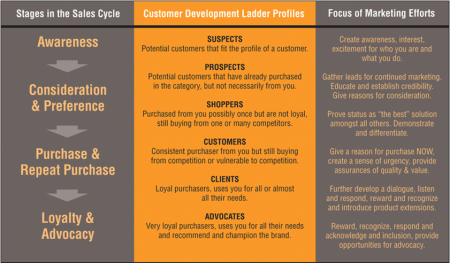 In an ideal world, every lead from every source would be waiting to hear from you so they can place an order. Please pinch yourself and wake up, this only happens in dreams! People respond for different reasons and it’s marketing’s job to sort out the wheat from the chaff in the lead generating process.
So many programs fail because the leads sent out to the sales force haven’t been qualified. The guys in the field are hunters and gatherers, and if someone isn’t ready to buy, then they are put in the dead file. Just because they aren’t ready to buy today doesn’t mean that they aren’t a prospect.
There are different stages in the selling cycle from awareness to loyalty and advocacy. Each stage requires a different message in order to move them up the development ladder. If you can identify what stage a lead is in, marketing can nurture leads along until they are ready to buy.
by tradespeopleinsights | Jan 12, 2010 | Marketing Tips, Social Marketing, Traditional Marketing
We’re all used to doing surveys after the fact to make sure the customers are satisfied and to see if you could be of additional service. Not many of us, though, think of surveys as a way to identify where the prospect is in the buying cycle and what the best way to communicate with them is.
I recently read a post by Stephan Dietrich of Neolane Inc. where he outlined ways to use surveys for this purpose. He suggests that e-mails and surveys can work well together.
One example he gives is that of a user downloading a white paper from your web site. If a few days later you can send him a survey, you can not only find out what their thoughts are on the paper, but also determine where they are in the buying process and maybe give them a limited time discount offer. While most results won’t end this quickly with a sale, it does give an opportunity to continue the conversation with the prospect and nurture them through the sales process.
Social media can be used to both identify and start conversations with potential buyers.
How are you using surveys to help generate leads and sales?
by tradespeopleinsights | Jan 8, 2010 | Marketing Tools, Traditional Marketing
Now that 2009 is over, we’re all looking forward to a new year. To that end, I’d like to know what kinds of plans you’re doing for 2010. Please take a few moments to take this quick 8-question survey. I’d be happy to share the results. http://tinyurl.com/yc4epnb
Thanks
by tradespeopleinsights | Jan 7, 2010 | Marketing Tips, Social Marketing, Traditional Marketing
As social media continues to grow, B-to-B marketers better be on board or the train will leave them at the station. In a recent Social Media Marketing Industry Report, it interviewed nearly 900 marketers. 88% were already using social media and 64% were using it 5 or more hours a week.
Their top 3 reasons for using social were exposure, increasing traffic and building new business relationships.
Does this sound like something you’d like to do? The professional tradesman is no different than any other consumer. Their time is limited and they choose the way they receive info both on a personal and professional level. The key for us marketers is to integrate social into our existing CRM programs. Steve Nielsen of Partner Up recently wrote a post on ways this could be accomplished. Here are some of the highlights:
- Online communities are more than networks; they’re end-to-end marketing engines that allow you to address customers’ concerns in real time.
- Online communities have the capacity to yield instant insight into brand awareness and reputation.
- Social media is a disruptive force turning traditional marketing and CRM on their heads. Those that can harness this disruption stand to gain the most ground.
According to Nielsen, companies seeking to re-energize their marketing should integrate online data into their existing CRM programs. Companies that follow this will become more relevant by transforming customer relationships and generating measurable business results.
So what are you doing to use social to reach those professional tradesmen? I’d like to hear from you.
by tradespeopleinsights | Jan 6, 2010 | Marketing Tools, Social Marketing
When it comes to online issues as they revolve around the B-to-B community, it’s mostly assumed that we are lagging behind. That may be true in some cases and we may not be using the latest widgets, but for the most part those that have embraced online activities do a pretty good job at it. Because some of the products our clients sell have a long selling cycle, means they have plenty of time to build and nurture a relationship. B-to-B marketers are utilizing the basics, Web sites, search, newsletters and now social to continue to build their brand and sell products.
Why B2B Companies Have a Distinct Advantage Online
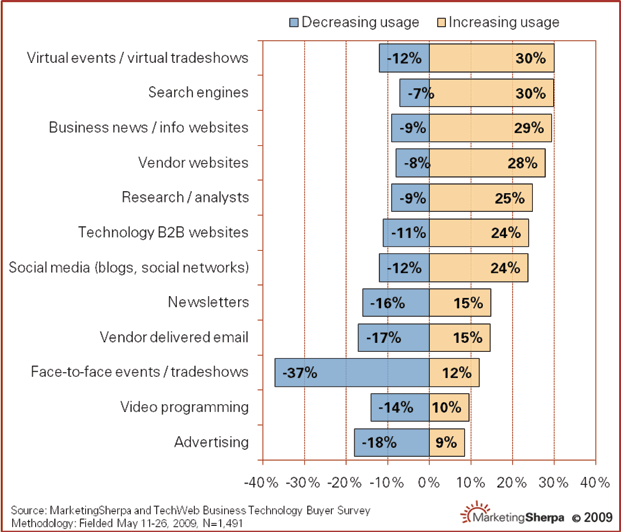
I’m not alone in this theory. Valeria Maltoni in a recent post, Why BtoB Companies Have A Distinct Advantage Online, outlines opportunities for the B-to-B world. That includes the case for customer communities and ways to go from conversations to conversions. It’s an interesting read and gives hope to all of us in the B-to-B world that we’re doing something right.
I’d like to hear what you think on this issue.
by tradespeopleinsights | Jan 5, 2010 | Marketing Trends, Social Marketing
Marketers in the B-to-B world and especially in the industrial or construction sectors are reluctant to try new things. One of the reasons is that in some cases their companies have been doing the same type of marketing for years, if not for decades.
Obviously over the last year or so they have been forced to think “outside the box.” Recent research from Forrester states that consumers (yes, professional tradesmen are consumers too) now nearly spend as much time online as they do watching TV.
Razorfish “Digital Brand Experience Survey” shows that even though consumers are more empowered than ever before, they still desire a relationship with a brand, and a brand has a major say in that relationship. It’s just that brands need to shift their thinking from one-way advertising to two-way consumer experiences if they want to take advantage of the attributes of the digital world.
I’m grateful to my good friend and mentor Michael Gass who passed on this Razorfish research and some key takeaways:
- Consumers are not shutting out brands – they’re interacting with them. 77% of consumers surveyed have watched a commercial or video advertisement on YouTube with some frequency; 69% have provided feedback to a brand, either through a web site or a third-party service like GetSatisfaction.com; 65% have played a branded browser-based game. Moreover, 70% have participated in a brand-sponsored contest or sweepstakes.
- Digital experiences create customers. The overwhelming majority of consumers who actively engage with a brand in digital fashion are much more inclined to purchase products and recommend the brand to others.
- Digital can make or break a brand. 65% of consumers say that a digital experience, either positive or negative, changed their opinion of a brand. Of those, 97% said that their experience influenced whether they eventually purchased from the brand.
- This is the year of the brand fan. According to this study, 40% of consumers have friended a Facebook brand page, and 26 % have followed a brand on Twitter.
Click here for a download PDF version.
by tradespeopleinsights | Dec 30, 2009 | Marketing Tips, Social Marketing
We all want to do our best when it comes to social media, and I find I’m always looking for suggestions and processes that can help me improve my end product. One of the ways I stay in touch and hopefully ahead of the curve is to follow industry leaders. Their insight and expertise is very valuable to me.
One such leader is Jason Falls who has a blog called Social Media Explorer. Jason recently posted The Four Spheres of Social Media Strategy, which focuses on the key areas we need to keep our focus on. While each of these four areas are important by themselves, the impact to a social program comes when they overlap. Here are some highlights of the circle:
- Brand Intelligence – This is pretty straightforward. You need to know and understand what your brand is and stands for.
- Consumer Insights – This revolves around the customer, profiling and audience research are two examples.
- Community Behavior – You need to know and understand how people interact. Is Twitter a better way to communicate to them or is Facebook?
- Tools & Platforms – You need to have an understanding of the tools and options out there to best promote your brand.
The key is to keep your eye on the ball and focus on elements such as Jason has outlined. Jason, thanks for your insights.
by tradespeopleinsights | Dec 29, 2009 | Social Marketing, Traditional Marketing
I thought I’d share the most popular posts of 2009 from my blog. Happy New Year and may 2010 bring us all better things.
- 3 Ways Tradespeople Can Use Social Media to Boost Credibility and Business.
- 5 Quick Tips to Promote Your Post.
- Social Media: Who Uses It and Why?
- 10 Engagements Tactics That Will Help B-to-B Marketers.
- How Do You Find Readers For Your Blog.
by tradespeopleinsights | Dec 23, 2009 | Marketing Tips, Marketing Trends, Social Marketing, Traditional Marketing

The answer is both. Contractors are busy folks and they get their info from various sources and sometimes it’s on the fly. I’ve done several interviews of contractors from HVAC/R, electrical, plumbing to general contractors that have said that they get info about how to run their business from both the traditional trade publications as well as various sources on the Internet.
They use the trade publications to catch up on what’s happening in the industry, who bought who, and to read articles to help them run their business. They use the Internet to do research on various things from troubleshooting to new product demos and online training. Some participate in online forums with their peer groups to talk about issues/problems they are having in their day-to-day operations. Most of the Internet activities are done either before or after the normal business day. One example is Contracting Business magazine who sponsors a forum – HVAC-Talk – that’s the leading forum for HVAC professionals to talk to each other. They average over 50,000 page views a month.
Contractors as a whole are lagging behind when it comes to social media. The reasons given range from, “I don’t have the time” to “I don’t understand it,” and with the economy the way it is, my first priority is to stay in business. The ones that get it and are using it have found that it’s another marketing tool to generate new business and stay connected with their customers. Most trade associations haven’t done a good job explaining to their members the possible usages and benefits for social.
Manufacturers shouldn’t be discouraged. Those that have embraced social are reaping the benefits. It’s just another way you can get customers to interact with you. Here’s a great example of a hand tool company, Snap-on Tools, that on Facebook has over 25,000 fans. Every time Snap-on updates their events section or uploads new video or photos, all their fans are automatically updated.

by tradespeopleinsights | Dec 22, 2009 | Marketing Tips, Social Marketing, Traditional Marketing
 Social media is obviously the hottest topic in most marketing circles today. You have people on both sides of the fence (some who will never use it and some who say it’s the savior of marketing as we know it). Unfortunately, both of these opinions are wrong. Too much or too little of anything isn’t good.
For those who don’t embrace or understand social media, I’d recommend you get your head out of the sand. Social isn’t going away and you’re better off understanding it and begin using it sooner than later.
For those that do embrace it and think the world will revolve around it, you should wake up and smell the coffee. When in the history of marketing and advertising have we had only one media source to get our message out?
Here’s a reality check. What are we trying to do here? Unless you work for the Government, I believe we’re ultimately trying to sell something. Let’s face it, no sales, no job! As marketers today, we’re faced with so many challenges to identify potentials and move them along the sales cycle. We need all the help we can get and we should know and understand the tools that are available and use them appropriately.
I try to use this blog to inform my audience of Manufacturers who are trying to reach the professional tradesman that they should start using social as one more tool in their marketing plans. I certainly haven’t told them to blow away the traditional ways of reaching their audience like print ads, PR and trade shows. We all can’t lose site of what our ultimate goal is…to sell something. Social can help identify potentials, but there are other tools that can nurture them through the sales process and we need to use them all!
What are your feelings on social and how it plays a role in your plans?
by tradespeopleinsights | Dec 17, 2009 | Marketing Trends, Social Marketing, Traditional Marketing
As we all look forward to 2010 in our planning processes, we’re all looking for ways to generate exposure and ultimately leads that turn into sales. Most marketing budgets will still be tight in 2010, and marketers are looking for ways to get the best bang for the buck.
According to eMarketer.com, 75% of small businesses (under 500 employees) plan to increase their e-mail marketing in 2010. 70% will put more dollars toward social media according to Vertical Response data.

B-to-B marketers are using these tools because they are inexpensive and generate quick measurable data. Campaigner and Hurwitz & Associates studied small businesses under 20 employees and found 28% of those that used e-mail marketing considered it inexpensive and an effective way to reach new customers.

Smart marketers will include both e-mail and social into their 2010 plan. That and some search engine marketing and you’ll have a winning combination.
I’d like to hear from you on whether e-mail and social are in your 2010 plan.
by tradespeopleinsights | Dec 16, 2009 | Marketing Tools, Social Marketing
Manufacturers should not lose site that videos are a powerful informational tool when it comes to building credibility with contractors. Consider if you will that next to Google Search, the next highest search is YouTube. That alone should tell you something.
From case studies, testimonials and training, to new product info, videos are a unique way of telling your story and add another dimension to the story by engaging the viewer. According to eMarketer.com, rich media ads with video had a higher dwell rate than those without, and almost double the dwell time.

This translates into fewer impressions needed for the same results.
by tradespeopleinsights | Dec 15, 2009 | Marketing Tips, Marketing Tools, Social Marketing
 I tell everyone if they could only use one social media tool to generate new business, I’d use LinkedIn. While my blog is important (long term), and Twitter is very useful once you get your followers, LinkedIn offers you a way to be more proactive. Before you start utilizing it, you first have to make sure that your page is updated and as near to the 100% mark as you can get it. Once that’s done, dig in and have some fun.
Here are 5 ways I utilize LinkedIn:
- Ongoing program to increase your contacts – After going through your contact list, continue to add contacts each week by setting a goal of say 4-5 new contacts. It’s easy to do. When you’re at social or business events and meet people, when you get back to the office, see if they’re on LinkedIn and get connected. Every time you go to your LinkedIn page, it prompts you in the upper right hand corner to invite people that might be primary contacts of someone you know or a group you belong to. This should be good for 2-3 new contacts each week.
- Search company profiles – for niches/markets you’re trying to target. Get in and get involved!
- Search for groups – this allows you to search associations, buying groups or other folks who share common interests. I normally, once a week, take a recent post and put it on all the groups that I belong to. This is a good way to not only build credibility, but also drive more people to your blog.
- Search individual profiles – there’s a whole bunch of info on individuals that you target. Take some time to review their profile and see what kind of connection and groups they belong to. If you do your homework, you’ll know a lot about a new potential friend, and when you ask him to join your network, you can talk about some common interests in your first contact. This is a great way to get a conversation going quickly.
- Search by market terms – determine what questions or answers can be searched that will bring up like-minded people. By reviewing your findings, “experts ” in the field will be easily identified.
Once you have a system in place, then you need to start listening and contributing. These are the ways I utilize LinkedIn. I ‘d like to hear how others out there are doing using social as a new business tool.
by tradespeopleinsights | Dec 10, 2009 | Marketing Trends, Social Marketing
According to a recent survey by emarketer.com, B-to-B clients are going to increase their spending in the social media arena in 2010. It certainly makes sense that the ones who have tried various aspects of social must be getting some traction or they wouldn’t be spending more. It’s interesting to note that the 3 top areas they plan on increasing are web sites, e-mails and search. The three main reasons are:
- Thought leadership
- Lead generation
- Customer feedback

What are you planning for 2010?
by tradespeopleinsights | Dec 9, 2009 | Marketing Trends, Social Marketing

I think it’s safe to say that social media is here to stay. For those of us who have accepted that fact, we are moving on from adoption to trying to understand how businesses can take advantage of social in a work context today. A recent 2009 Business Social Media Benchmarking study (download a copy) was compiled from approx. 2900 responses and is an excellent overview of how businesses are trying to utilize this media. The report covers both how businesses are using social media to find relevant information and how they judge its success.
Of particular interest to our target audiences using social media as a business information resource, Constuction was at the top of the charts and Industrial was lagging a bit. The most popular media resources for businesses were webinars or listening to podcasts(69%), followed by reading ratings reviews for businesses, products or services (62%). The least popular were saving links on social bookmarking sites (28%) and participating in discussions on third party web sites (29%).
by tradespeopleinsights | Dec 8, 2009 | Marketing Tips, Social Marketing
 I’ve always said that social media isn’t the silver bullet that will make all things right. It’s just a tool like any other tool in your marketing tool box. Whether it’s e-mail, snail mail or social media, they all work better when they are a part of a bigger picture and an integrated plan. When we talk with clients about social, they are so focused on the “how” instead of the ” why.” “How” isn’t relevant if you don’t have plan on “why” you’re going to integrate social. Marketers need to realize that by integrating social into existing programs, the net result will be better because social lets potentials identify you!
I read a post recently by Jay Baer, The big social media integration picture, that highlights ways to achieve cross-media synergy using social media that I think is worth reading. Jay is a leading authority in social and he’s on my must-read list every day.
I’d like to hear from you on ways that you’re integrating social into your current marketing plans.
by tradespeopleinsights | Dec 2, 2009 | Marketing Tools, Social Marketing
With more B-to-B marketers jumping on the social media bandwagon, some are so focused on the content that they sometimes ignore the metrics to see if what they are writing is being read, and more importantly, acted upon. Analytics are a crucial component to successfully generating traffic to your blog,Web site and inbound new business leads. But for many manufacturers, best practices for using analytics isn’t understood at all.
The tools are available and be sure to use them. A good resource is the Interactive Advertising Bureau (IAB). Their IAB SmartBrief is one of the daily e-mail newsletters that I receive. It always has helpful information, “what you need to know,” about analytic practices, trends and research pertinent to your company.
Here’s a sampling of some of the latest articles from IAB Smart Brief newsletter:
Click Here to sign up for the IAB SmartBrief.
by tradespeopleinsights | Dec 1, 2009 | Marketing Tools, Social Marketing, Traditional Marketing
 Whether you’re using traditional marketing tools or social media, one of your key objectives should be to become the thought leader in your market or category.
As a B-to-B marketer, Thought Leadership is one of the most valuable assets of your brand. When reaching out to the professional tradesman, you have several audiences that you need to build relationships with – Distribution, Buying Groups, Associations and ultimately, the Contractor or End User. Messaging to each of these markets while sharing common traits can and will be different. The sooner you begin building relationships in the buying cycle, the better off you’re going to be. Thought leadership and brand building should be an ongoing process.
I believe social media affords you a better means of reaching your objectives. You don’t become a thought leader overnight. It’s a process that takes time. You need to gain trust of your audience and become the “go to” resource. What better way to accomplish this than through the likes of LinkedIn, Facebook, Blogs and Twitter? Think of it as a form of “opt in” places that people go on a regular basis to read and learn. People follow blogs because the subject matter is relevant to them. People follow you on Twitter for the same reason. LinkedIn has groups you can join based on interest levels in particular issues, causes or markets. You get the picture. There are numerous ways to stay connected and build your Brand.
Jon Miller in a recent post on Marketo, outlines 4 ways to build your brand:
- Use your company’s blog to provide insights
- Be a solution to a specific problem
- Provide original research
- Join a speaking circuit
Those are my thoughts on the subject and I’d like to hear what you’re doing to build your thought leadership.
by tradespeopleinsights | Nov 25, 2009 | Marketing Tools, Social Marketing
 Webinars are a good way to mix up the way you deliver your message to tradesmen. They allow you to set yourself apart as an expert, gives you visibility, credibility and immediate feedback on your topic. They take a lot of work, but if done right will reap you benefits for a long time. You can also repurpose them as webcasts and put them on your web site so the contractors can view them at their leisure. Here are some tips on how to make sure your Webinar is successful:
- Pick a timely subject – You want to not only be topical but timely with what you pick as a topic. Remember, one of your objectives is to be a thought leader.
- Make sure you address “what’s in it for them.” How will your new tool or process help them do their job better.
- Promote it both pre- and post-event – Make the most out of it by using Facebook, LinkedIn, Twitter and any groups you belong to, to generate interest and sign ups. Promote it to your customer and potential lists, as well as through any trade organization or association. After the event, convert it to a Webcast and put it on your web site.
- Keep it to no more than an hour. My rule of thumb is keep your presentation to ideally 30 minutes, but no more than 40, and leave the rest of the time for questions. Also, when appropriate, add some humor. Tell a joke or show a cartoon to help illustrate your point.
- Don’t try to put 10 lbs. into a 5 lb. bag – If you have that much info, break it up into 2 Webinars. Remember, people can only retain so much info, so make your point and then deliver on it.
- Keep audience engaged by taking little surveys throughout the presentation. This not only gives them a reason to stay engaged, it gives you a moment to get ready for the next point.
- Practice, Practice, Practice – This might be the most important point of all. Remember, you’re trying to come off as the “expert” and you don’t want to stumble through the presentation. Prepare and give it to some co-workers or friends and listen to their critiques. You need to be upbeat and engaging in order to keep the audience from clicking off.
Webinars are not hard to do, but they do take time. Don’t be intimidated. You can do a simple Power Point presentation. Remember, content is the important factor here, not some slick graphics or flash presentation.

by tradespeopleinsights | Nov 24, 2009 | Marketing Tips, Social Marketing, Traditional Marketing
20 Reasons Why Social Media Won’t Replace Email

Email marketing is still an important tool to your new business program.
The rise in popularity of social media only enhances email. The two can work powerfully together. Two excellent articles, Chris Crums, writer for WebPro News, “10 Reasons Social Media isn’t Replacing Email” and VerticalResponse CEO, Janine Popick, “10 More Reasons Why Social Media Wont Replace Email.” Chris always has great marketing insights. Janine also provides some insightful resources and practices what she preaches for both email marketing and social media. I recommend them both.
Here are their 20 reasons why social media won’t replace email:
- People still send hand-written letters.
- Nearly all sites on the web that require registration require an email address.
- Email notifies you of updates from all social networks.
- We haven’t seen any evidence yet that Google Wave really will catch on on a large scale.
- Email is universal, and social networks are not.
- There are plenty who have no interest in joining social networks.
- Email is still improving.
- Even social networks themselves recognize the importance of email.
- More social media use means more email use.
- As far as marketing is concerned, email is doing pretty well.
- Twitter and Facebook are fantastic products and companies; but that’s what they are, companies.
- Your email recipients are still going to use business email for business purposes.
- You can’t easily segment your friends and followers to do targeted marketing (through social media).
- You can’t tell who clicked on a link with some social media outlets.
- That said, you can’t tell who didn’t click on the link so you can follow up with them with a different message.
- You cannot personalize your Facebook updates.
- You cannot size your graphics or use more than one in Facebook.
- You can’t track how many clicks you got on your links in Facebook.
- You are limited to 140 characters in Twitter.
- You almost have to have separate social media accounts for your business and your personal life.
by tradespeopleinsights | Nov 18, 2009 | Marketing Tips, Social Marketing, Traditional Marketing
 When we communicate with our target audiences, whether it’s through traditional methods or the use of social media, we want to inform and hopefully engage them. It’s through the engagement process that we start a dialog with them which hopefully will turn into something more (hopefully a sale). I’ve enclosed some tips on how we successfully engage tradesmen:
- Make sure you identify WIIFM (What’s In It For Me) for the contractor.
- Make sure the message is easy to skim (bullet points, bold or italicized type, photo captions).
- Make sure your message is clear and expressed (understood) quickly.
- Offer a demo – either online or in person.
- Contractor testimonials – Peer reviews are more believable and hold more influence on other contractors.
- Offer several ways for them to easily contact you and get more info.
- Offer incentives or other reasons for them to respond immediately.
- Make it easy for them to respond – email, website form or special phone number.
- Back up any claim with the proper proof (or reference where they can get it).
- Make sure offers appeal to the different stages in their buying cycle.
These are my top 10 ways. I’m sure you have some proven ways and I’d love to hear about them.
by tradespeopleinsights | Nov 17, 2009 | Marketing Tools, Social Marketing, Twitter
 Some B-to-B marketers are having a hard time including Twitter in the marketing mix. You need to think of it as a relationship-building tool. Twitter should never be used as a stand-alone tactic. It should be used in conjunction with other social media as well as traditional tools like e-mail. Jon VanZile wrote an interesting post, Is B-to-B Ready For Twitter? that you might find interesting.
One of the concerns of B-to-B marketers is that “none of my customers or potentials are on Twitter.” While that may be true now, they will be soon. And how do you know unless you ask them? This week Twitter passed the 5 billion tweet mark. Somebody is using it! According to a study released this summer by Nielsen Co., Twitter growth has been phenomenal especially toward adults. According to Nielsen, Twitter reaches 11% of all Internet users. 80% of people who Tweet are over 25.
While you’re waiting for your customers to get in the game, Twitter still offers you some great free analytic tools you should be using to keep track of competitors as well as find conversations related to a post or article. Here are 5 good ones to start:
- Twitterstats Hour-by-hour and for any 24-hour period, track up to three keywords (think competitors) w/g/t click volume. Useful if, for example, there’s news being dropped during the same time period and/or an event/tradeshow and you want to compare message volume/activity around keywords or companies.
- Tweeps.info Nifty free tool that lets you track on individual Twitter accounts (think YOUR competitors). Inside look at #tweets per day, current and prominent keywords, to what degree the account is using hashtags, following snapshot. Also has a keyword search which is useful if you’re looking to build your follow list around a particular topic.
- BackTweets A real-time, conversational-tracking tool which allows for keyword and/or URL searches to find conversations related to a post or article; connects: WordPress, Blogger, TypePad, Twitter and Friendfeed. Useful for community buzz centralized listening, brand monitoring. An “alert” function.
- Twitteranalyzer Google Analytics for Twitter users. More than 50 statistical measures displayed with graphics and maps. Among the views: Reach, Subject Matter, Follower Growth, Follower Density Map, Follower Activity, Sharing Capability. Primarily a tool for Twitter users to analyze themselves or their friends.
- TwitterFriends A “reach/extended-reach” tracking tool that helps you discover information about the network behind your follower/their follower lists. Identifies meaningful users you should be talking to, or who are feeding you useful links. Capability to account search/compare (think comparing your company to your competitors, or thought leader accounts, etc.)
by tradespeopleinsights | Nov 11, 2009 | Marketing Tools, Traditional Marketing
Training Tradesmen – do you use a carrot or a stick?
This is the second part of a two-part series (Part 1) by Lisa Bordeaux from BlueVolt, an online marketing and learning platform that focuses on the professional tradesman.
Whether you are using the carrot or the stick to drive training participation, providing contractors resources for their folks to take advantage of can be a very real benefit to the tradesman in the field.
From a contractor’s perspective, having a manufacturer that’s committed to training is an obvious win. These guys are in the field and it’s a real challenge to corral folks into the office for formalized training. At the same time, the guys in the field need training to stay safe on the job, learn about new products, maintain their licensure or certification.
One of the reasons we started in the business was because we recognized there was a need for people in the field to have better access to information. When you sit at a desk, it’s different then when you work in the field. So early on – we thought it would be best to provide bite size information to folks that they could take on the fly.
Training with the Carrot –
The idea of incentivized training is not new. Tying a carrot to something that you want to deliver to the market is a very effective way to build an audience of learners who are open to the information. In fact, when we launch courses that have incentives, we see a 10X greater usage pattern then courses that don’t have incentives. If the information is not all product based and serves some more general purpose, manufacturers may actually charge for their courses and then offset the charge with a reward of equal or greater value.
Training with the Stick –
Individuals in the trade in many cases are training as a requirement of their job. This may be something like forklift safety which is regularly required or code related if the state requires code updates for license renewal. In this case, we see different usage trends – the majority of the training gets taken just at the point of need. So for instance, when we started our code change course in 2002, in Oregon there were 26,000 licensed electrical workers that were required to take 8 CEUs of code update. The deadline was October 1, and as of July 15, 17,000 of the license holders had yet to complete their code training. http://go.bluevolt.com/CoBrandTemplate/CourseCatalog.aspx?CategoryID=884
This becomes a real problem and the companies offering the code training in-person are flooded with calls they can’t satisfy. Online training really makes sense. The timeline creates a sense of urgency which can be a great driver of participation.
by tradespeopleinsights | Nov 10, 2009 | Marketing Tools, Traditional Marketing
Training – both product training and safety training – are important to professional tradesmen. That’s why several years ago we formed a strategic alliance with BlueVolt to help educate and inform our client’s customers (the professional tradesman). BlueVolt creates online marketing and learning platforms that are focused on the professional tradesmen. They have delivered over 535,000 courses to 50,000-plus registered users. We have the privilege of having Lisa Bordeaux, director of sales and partner development, here to share with you a two-part series on the benefits of online training. Enjoy her insights!
The most successful companies are the ones that not only offer training to individuals but they support them with online tools and resources, a community. In many cases, suppliers may or may not tie this to their website, they may work with associations or we may collaborate to syndicate their content. If done right, training can make it easier to engage with customers and develop a relationship that supports and fosters sales for years to come.
Training can be a great way to go to market. It’s a softer sell than advertising and it provides value to the customer while building brand affinity. BlueVolt works with a number of manufacturers, some have a strong history of training. In fact, one of them is so committed to training, they have one person in the marketing department, 7 people in the training department. Training is done both online and in-person and their training staff is teamed with sales people by territories. This fosters a tight relationship between sales opportunities and education.
Over the years I have come to think that in many cases, training is a Trojan horse for Marketing. I have seen this done to great effect in a number of cases. Here are three examples of efforts we have supported:
- Using education to generate sales. We have a number of examples in this case. Many manufacturers have fairly complex products either to operate or install. Providing training on a specific product can ensure that people prefer it over other products. We find offering training can provide a market of excited advocates and experts, doing it online provides an easy way to communicate and follow up with folks. The individual may pay for this training and the supplier most typically gives either a product or incentive to the individual to offset the cost of the training. http://www.bluevolt.com/case-studies/wright-tools
- Just in time training on new products. This is a big one for taking training online and we do it daily. When done right we significantly shorten the return on development for a new product. By delivering information to people online about new products either live, archived or even a simple PDF cut sheet that individuals many manufacturers leverage provide training just in time. This training is most often incentivized. That is, the individual receives some sort of reward for proving their knowledge. http://www.bluevolt.com/case-studies/uei
Building a market through education – this is an expensive proposition, but can be very effective. We undertook this with a large switch manufacturer who built a course to train home integrators so they could network devices in residential. They didn’t make any products in the space, but believed they would sell more switches and routers, if there were more integrated homes needing bandwidth. Through a series of partnerships, we built a community of training centers and hosted and tracked all the training online. This is typically a scenario where the individual would pay to participate in the training. As a manufacturer, you really need a long view and high level of commitment to improve the industry.
Next, you’ll learn which has more impact, a carrot or a stick?
by tradespeopleinsights | Nov 4, 2009 | Marketing Tips, Social Marketing
 We all have limits on our time and those of us who have dived into social media have to find time in our schedules if we want these marketing tools to work. The key, like anything, is organization and setting priorities so you optimize your time spent. I recently read a post by Adam Singer (worth reading), 21 Must-Follow Tips for Optimizing Time Spent on Social Media and it got me thinking of several ways to make the most out of your time.
- Periodically review your RSS feeds – It’s so easy with all the tools out there to subscribe to something you think might have value long term, but come to find out the info you get there you can find somewhere else, and some of the original article/topics that got you to subscribe in the first place come infrequently. Don’t burden yourself down. I, at least quarterly, purge some of these that are not as relevant as I once thought.
- Focus on your niche – There is so much info on the Internet that it could easily overwhelm you. Focus on your respective core markets/interests and spend more time on those trusted sites.
- Monitor your time – This is a big one. Let’s face it, we all have limited time and everyone is asking us to do more and more. The Internet can be a fooler and suck you in and all of a sudden you’ve let hours pass instead of minutes. My rule of thumb is that I won’t spend any more than 1 hour a day checking my accounts and doing research/reading. This does not include the time I spend researching and writing my blog.
- Learn to skim – There’s not enough time in the day to read everything. You need learn how to skim articles quickly to see if they are really what you’re looking for. I find the better bloggers I read keep paragraphs short and get to the point quickly. You should be able, in 30 seconds, skim an article and determine whether or not it’s of interest to you.
- Monitor your audiences – If you’re a blogger, there are metrics which allow you to monitor views. Look at these periodically and focus your efforts on those topics where you’re getting the most action.
These are some of my priorities. What are you doing to manage your time?
by tradespeopleinsights | Nov 3, 2009 | Social Marketing, Traditional Marketing
Gee…who would you believe, the national news anchor or someone on one of your social networking sites?
According to the Harvard Business Review, “the American public assessment of the accuracy of the news media has reached a new low. 63% of American adults say news stories are often inaccurate, compared to 53% in 2007 and 34% in 1985. 70% say that the news media tries to cover up mistakes, and 27% describe the press as “not professional.” Right there is a pretty good reason no one is watching the nightly news. But come on, we do have options don’t we, or do we have to rely on someone pushing their agenda on us? How many times have you listened to the news and only got one side of the story?
According to The Sacred Heart University Polling Institute who released its 3rd survey on, Trust and satisfaction with the news media. Nearly two-fifths of all respondents, 38.1%, said they are reading newspapers less often than they did five years ago. And, nearly half, 45.0%, agreed that the internet is adequately covering for failing newspapers,
Now take social media. Do you think a national anchor would get away with some of the things they say on TV if they had to interact with the social media scene? Afraid not! They would have their head handed to them. Why, because social allows other people to have an opinion and they aren’t afraid to call you out if you’re wrong. Americans aren’t as dumb as the Networks think we are. People are relying more on social. Look at Twitter. You knew about the plane landing in the Hudson, along with photos, long before the mainstream media knew about it. If you really want to know what John Q Public is thinking, you need to get to the streets. Social literally has put “the man on the street” interview back in vogue. Only this time the man isn’t a staged prop.
75%-plus of us use the Internet when we’re looking to buy something and want to do research on it first. Yes, we might look at some manufacturers’ sites for features and benefits. What most people like is a site that has a place where people can leave comments and rate the product from a customer’s view. People trust other people’s experiences and views.
What are your thoughts?
by tradespeopleinsights | Oct 28, 2009 | Marketing Tips, Social Marketing
If you don’t measure it, you can’t improve it.
One of the main reasons folks should use social is, for the most part, easily trackable and you can see quickly your success/failure rates. I’m amazed when asking people who are using social tools how are they doing, they come back to me with some generalized statements like, “I’m doing really well.” If I press them for more details, I come to find out that they really don’t have a plan for measuring what they do and the time they spend at it. Metrics are an important component for the use of social media. Especially measuring for ROI in regards to the amount of time that must be invested. You would think this would be a no brainer. But according to a recent a survey by Mzinga and Babson Executive Education, a whopping 84% of professionals do not measure ROI for social media. It appears that hardly anyone is taking the time to measure the ROI for social.

Some additional insightful statistics from this survey:
- 86% of respondents to the survey of professionals from a variety of industries said they had adopted social technologies.
- 57% said they were using social media tools for marketing.
- More than four in 10 respondents did not even know whether the social tools they were using had ROI measurement capabilities.
- 3 in 10 reported using social media for customer service and support.
Click Here to download a copy of this report.
Here’s another post you might find interesting: How Do You Measure Social Media?
A great resource of social media articles and fresh reports comes from eMarketer. I found the original source of this survey through their eMarketer Daily Newsletter. I highly recommend it.
by tradespeopleinsights | Oct 27, 2009 | Marketing Tips, Social Marketing, Traditional Marketing
 This probably doesn’t come as a surprise to most, but most Industrial Marketing budgets have been cut this year. It’s also no surprise that Mar/Com departments are still charged with bringing in leads. But what I want to warn everyone about is, don’t be focused on just the number of leads (yeah, I’m assuming that they are ROI, qualified in some manner). You need to separate the suspects from the prospects from the shoppers. Shoppers are getting ready to buy, and these are the ones that need to be identified and passed on to the sales department. There is nothing wrong with the suspects or prospects, they just need to be nurtured along and up the customer development ladder. Matt Sonnhalter had an article in BtoB Magazine, pointing out that you need to make sure to look for the right decision maker.
Tough times make us focus more on ROI, but we should be doing that all along. I’ve listed several other articles that I thought might be of interest on this topic and I’d like to hear how you’re doing on your ROI.
Increase your sales revenue by 20% using existing inquiries
5 highlights from GlobalSpec marketing trends survey
Use social media to generate professional tradesmen leads
Industrial marketers focus on social media
Industrial community responds to online marketing
by tradespeopleinsights | Oct 21, 2009 | Marketing Trends, Social Marketing, Twitter
Social media as a whole continues to surpass growth estimates. eMarketer reported earlier this month that Twitter has over 18 million adults who access on at least a monthly basis. That’s a 200% increase over last year.

Universal McCann’s “Power to the people-social media tracker” also sees social networking continuing to increase. eMarketer estimates that 44.2% of all Internet users in the U.S. are social network users. Worldwide, 62.5% of active users ages 16-54 have a social networking profile in 2009. Worldwide, 62.5% of active Internet users ages 16-54 have a social network profile.
Users are looking to social networking sites that can consolidate multiple social media into one place. As noted above, despite consolidation, social media is not a one-stop shop. Universal McCann advises marketers to give consumers options when engaging them through social media. Allowing individuals to share and discuss on their platform of choice remains important.
by tradespeopleinsights | Oct 20, 2009 | Marketing Tools, Social Marketing
Another new tool that needs to be on your radar.
I don’t know if the world is ready for this, but it’s here and it’s from Google, so you know that there’s been a lot of thought behind it.
Google Sidewiki allows you to contribute helpful information next to any Web page or even critical information to a competitor’s Web site. Google Sidewiki appears as a browser sidebar, where you can read and write entries along the side of the page. Google uses an algorithm to display the most relevant and helpful posts up top.
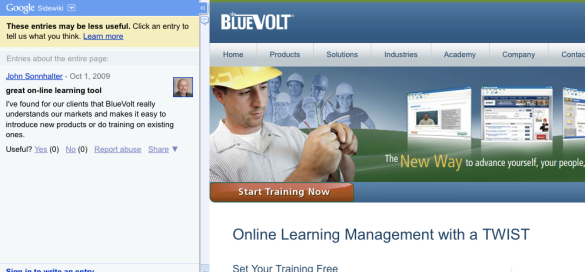
Click for detailed view
The key benefits:
- You can publish helpful information about any Web page from any browser
- Read insights in context from Sidewiki entries added by others
- Share Sidewiki entries through Blogger, Facebook, Twitter and Google profiles
Google could eventually put ads in the Sidewiki space – monetizing another company’s content.
As Jeremiah Owyang points out in a recent post, Google’s Sidewiki Shifts Power To Consumers – Away From Corporate Websites…
“There’s nothing stopping them from allowing advertisers to put ads on Sidewiki as “sponsored” information. For example, Coke could run their latest ads on the Pepsi.com Sidewiki area. HP could run ads on the Dell.com site. This ‘already’ happens in the search engine result pages on Google.com, why not in Sidewiki?”
I agree with Jason Falls‘ assessment of Sidewiki, “It will force every company in the world with a Web site to get hip to social media and do it now.”
If you’re ready to start exploring the Web with Google Sidewiki, visit google.com/sidewiki to download Google Toolbar with Sidewiki and contribute your own entries alongside pages on the Web.
So what are your thoughts on this new tool?
You might find this post by my mentor, Michael Gass, useful, How to keep up with social media.
by tradespeopleinsights | Oct 14, 2009 | Marketing Trends, Social Marketing, Twitter
The idea of marketers adopting social media by the boatloads is not a surprising statement. One of their biggest concerns has been will the consumer return the favor. Well some recent data shows that half of social networking users have became a fan or follower of a brand online. eMarketer recently published a report from Anderson Analytics that said, “52% of social network users had become a fan or follower of a company or brand, while 465 had said something good about the brand or company on a social networking site, double the percentage who had said something negative (23%).”

Another study from Penn State indicated that 20% of all tweets mention specific brand names or products. They studied over 500,ooo tweets and found both positive and negative comments about the brands or products.
Measuring social media success remains difficult for marketers. Many of the metrics that marketers can track on social networks today involve what is called “soft ROI”— which does not show up in the bottom line. But a study from the Altimeter Group and Wetpaint, along with a separate study from Razorfish, indicates that the stronger a brand’s social media presence, the better the brand performed—whether measured in conversations or in financial performance.
“Social networks are a constantly changing database of consumer sentiment, attitudes and information, and marketers today have only the earliest glimpse of the potential,” said Ms. Williamson, senior analyst at eMarketer. “Companies that want to maximize their presence on the social Web must take advantage of social networks in all stages of the purchase funnel, from awareness to learning to buying to loyalty.”
What does this mean to you and me? It means that you can’t just simply set up shop on social and sit back and wait for people to come. Users are seeking out their favorite brands whether it’s online or through other avenues and you must be there.
Maximize your social network marketing. Download the new eMarketer report, “Marketing on Social Networks: Branding, Buying and Beyond,” now.
by tradespeopleinsights | Oct 13, 2009 | Marketing Trends, Social Marketing, Traditional Marketing
 I’m hooked on the cable series Mad Men. I guess since I’m in the business and I started my ad career as the 3-martini lunches were winding down, I look at these guys and marvel at how simple their lives were. What did they have to offer the clients? TV, Radio, Outdoor, Papers and Magazines were pretty much what they had in their bag of tricks. Today, we have the Internet, Web 2.0, mobile media, digital ads and a host of other options that keep changing daily.
One of the newer ones out there is social media, and while the consumers have latched onto this in a big way, the B-to-B community has been slow in recognizing the power and potential of this marketing tool. Times are changing and the traditional marketers should come to grips sooner than later on the changing world we live in. The enclosed study by IBM should open your eyes as to what is coming and the key word is CHANGE. You think social media is a challenge, just wait. You’ll need to re-think the way you communicate with your customers, no matter who they are.
The next 5 years will hold more change for the advertising industry than the previous 50 did.
The information for this post is from an IBM global survey of more than 2,400 consumers and 80 advertising experts… the report is titled, “The end of advertising as we know it.”
Imagine an advertising world where...spending on interactive, one-to-one advertising formats surpasses traditional, one-to-many advertising vehicles, and a significant share of ad space is sold through auctions and exchanges. Advertisers know who viewed and acted on an ad, and pay based on real impact rather than estimated “impressions.” Consumers self-select which ads they watch and share preferred ads with peers. User-generated advertising is as prevalent (and appealing) as agency-created spots.
Based on IBM global surveys, there are four change drivers shifting control within the ad industry:
- Attention – Consumers are increasingly in control of how they view, interact with and filter advertising in a multichannel world.
- Creativity – Thanks to technology, the rising popularity of user-generated and peer-delivered content, and new ad revenue-sharing models (e.g., YouTube, Crackle, Current TV), amateurs and semi- professionals are now creating lower-cost advertising content.
- Measurement – Advertisers are demanding more individual-specific and involvement- based measurements, putting pressure on the traditional mass-market model.
- Advertising inventories – Will be bought and sold through efficient exchanges, bypassing traditional intermediaries.
There is no question that the future of advertising will look radically different from its past. The push for control of attention, creativity, measurements and inventory will reshape the advertising value chain and shift the balance of power.
by tradespeopleinsights | Oct 7, 2009 | Marketing Tips, Social Marketing
 I recently put on a Webinar on how social media could be used by B-to-B, and one of the most common questions is what tools should I use? Should I concentrate on Facebook, LinkedIn or is Twitter the best for me? When I ask them why are they doing social media, I get a silent pause. One of the first things we talk about is the “Why” you want to participate in the social media scene. If you can’t answer the Why, then the How doesn’t matter. Don’t get into social because you think it’s cool or that this will be the “silver bullet” that will save your business. You need to treat social like any other marketing program. Define expectations and outcomes. Adopt a phased approach to meet these business objectives. Here are some questions to answer to better understand your goals:
- Why are you participating?
- How can social media improve your customer relations?
- Can social media help you build/reinforce your brand?
- Do your current customers use social and which sites do they frequent?
- How do you define success?
- What kind of metrics are you going to set in place to monitor your success?
- How can social media help you gain more knowledge?
- What kind of social media policy do you have in place?
Like any other program, success is based on developing a plan and then implementing it. If you want to be cool and hip, do your homework and you’ll find out that people respond when you have a plan.
What are your thoughts?
by tradespeopleinsights | Oct 6, 2009 | Marketing Tips, Marketing Tools, Social Marketing, Traditional Marketing
Sales leads and what to do with them has been an age old problem. Today though, there are programs and processes available to help you monitor and mine those precious sales leads. I’ve been associated with Russ Hill from Ultimate Leads for over 20 years. He “gets” the closing the loop issue and I’m glad to share with you some of his thoughts.
According to the CMO Council/BPM Forum survey in Marketing Today, corporate officers who were polled in an online survey believe revenues at their companies could increase by more than 20 percent by improving their prospect cultivation and management techniques. Marketing and C-Level executives are dissatisfied with the way they generate new business, yet more than half lack formal process to correct the problem.
And my guess is that they are not alone. According to the Advertising Research Foundation, 67 percent of industrial product inquiries are from real prospects with real needs, yet 72 percent NEVER hear from a sales person.
Clearly these executives are onto something. Does this sound like your sales team?
Haley Marketing Group cites recent studies indicating that more than 50 percent of sales people stop working a prospect after the first call. The percentage grows to 65 percent after the second call and 80 percent after the third call.
A whopping 90 percent of sales people call it quits by the fourth call. Here is the troubling part – some 70 percent of prospects won’t make a decision until after the fifth call. Are these sales slipping through your fingers too?
To some degree these numbers are easy to understand. Most sales people are like gunfighters interested in the “quick kill.” The study suggests that while companies may be good at generating large volumes of business leads, most opportunities languish because sales people all too often focus on only closing the most promising and qualified short-term opportunities.
Marketing and C-level executives are dissatisfied with the way they generate new business, but still more than half lack a formal process to correct the matter.
Sales and Marketing teams often point fingers at each other as companies struggle with reaching their sales goals. Sale people complain about receiving too many or too few unqualified leads and marketing complains about poor follow-up, lack of feedback, and wasted dollars. In our 25-years-plus years of experience in sales lead management and CRM services, this lack of synergy can usually be traced back to three specific things:
1) A lack of training about each function’s role and challenges
2) Utilizing agreed upon methodology for generating, qualifying and following up on leads
3) Getting everyone to keep their “eye on the prize.”
If Marketing’s job is to identify target markets, communicate the “right” company message and generate viable sales opportunities, then it is Sales’ job to cultivate and sell those opportunities. Who qualifies a lead and when should it be handed off to sales is an important question. Sales and marketing need be in agreement to be successful. Failing to address this important issue can trap management in something I call “the Transition Zone.”

When marketing and sales management work together to establish mutually agreed upon processes and goals, then train their teams to continuously work to both improve practices and to work together, good things can happen – more business can be captured from existing opportunities, ROI improves…and that is good for everyone.
So, the next time you are considering where to look for new business, take a fresh look at your existing prospects and sales leads. Improving your opportunity management practices may be your first and best means of growing your business.
by tradespeopleinsights | Sep 30, 2009 | Marketing Tips, Social Marketing, Traditional Marketing
 With the economy being what it is and growth for ’10 in the construction, industrial and MRO markets being minimal at best, what could/should manufacturers do to work together? Here’s an idea. If you’re two non-competing companies that serve that same market, why not do a cross promotion for both Product A and B? For those manufacturers who belong to a buying group, this should be a “No Brainer.” They are already preferred suppliers and they should welcome this kind of promotion. Here are 3 reasons why you should consider such a concept:
- Creates buzz at both the user and distributor level. From the user perspective, they could offer better deals on specific packages if bought in conjunction with the promotion. Distributors can have more of an “event” atmosphere .
- More reach – Both companies can promote the event on their respective web sites and print ad campaigns.
- Better utilization of assets – Direct mail and e-mail can use combined creative and share the costs. Imagine if you have an e-mail list of 50,000 user names and the other manufacturer had the same. Let’s also assume there’s a 20% overlap in names. The bottom line is you now have 80,000 names to send to. Having these joint events at both user and distributor levels allows you to share the costs as well as the limelight.
I’m sure you could add to this list, and I’d like to hear from you. Let’s think outside the box.
by tradespeopleinsights | Sep 29, 2009 | Marketing Tips, Social Marketing
The great thing about social media success isn’t measured by how big your bank account is. According to Soumitra Dutta and Matthew Fraser in an article that appeared in the August Chief Executive, “The elimination of entry barriers puts small companies with little-known brands on the same level playing fields as the global brands.” They also point out that “CEOs have long functioned in closed, bunkered environments and aren’t used to the rules of social media, they are used to leading from a top-down authority, manage vertical hierarchies, and assert power through the implied threat of sticks.” All these traits go directly against the grain of what social media is all about.
This, in my view, is an advantage to the small guy. I’ve been associated with plenty of Entrepreneurs in my 35-plus years in this business, and what’s so refreshing about most of them is that they already exhibit the traits of social media long before it was invented. Think about it.
- They want to be in front of the customer.
- They listen to what the customer wants and says.
- What you see is what you get – which bodes well for developing that personal relationship.
- They can react to the marketplace quickly.
CEOs of big, publicly held companies are so entrenched in wanting to control everything and continue to have a one-way conversation. There are personal agendas of those under a CEO that can get in the way as well. As you go up the ladder, people don’t want to take a risk or lose control. There are a few strong-willed CEOs that get it, but they are the minority for sure.
So if you’re the little one, you have the advantage in my book. Don’t give up. Your contacts are talking to you, not someone else.
I’d like to hear some success stories from some of you independent business owners who are the backbone of our country.
by tradespeopleinsights | Sep 23, 2009 | Marketing Tips, Social Marketing
Today we are continuing an article by Nicky Jameson on how Tradespeople can use social media to generate new business.
Yesterday, Nicky talked about establishing trust with consumers. Today she will cover building a positive word of mouth and how to establish yourself as an authority.
2. Use social media to build positive word of mouth
Whether you are involved in social media or not, people are already talking about you. They are discussing your services and your brand for good or worse. For tradespeople, it’s even more crucial when people are discussing your industry.
How many times have we heard what to us seems like the “experience from hell” listening to a friend’s home renovation story? As consumers who will probably need to use a tradesperson in the future, we cross our fingers and silently thank our stars we’re not the victim… then we wonder how we go about finding a great tradesperson ourselves. The problem is that the “rogue traders” ruin it for the thousands of honest, reputable tradespeople.
If you as a tradesperson have a blog, are on Twitter or have a Facebook page, contribute to a tradesperson’s forum or use another social network, that’s a big help for us and a big advantage for you. First, we search online to see what people are saying. If we like what we find, we’re likely to call you… and when you do a great job, we spread the word…. On Facebook, on Twitter, in our other social networks. In fact, we don’t wait until someone asks us, we’ll generally tell our friends via Twitter, Facebook, forums etc… because our friends trust our recommendations. They in turn share our positive experience, and word of mouth spreads.
What’s more, those recommendations stay online indefinitely. Of course, it can work both ways. The adage that one unhappy customer tells 9 other people has huge implications when you bring in the social media mix. Overall, though, social media is an opportunity for you to take advantage of exponential word of mouth.
3. Use social media to establish yourself as an authority
While not every builder is going to be a Mike Holmes, as a tradesperson you probably have helpful tips and information your clientele (present and potential) need.
You have the answers to questions like:
- How do I hire a tradesperson?
- What questions should I ask the tradesperson?
- How many estimates do I need?
- How do I know the tradesperson can do the job I want?
- Should I ask for credentials?
With Social Media, it’s easier than ever to create and distribute valuable content for your clients.
Here’s an example:
Pete loves the idea of social media. He has a home construction business and over the years has noticed that people ask the same questions over and over again. He found out he could do video so easily he did a short video on just one of the topics people were asking about and posted it on YouTube and posted a link to his website.
He was overawed at the result. Over 500 people accessed the video in 2 days and clicked back to his website. The response was so good that he decided to do a series of short videos, answering the top questions people asked, and even asking people to submit their most pressing questions.
He had phenomenal results. Pete now does a regular video tip every other week, uploads it to YouTube and his website, and has got some good business from it, because people click his link and go to his site. Best of all, he’s established trust and is seen as an expert standing by his audience.
You can video to share tips and valuable information with your clients. People can watch and share your video with their friends who can then share them with their friends. Thanks to the power of social media tools and social networks, your video and content can go viral in less time than you might think.
Social media gives you almost unlimited opportunity to expand your relationships with fellow tradespeople and your customers. People do business with those they like and trust and using social media extends your ability to establish relationship and trust.
Nicky Jameson is an online Copywriter who specializes in improving B2B websites. She’s also a blogger on using social media for business. Nicky blogs at http://nickyjameson.com and her website is http://copywritingstudio.com
by tradespeopleinsights | Sep 22, 2009 | Marketing Tips, Social Marketing
I’m always trying to give manufacturers ideas on how to reach the professional tradesman by using social media. I’ve asked a friend of mine and fellow B-to-B blogger Nicky Jameson to offer her comments and insights on how the tradespeople can utilize social to build their business. I think you will enjoy her comments in this 2-part series. Enjoy.
Many tradespeople feel they don’t really need to have anything to do with social media. Perhaps because their business comes mostly through referrals, or they don’t see immediate value in social media, or they feel it may take up too much time and they need to be out getting new business. And many tradespeople feel intimidated by social media.
Getting business is important and should never take a back seat to your marketing activities. Social media tools are exactly that – tools. However social media is an opportunity you don’t want to miss because it can actually help you target local business more effectively. More importantly, it can help establish you as a trusted person to do business with. Trust, engagement and relationships are the building blocks of business – and social media.
If you’re a tradesperson, you rely on word of mouth to spread the word about your business and services. Did you know social media can help you take this to a new level?
Here are 3 ways Tradespeople can use social media to benefit their customers and business:
1. Use social media to establish trust with consumers
Did you know that one of the top concerns consumers have with regard to allowing tradespeople into their homes is trust? Put yourselves in your customer’s shoes for a moment. As a customer, you’re alone in an emergency. You need a plumber or an electrician… or another tradesperson to fix something you can’t do yourself. You’ve never met the tradesperson, yet there you are about to let a complete stranger into your home for an unspecified time. Most people are uncomfortable about allowing strangers into their homes at any time and they usually have no way of knowing who’s trustworthy and who isn’t.
 According to Hattie Hasan of UK plumbing company Stopcocks, trust has never been more important and consumers are becoming increasingly cautious when hiring tradespeople. They also want to ensure they spend their money wisely… on jobs well done.
When you join a social network that operates on a trust basis with other tradespeople, it helps you establish trust with consumers. When they search for you online and see you are in a trust-based social network, it helps build confidence in potential customers.
Part two will cover :
Using social media to build a positive word of mouth
Using Social media to establish yourself as an authority
See Part 2 here.
Nicky Jameson is an online copywriter who specializes in improving B2B websites. She’s also a blogger on using social media for business. Nicky blogs at http://nickyjameson.com and her website is http://copywritingstudio.com

 I recently interviewed Jim Lucy, the Chief Editor of Electrical Wholesaling Magazine on the state of the industry. Jim has been with Electrical Wholesaling for 28 years and has a good pulse on what’s happening in the industry. You can listen to the entire interview here.


