by tradespeopleinsights | Jan 18, 2011 | Events/Trade Shows
 For those of you that are going to Vegas at the end of the month for the AHR Show, we put together an Insider’s Guide to Vegas by asking friends and business associates about gems in the city that you might not be aware of. It includes Restaurants, Nightlife, Events and more. Click here for a copy.
Have a good show and we hope to see you there.
by Sonnhalter | Jan 17, 2011 | News, Press Release
BEREA, Ohio – January 2011 – Sonnhalter, a communications firm marketing to the professional tradesman in the construction, industrial and MRO markets, has released a new white paper, “Trends in Mobile Media.”
The white paper covers the ever-changing trends in mobile media enabled by the increased use of smartphones. Topics covered include: QR codes, Microsoft Tags, JAGTAGs, Shotcode, Sticky bits, QR code readers, and augmented reality.
The paper provides an introduction of QR codes, their creation, origins, and different types of codes such as Microsoft Tags and Shotcodes. The mobile marketing platform, JAGTAG, is presented along with QR code reading applications. The comparison of QR codes versus Microsoft Tags is outlined along with an analysis of QR code readers. The white paper overviews augmented reality, a 3-D, interactive technology that combines real and virtual data. It concludes with an explanation of Layar, a reality browser, and a summary of the changing infrastructure for wireless communications.
“Sonnhalter is always working to stay on the forefront of new industry technologies and trends,” said Matt Sonnhalter, vision architect, Sonnhalter. “The ‘Trends in Mobile Media’ white paper is one of many ways we have of passing on that knowledge to our clients and the public. By taking the time to decipher the new tools and passing on the information through a short readable document, we are saving our clients time and money while allowing them to stay abreast on new topics.”
To sign up to receive a copy of the “Trends in Mobile Media” visit http://SonnhalterMobileTrends.notlong.com.
Established in 1976, Sonnhalter is the leading B2T marketing communications firm to companies that target professional tradesmen in construction, industrial and MRO markets. Sonnhalter’s brand identity highlights its expertise in marketing to the professional tradesmen. Its tagline, “Not Afraid To Get Our Hands Dirty,” promotes the employees’ willingness to roll up their sleeves and dig deep into clients’ businesses, also, it refers to the market we target: the tradesmen who work with – and dirty – their hands every day. Sonnhalter developed the acronym “B2T,” which stands for “business-to-tradesmen” to capture the essence of its specialty. In 2009 and 2010, Sonnhalter was named one of BtoB Magazine’s Top Agencies. For more information, visit the company website at www.Sonnhalter.com or visit the company blog at www.TradesmenInsights.com.
by tradespeopleinsights | Jan 13, 2011 | Marketing Tips, Social Marketing, Traditional Marketing
Synergy-the combined effect that exceeds their individual effects.
This certainly applies with marketing. But it takes more than just playing lip service to social media by adding a Twitter or Facebook bug to your ads, PR and direct marketing plans.
You need to define a process that works for you. There is no cookie cutter approach that will work for everyone. Granted there are best practices to follow, but it begins with the question of “how do I think” about blending the old with the new. The key is that there is value in integrated thinking.
Tom Martin, founder of Converse Digital, outlines 6 steps in establishing a social media framework:
- What’s the goal? It’s simple but important. Start with what your business goal is.
- Who’s your audience? Go beyond demographics. What do they look like, where would they hang out?
- Where’s the audience? Go beyond the obvious like where are they in their lives?
- How can I connect? What’s the best way? It may not be traditional.
- How do you keep the conversation going? Once you open the dialog, what’s next?
- How can the conversation get going; can I get my audience to introduce me to others? People are afraid to ask people to pass info on. You’d be surprised that people if they know, like and trust you will be your biggest ambassadors.
So when you’re putting together a plan, make sure you think – Integrate!

by tradespeopleinsights | Jan 12, 2011 | Marketing Tips, Social Marketing
This is a guest post from Marc Levine, social media director for RiaEnjolie, a website developer for small business owners. Marc shares some best practices he uses to get the most out of social media highlighting some of the things we need to consider when jumping into social media.
Be Wary of the Fine Line.
We all must all do our part to ensure that the Era of Social Media is never referred to as the Age of Irresponsibility.
Every one of us needs to be extremely careful and overly thoughtful while engaging with others in Social Media. Social Networking is a honeybee with a huge stinger. In the same way that the honeybee is responsible for a bounty of beautiful flowers, Social Media offers us many of a wonderful way to connect with the world. However, if we are reckless with our online relationships and are not careful choosing the words — and photos — we post online, we can easily be stung by the bee. The results can be very painful in a variety of ways, and in some cases, fatal to our reputations.
 The fact is that full-blown Social Media has only been around for about half of a decade. It is still a very youthful and impetuous communications medium. It has a lot of growing up to do and so do we as its users. The problem with anything so new is that we really “don’t know what we don’t know” about it. The human relations and legal implications of Social Media are not fully understood and those exposures inherent within its engagements are highly unpredictable and potentially dangerous. This is largely because we are dealing with a myriad of people coming to us from diverse cultures and backgrounds; each having their own set of values, ideals, expectations, tastes and motives. The latter are not always respectable.
“Don’t tell me the moon is shining; show me the glint of light on broken glass.”
— Anton Chekhov
Further complicating this complex dynamic is the understanding that Social Networking is a form of communication devoid of body language. This is particularly problematic because in Social Media we are only using words to express our thoughts. We are without the help of our usually telling gestures and universally understood facial expressions, which we exhibit to others in our face-to face exchanges. It is these expressions and gestures that give our words their correct meaning and proper context.
If you have ever seen the hit Fox television show, “Lie to Me,” starring the accomplished British actor Tim Roth, you’ll know exactly what I mean. In that show, trained law enforcement experts read and interpret the body language of suspects to determine whether or not they are telling the truth. A slight facial tic, subtle eye aversion or prominent swallow at a key moment during interrogation might reveal their guilt.
Most Social Media platforms do not allow for any physical expression and this can often lead to mistaken interpretations of one’s actual intent. And, because most Social Media takes place on either side of a one-way computer monitor, our inhibitions are also sometimes short-circuited; permitting inappropriate behaviors to take place. Don’t forget that whenever we interact with other people, it’s all about their perceptions and personal interpretations. We must always be aware of this for our own reputation management and that of anyone else we may happen to be representing, personally or professionally. A false impression can be just as damaging as the real thing.
“Consequences are the scarecrows of fools and the beacons of wise men.”
–Thomas Henry Huxley
Threat from anything with risk potential stemming from the volatility of casual and candid human interaction can sometimes bring with it the most unanticipated, unpleasant and costly consequences. When such exposures involve privacy matters, they represent — without a doubt — a potential landmine for somebody. Put all such concerns together in a single place and what you have created for yourself and often for others is a “perfect storm” of legal headaches. Since Social Media is a fairly new interactive phenomenon, there is very little case law on the books to help the legal system rule, fairly. What can judges and juries really count on to help them decide the innocence or guilt of individuals and businesses accused of crossing the lines of responsible and lawful behavior? It is much like a doctor performing a new operation for the very first time.
Beyond the legal system, there is also the court of public opinion and its close relative — the news media. They often work hand-in-hand as judge, jury and even as executioner. Lives and reputations can often hang in the balance. Many a robust career and solid marriage have been ruined as a result of someone’s deliberate actions or even careless mistakes. And, others have unfairly suffered loss and indignity from an unfortunate misinterpretation or misunderstanding. After all, we are all not equally gifted as flawless communicators.
The stakes are very high. Social Media must always be respected and handled with kid gloves. After all, it is just a “thing,” with no soul and no conscience. It only does what we tell it to do and what we do may be viewed by millions of judgmental readers – some with significant influence in our own lives.
“The higher the risk, the more necessary it is to engage everyone’s commitment and intelligence.”
– Margaret J. Wheatley
I have a rather unique professional background, which lends itself well to this discussion. After a long career in human resources and staffing industry management, I transitioned to Social Media Marketing. My intent was to try something different and to refresh my career interests. Should I be very surprised by what I have found in my new career? I have quickly discovered that Social Media, today, is where “personnel” was when I first met up with it back in the late 1970s. That was shortly before it matured into what we presently call “Human Resources.” By the way, the late 1970s was still a long time before anyone ever considered the idea of PHR and SPHR certifications for the field. In fact, back in those days, “personnel” wasn’t even really a legitimate career field. It was largely an administrative job involving mostly paperwork completion, filing and almost no decision-making.
What made Human Resources a “meatier” career field? With the advice of their lawyers, average employees realized that they could sue their employers over matters of age discrimination, sexual harassment, exposure to toxic chemicals, accidents in the workplace and a whole host of other things. The increasing threat of potential litigation involving employees and even job applicants created the need for a new strategic partner in the executive boardroom. Almost overnight, the personnel clerk was morphed into the human resources generalist.
Over the past 30 years, Human Resources can be credited with saving companies billions of dollars in losses, due to their wise counsel and their vigilant oversight of their function.
“Nothing in life is to be feared. It is only to be understood.” – Marie Curie
My post is not written to scare people away from using Social Media. The ongoing legal challenges associated with the hiring and firing of people didn’t make companies stop doing these things. It just made CEOs and other business people take a few steps back and make some important decisions about what they needed to do to reduce their exposures. Their thinking gave birth to the field of Human Resources. Today and every day, these professionals work side-by-side with their senior managers and employment attorneys to react and pro-act to the threats that businesses may face from a variety of potential litigants.
Fortunately, those in the business world engaging in Social Media have the benefit of having Human Resources and legal counsel around to help keep them out of trouble. But, without lots of solid planning and careful forethought, Social Media use can still result in embarrassing and costly mistakes. All parties must be willing to closely work together to better educate themselves and to train others in the responsible use of Social Media.
Social Media DEFINITELY requires clearly written and strictly adhered to policies and procedures; comprehensive and up-to-date training; full ACCOUNTABILITY and reams of supporting DOCUMENTATION, just like the field of Human Resources also requires to defend a company and/or employee when it becomes necessary.
Please forgive me for saying this, but I have found that the more things change, the more they seem to remain the same. This is especially true during the evolution of Social Media. For me, coming from the field of Human Resources, it’s deja vu all over again.
by tradespeopleinsights | Jan 11, 2011 | Marketing Tips, Social Marketing
 We have found that webinars are a very useful method of communicating, not only with customers, but with prospects as well. They are not hard to do and there are several services out there (we use Go To Webinar) that can help you put them on. The key is being organized and keeping the subject matter focused.
Here are some tips that might help:
- Make sure the topic is relevant. Not to you, but to your audience. If your topic isn’t important and timely to your audience, it’s going to be difficult to engage them.
- Show that you have a solution. In other words, answer the question of what’s in it for me from the partipant’s view. This can be done with pre-webinar promotions and it could be as simple as the webinar title.
- Keep the topic focused and precise. Make sure your presentation is meaningful, and from a time element, it should be no longer than 30-40 minutes.
- Engage them during the webinar. Ask questions, take surveys, keep them involved.
- Give them a way to ask questions. If you have a big audience, it’s probably wise to limit questions to e-mail questions. If the group is smaller than 10, I have found that opening up the microphone for actual questions works better.
- Follow up after the session. Thank them for participating. Ask them to rate your performance. Ask them if they have any specific issues/questions they’d like to talk about and give them a way to contact you. People who come and invest an hour of their time on a subject that they are interested in is obviously a qualified prospect. Keep the conversation going.
If you like this post, you may want to read:
Webinars-Tips on How to Promote Using E-mail.
Why Webinars are a Good Marketing Tool to Reach Professional Tradesmen
Those are some of my tips. I’d like to hear what works for you.
by tradespeopleinsights | Jan 6, 2011 | Marketing Trends, Social Marketing
Each of us are at different stages in the social media process. Some are in “denial” while others have drank the “kool aid” and have jumped in with both feet. If you’re a serious marketer though, and represent a brand or company, you really need to get on the bus.
A recent benchmark study on social media from Ketchum and Fedex found that 100% of those surveyed had some kind of social presence. 94% hoped to increase awareness and interactions with consumers.
The thing I found interesting is different levels of engagement. 75% participated while 10% wanted to be leaders and 15% just wanted to be observers.

This, in my mind, tells me there is a whole lot of room at the top for leadership and that folks should be moving in that direction. By integrating social media into a bigger marketing plan, they can leverage social media.
Common goals among participants were:
- word of mouth advocacy
- close relationships with customers
- manage customer service
- educate media about company related issues
Other posts you may find interesting:
Should Marketing and IT Work Together?
How Do You Measure Social Media Success?
by tradespeopleinsights | Jan 5, 2011 | Marketing Tips, Social Marketing, Uncategorized
This is a guest post from Marc Levine, social media director for RiaEnjolie, a website developer for small business owners. Marc shares some best practices he uses to get the most out of social media.
Social Media Marketing Requires Focus and Discipline
Effective Social Media Marketing requires strong multi-tasking and solid organization skills. Without these two key requirements, a small business owner can be easily overwhelmed and consumed by a “beast” starved for jealous attention and fruitless labor. Social Media Marketing is a “beast” that makes no promises for success or ever feels the need to apologize for bad results, despite the best efforts of marketers. Indeed, Social Media Marketing makes the strongest possible argument for planning to working smarter, rather than simply working harder…and longer.
 The Blogs are overflowing with “how to” lessons on “taming the beast,” we call Social Media Marketing. You don’t have to look very hard to find blog posts that promise great results from a one-hour daily commitment in Social Media. Is this not possible? I suppose it is; depending on a number of unique variables that begin with having a realistic set of goals and expectations. What works well for some may not work as well for others. So, don’t be disappointed if what you read somewhere was not the panacea you hoped it might be. Your situation may require an entirely different approach.
Let me tell you what works for me. I can’t guarantee it will work for you, but it may – at least – be a starting point for your own Social Media effectiveness trials. Taken together with the advice of others, some personal tweaking may result in creating a workable plan exclusively for you and your business.
In my position as Social Media Director for a growing web design company, RiaEnjolie, Inc., I am charged with contributing directly to the corporate marketing effort, as well as assisting the many small business owners that purchase their new websites from RiaEnjolie. My major goals are to increase Brand Awareness for RiaEnjolie, as well as to “converse” with our customers and prospects, so as to better understand their needs and help them in their own Social Media Marketing efforts.
These are rather modest goals with an expected ROI measured mostly in customer smiles and business compliments. For a company that is young and relatively new in Social Media, RiaEnjolie is confident that it has started in – exactly – the right place with the appropriate focus and a reasonable set of expectations. Let me explain more about our use of Social Media.
We find that Facebook and Twitter work particularly well for us. We focus most of our attention on these two sites, in addition to the regular blogging we do. If you know where your target audience generally “hangs out,” you need to go there and invite everyone else to join you. These places, along with your own Website, become your “base of operations”…your primary residence, so to speak. If one has too many homes to maintain, it becomes very expensive and time consuming. This is also true in Social Media for those who attempt too much. Therefore, if Facebook is your primary choice, you need not apologize for not participating on MySpace, as well. Just be sure to direct everyone to where you can usually be found (on the Web) and they will eventually arrive there, as long as you offer them some real value.
Once you have established your “base of operations,” consider what your presence will be like once there. In other words, “when can you most often be found at home?”
They say that the single best time to Tweet is 9:00 am PST (Pacific Standard Time). They also say that the best time to get re-Tweeted is 4:00 pm EST on Fridays. These recommendations offer an educated framework to consider for “planning when to be home” in Social Media. In fact, there is plenty of free automation software available such as “Tweetdeck” and “Hootsuite” to program tweets for when you are not physically available on the Web. My recommendation, though, are to use these programs very sparingly. They are increasingly seen as very impersonal. They often come across more like annoying sales tools than true relationship builders.
Each day, I schedule about three Social Media sessions for myself. Each session runs about thirty minutes. I base my activity on peak user times reported in online studies. My online sessions are often supplemented with additional tweets and posts – throughout the day – as interesting news and tips come my way. This is why I keep Twitter and Facebook minimized on my laptop, all day.
Each morning after calling up my web browser, I open up four screens before minimizing three of them. Up and running, concurrently are:
1. Twitter
2. My Facebook Group (Social Media Marketing for Small Businesses)
3. Bit.ly (a URL shortening tool)
4 Google.
Next, I search Google News for a short list of topics to be shared with our audience.
RiaEnjolie shares the latest news and tips for Social Media, Small Business, Website Design and Charity Programs. The searches are refined to “past hour” results to help insure we are among the first to Tweet and post this news. In fact, rather than burden followers and “friends” with article links, I carefully review each item for its content value and for any quotable quotes by the principals in the article or post. Often the best quotes come from people we have not heard of before and what they have to share – in just a few words – sums up the entire article their views are contained within. Make no mistake that quotes are very re-Tweetable. Just make sure to give each quote a related category with a hashmark in front of it (i.e. #smallbusiness) so that others can search for it, find it easily on Twitter and attribute it to you, as its original Tweeter.
Beyond sound bytes, any article or post we read has intellectual value. We either agree or disagree with its contents. It is a definite learning experience for us and often the source of good debate. So, we gain something to internalize and to share with others in the form of a Tweet; a re-Tweet; a Facebook post; an E-mail to someone we know; or it might even become the subject our next blog article. And, while we are at it, we can comment on the article or the post we are reading; leaving behind our professional footprint and a valuable backlink for our own website.
With all four of the above mentioned screens available on my desktop, I essentially become a Social Media production company. I am able to create split screens and multi-task the information that I am working with in a number of different ways. At the very same time that I may be tweeting some memorable quote, I can also be expanding on the same thought with an insightful – and sometimes provocative – post to my Facebook Group audience. Thinking man’s Social Media at its best.
If a link is particularly long and takes up too many Twitter characters, Bit.ly is also open and ready to go for creating short URLs. Keeping these few platform and tool screens open throughout the day, saves time and allows for a smooth and steady flow of content from reading to analysis to publication and commenting. Since much of this also plays into analytics, measurement is also possible through Google Analytics and other similar programs.
None of this stuff is rocket science. It is mostly based on individual and collective user experience. The technology is all here and we just have to consider how best to use it to achieve our unique goals. There are even better ways to do the things I just described. I am confident you and others will find them through your own exploration, trial and error. Meanwhile, my system works for me. There is no right or wrong, just satisfaction. If you feel comfortable with a plan that gets you the results you are looking for, that’s three-quarters of the challenge.
by tradespeopleinsights | Jan 4, 2011 | Marketing Trends, Traditional Marketing
Professional tradesman, for the most part, do more field work so they have a mobile office. And let’s face it, most manufacturer’s biggest challenge is how do I connect with them? The smartphone is coming more and more into play, so if your company doesn’t have an app, you may be missing an opportunity. According to Nielsen, as of the 3rd quarter of ’10 – 28% of mobile phones are smartphones with 41% of recent acquirers moving in that direction.

So what does that mean? It shows the trend is going strong for smartphones and we’d better be ready to capitalize on this tool. I know what you’re thinking, that most of the users are under the age of 35, and you would be correct. Isn’t that a targeted segment of the tradesman audience that you, as a manufacturer, are trying to come to grips with on how are you going to get your message to them? This would be one way to reach them. As a matter of a fact, the majority of smartphone users are under 45 years of age.
50 percent of Android owners are under the age of 35 – Apple has the most smartphone users under the age of 44.

I’m curious as to how many of you currently have a mobile App or are planning one in the near future?
by tradespeopleinsights | Dec 23, 2010 | Uncategorized
I’ll be taking a break over the holiday and will return after the first of the year. I’d like to wish everyone a great holiday season and a happy New Year. Hopefully 2011 will will bring us all some cheer!
by tradespeopleinsights | Dec 22, 2010 | Uncategorized
As the year comes to a close, I thought I’d share the Top 10 Posts from the Tradesman Insights blog for 2010.
Social Media: Who Uses It and Why?
Made in America: It Still Matters!
Social Media: Here’s a Manufacturer That’s Getting it Right
Social Media: Don’t Forget the Human Side
LinkedIn: 5 Ways to Make the Most out of Your Connections
50 Power Twitter Tips to Help B-to-B Marketers
Generate Qualified Leads Using LinkedIn Answers
Reps vs. Factory Direct: The Debate Continues…
Enjoy your Holidays with Family and Friends.
by tradespeopleinsights | Dec 21, 2010 | Marketing Tips, Social Marketing, Traditional Marketing
Maybe you should!
In the good old days when you wanted to tell a customer about a new product, you had limited delivery methods, among them a personal visit, snail mail or you gave them a call (before there was such a thing as voicemail).
Today, the list of options on disseminating info is almost endless, and the preferred method of delivery to each individual could vary by age, type of job they have, industry they are in or several other options. The point being is when was the last time you asked your customers how they would like to receive information? And better, if you have asked, did you respect their wishes?
It stands to reason, at least in my mind, that if I say I want all new product info via e-mail, and copies of invoices on paper with a copy to accounting and an electronic copy for my files, then you should try to respect their wishes.
If I deliver info the way customers want it, you stand a better chance of them doing something with it and at the same time, you’re making it easy for them to business with you (a novel idea).
That’s why I’m suggesting if you haven’t done a survey to customers, you should. It could be a part of a bigger customer service survey so you can get more valuable info on your clients’ profile. The results may surprise you. E-mail programs like Emma and Constant Contact have survey modules built in. This info should be put into your CRM program so you are able to deliver by their preferred method.
I’m curious how many of you have done customer surveys on a regular basis to collect data like this?
by tradespeopleinsights | Dec 16, 2010 | Uncategorized
Social media marketing is important in its own right, but efforts in the area can boost more online channels according to an article in eMarketer.com.
According to the data from B2B magazine and Business.com, marketer’s No. 2 goal for social media after brand building was increasing traffic to websites. Search ranking increased with increased social activity. If you generate more traffic, a logical conclusion is that you’ll generate more leads.

Are you utilizing social media to improve your search as part of your overall strategy?
by tradespeopleinsights | Dec 15, 2010 | Marketing Tips, Marketing Trends, Traditional Marketing
Aylie Fifer, Relationship Architect here at Sonnhalter, has put together some information on Augmented Reality.
Augmented reality is a new technology that is starting to take flight in many different ways. Think of a flight simulator – the pilot goes into a “cockpit” and can use the actual controls of an airplane, but the visual is a non-real place – a video or computer generated environment to simulate the environment of a real world situation. In essence, this is very much like Augmented Reality.
Augmented reality:
- combines real and virtual data – meaning it uses real time video and integrates with computer generated data to create an “Augmented Reality” experience
- is interactive in real time
- is registered in 3D
Sometimes QR codes are used to launch an Augmented Reality site or game. The QR code just redirects to the URL or information coded in the 2D QR code and the Augmented Reality site utilizes information that the phone/computer is receiving (either by camera, video, or GPS) to incorporate a virtual reality with the real reality and allowing you to interact in real time. Essentially, it layers a “virtual world” into your actual reality world.
Examples:
http://www.digitalbuzzblog.com/top-10-augmented-reality-examples/top-10-augmented-reality-examples/
http://ngm.nationalgeographic.com/big-idea/14/augmented-reality

In the National Geographic article, you will see that the Air Force is using Augmented Reality as a means to train mechanics. Augmented reality is already being used with video games as well. It is a matter of time before this technology enters into other areas of our life. What I am excited to see is how marketers will use this new media to promote their products.
Photo courtesy of National Geographic.
by tradespeopleinsights | Dec 14, 2010 | Marketing Tips, Social Marketing
I hate to exercise, and mentally every morning, I use every excuse not to get out of bed. They’re all lame excuses, but that doesn’t stop my brain from trying to convince my body to stay put.
Social media for some, even though they may not hate it (some don’t really know what it is and how it can help them), is one of those things that you keep making excuses why you’re not jumping on board.
I recently read a post by Jay Baer, Destroying the Myths of B2B Social Media that I suggest you read and pass it onto your associates who are always making excuses. He dispels all the excuses. Here are some of the myths he responds to:
- My customers don’t use social media.
- Social media isn’t worth the trouble.
- If nobody is tweeting about my company, I don’t need social media.
Hopefully some of the naysayers will change their minds after reading this.
Share with someone who is always making excuses. It’s time to get on the bus!
by tradespeopleinsights | Dec 9, 2010 | Marketing Tools, Social Marketing
While blogs have been around for over a decade, it hasn’t been until the last few years that traditional media (journalists) have embraced the tool. Companies similarily were slow to adopt, but now blogging has become an important marketing tool for both large and small companies alike.
eMarketer estimates that 34% of US companies will be using blogs in 2010, and they estimate that it will continue to grow to 43% by 2012.

The main reasons companies are starting to blog are:
- Develop thought leadership
- Develop leads
- Brand building
- Full control over content
- Searchable database of information
- Key word searchable
These reasons coupled with the fact that when journalists are looking for sources and info, guess where they go? Search engines, and if you do your homework, they will be calling you instead of the competition.

If your company hasn’t started blogging, maybe this will help you make the move.
If you like this post, please pass it on to a friend.
by tradespeopleinsights | Dec 8, 2010 | Marketing Trends, Social Marketing, Traditional Marketing
It’s that time of year again for our annual spend survey (8 questions). We’ll be happy to share the results with you and compare them to what you said in 2010. You can take the survey here.

by tradespeopleinsights | Dec 7, 2010 | Marketing Tips, Social Marketing
I know it’s hard to believe, but not everyone has bought into the social media scene. Some are just disbelievers (we can’t worry about them), while others are intimidated by it. Well, if you’re one of those people who are apprehensive, or you know someone who is, please pass this post on to them.
I don’t normally do book reviews, but I came across an easy read that will take the stress out of getting started. The name of the book is, “the zen of social media marketing” by Shama Hyder Kabani of the Zen Marketing agency.
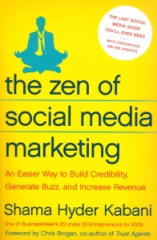 She gives you an overview and basic steps to get set up on Facebook, Twitter and LinkedIn. She helps you understand where social media fits into the bigger picture and how to use these together to maximize your efforts. What’s neat about this is there is an online version of the book that has continous updates which are really helpful. So in essence, the book never goes out of date.
If you’re in marketing, whether it be for a small local company or a large international one, this book will make you look like a hero (only in social media). You can get it on Amazon. I read it in one night and it would make a great gift for someone.
by tradespeopleinsights | Dec 2, 2010 | Traditional Marketing
Most of our clients have trade show schedules and are reluctant to give them up. The costs for most shows are in the tens of thousands per show which doesn’t include your sales people time.
According to the trade show bureau, it takes 3.6 touches to make an average B2B sales from a trade show lead rather than 6.7 touches from other leads.
So are trade show leads better than other leads you pass on to your sales team? I’d like to get your input.
by tradespeopleinsights | Dec 1, 2010 | Marketing Trends, Traditional Marketing
 It seems like these days that everything is moving as fast as a digital download. Information is at your fingertips with smartphones getting more and more popular and with access to everything you could possibly want to know in the palm of your hand.
We see this in the news media as well – stories no longer take weeks or days to break, but are posted within a few minutes so you can know what is happening half way across the world in seconds. It is with this trend of fast information, and the technology of mobile media that fuels it, that marketers are forced to keep up.
More and more people are getting their information from their smartphones and carry them with them at all times, so marketers need to reach their targets where they are absorbing information.
This white paper reviews the current state of affairs and touches on QR codes and Microsoft Tags and highlights best practices.
A free copy for download is available. Click here to sign up.
by tradespeopleinsights | Nov 30, 2010 | Marketing Tools, Social Marketing, Traditional Marketing
One of our strategic partners, Ultimate Leads, has come up with an intriguing service to help you identify who’s coming to your site by company. Russ Hill, the company president, explains how it works and has given our readers a free trial.
 More than 95% of visitors to B2B websites leave sites without requesting additional information according to recent research. Visitors may click links to “Find a Distributor” or download a document without you knowing who they are. And if they arrived at your site via a “pay-per-click” banner ad, wouldn’t you like to know who they are?
Now you can! LEADADVANTAGE is a program that helps you identify companies that visit your website, their interest (pages viewed), and key contacts at that company and more. Great stuff for the B2B marketer interested in generating new leads and targeting new prospects. Visitors finding their way to B2B websites usually get there because they were seeking out information on particular products or services. (Do business people have the time to visit websites about things like lift trucks, hydraulic fittings, or industrial electronics for fun?)
Who’s Looking at YOU?
Simple reverse IP address look-up technology has been around for a while. Website traffic counts, page views, cost-per-click and return visitor numbers are standard fare in Google Analytics, WebTrends and other sites. These counts are little more than the old method of counting raw “Bingo” card inquiries and trade show booth visitors by previous advertising generations. B2B marketers need more. LEADADVANTAGE pulls detailed company and contact information from sources like LinkedIn and Jigsaw. For B2B marketers, it’s not enough to just know how many are visiting your website, but who!
Identifying and capturing website visitors is an excellent way to develop “soft leads” of prospects and new sales opportunities. It’s also a good way to learn which of your existing customers are visiting your website in search of information. Remember, these are companies that sought you out. Don’t let these opportunities elude capture.
To learn more about how to gain the LEAD ADVANTAGE, call 800-323-0550 for a no obligation 10-Day Free Trial.
by tradespeopleinsights | Nov 24, 2010 | Marketing Tips, Marketing Trends, Traditional Marketing
Yesterday, Aylie Fifer from Sonnhalter gave us an overview of what QR codes were and how they can be used. Today she’ll talk about the differences between Microsoft tags and Traditional QR codes.
If you want to see how it works, print out this page, download the app and scan the tag with your phone to see where it takes you. Or, if you already are familiar with this, scan the tag off the computer screen.
 In our last post, we explained what QR codes are. Today, we want to tell you about the proprietary Microsoft Tags and what advantages they have over the traditional QR codes.
Microsoft Tags:
A Microsoft Tag IS a QR code – QR code means “Quick response code” and is a 2-dimensional, scan-able code. By definition, a Tag is a QR code.
The MT is a “High Capacity Color Barcode.” What this really means is more information can be packed into the code and can be used in color or black and white. This is what allows users to create an image over the code if wanted.
QR Codes vs. Microsoft Tags:
QR Readers:
You need to download a QR Code reader app to your phone in order to enable this to work and not a lot of people know about it, know how to do it, or want to spend the money on the app. Here are some recommended ones. Please note that not all QR readers will read all QR codes. For instance, Microsoft Tags have a special reader called “Tag Reader” that does not work on generic QR codes or vice-versa.
A lot of the phones that are currently being manufactured are being built with a reader built in. We are going to see this surge over the next 6 months – 1 year, I would guess, but it really is quite simple to download an app. We also will see the acceptable platforms expand. As I mentioned, this is already a huge phenomenon in Japan and is a more developed market for use of QR codes meaning people are more accustomed to seeing and using QR codes over there versus the U.S which is a less mature market at this point in comparison.
Metrics:
The other major difference with most QR codes and Microsoft Tags is the metrics. With most QR codes, you can track traffic by using Google Analytics to track the codes with unique URLs for each Tag. However, Microsoft Tag Manager actually will track the scans of each code. This way, we have one more level of information. With just Google Analytics, we only see how many people went through to the URL. With the added layer of information, we can see if someone scanned and stopped mid-process or had another issue.
Microsoft Tags actually have a lot of reporting available in the free version too. Here is a list of the reports available with the MS Tag Manager:
- Heat Map
- Represents where Tags were scanned on an interactive map
- Daily Scans
- Charts the number of scans per day for a single Tag
- Scan Totals
- Charts the total number of scans for each Tag in a category (over the lifetime of a tag)
- Scan Totals by Category
- Charts the total number of scans for each of your categories
- Daily Scans (Multiple Tags)
- Charts the number of scans per day for multiple selected tags in a category
- Daily Scans (Category Totals)
- Charts the total scans per day for all tags in a category
- Daily Scans (Compare Categories)
- Compares the total number of daily scans for different categories
In addition to all the reporting, it also provides the option to set a date limit for the Tags. And, of course, you can change the URL on the fly, an attribute which we find especially helpful.
Even though the Microsoft Tag has only been out for a year, I think it is going to rise to the top not only because of its innate high-capacity to hold information (it was developed to be more robust), but also the added tracking and reporting features and the fact that you can also brand each Tag by overlaying a picture or a logo over the Tag and it will still be readable. I think that once the market gets used to using QR codes in general, this feature will become more appealing to users and publishers/marketers, so I think it is a better long-term option. And because it can hold more information, the Microsoft Tags can be printed much smaller than most QR codes. There are micro QR codes, but a micro QR code only lets you hold 35 characters of data – which really doesn’t allow you to do a whole lot.
The other nice thing is that it has a high tolerance for reading damaged tags. For a lot of the QR codes, if the code is damaged in any way, the phone camera cannot translate the code. When developing the Tags, Microsoft took into consideration the low-quality of most cell phone cameras (blurred shot, lack of autofocus) and adjusted the tolerance for a bad photo or camera so you don’t need an exact scan or a perfect picture like most QR Code scans require.
As far as the readers go – that is my other concern. Not all QR readers work on all QR codes. Most QR generation sites provide you with a listing of acceptable phone platforms. Some of the major ones, in defense of the QR readers, do support the more popular phones like iPhone and Android, and Blackberry. Microsoft Tag Reader supports all the major phone platforms and is rapidly adding new platforms. It is a free download for the Tag Reader versus some of the better QR code readers you have to pay for (usually $1.99 or less, but still…).
While there have been a lot of companies using QR codes, I would argue that there are the same amount using Microsoft Tags. Fox for instance, used them to promote Avatar. Publications like Food & Wine, Details, Conde Nast Traveler, Entertainment Weekly, Glamour, Golf Digest, Ladies Home Journal, Lucky Magazine, Self, Seventeen, Traditional Home, and TV Guide have used tags. As well as some big companies and brands such as Campbell’s, Dominos, Dr Pepper, Ford, General Mills, Goodyear, Kraft, Mazda, Mountain Dew, Procter & Gamble, Porsche, Sprint, Toyota and Whole Foods.
At the end of the day, each have their own merits, but at this point in time, to me the better long-term choice seems to be Microsoft Tag because of its innate capabilities. No QR code (as of this moment, I know there are some sites in the works) can offer as much as the Tag can.
If you missed Part 1, click here to view.
by tradespeopleinsights | Nov 23, 2010 | Marketing Tips, Marketing Trends, Traditional Marketing
B-to-B Marketers need to take advantage of every marketing tool, especially if your target market is the professional tradesman. Most of these folks are on the move and depend on their cell phone, not only to stay in touch, but to get valuable info that will help them do their job. One tool for mobile smart phones that probably is overlooked is the QR code.
More and more these days, we are seeing the use of QR codes in the consumer market. But QR codes are fairly new to arrive in the business-to-business sector. Since we see these as a great way to build a bridge between print and online presence, we thought we would take the guesswork out of these strange little codes.
Today Aylie Fifer, Relationship Architect at Sonnhalter will hopefully take some of the mystery out of this potential marketing tool with this 2-part guest post:
What are QR codes?
A QR Code is a matrix code (or two-dimensional bar code) created by Japanese corporation Denso-Wave in 1994. The “QR” is derived from “Quick Response,” as the creator intended the code to allow its contents to be decoded at high speed.
This 2D bar code that stores URL information (or other information) so that when scanned with a smart phone reader (using the mobile’s camera), it directs you to a specific URL (or other location such as a video, a v-card, etc.)
These are very, very popular in Japan and are starting to catch on it the U.S., but mostly in the CPG market right now – we are starting to see it enter into the business-to-business world.
Here is a site to show you how QR codes work (you have to have a phone that has a QR reader on it or download an app):
http://www.google.com/help/maps/favoriteplaces/business/barcode.html
The creation of QR codes:
Usually synonymous with mass production, the quick response (QR) bar code was originally created by Japanese company Denso-Wave to keep inventory. However, because QR codes allow for more data than the standard 10-digit bar code, and because scanning requires less effort than typing a URL, the QR code has taken a turn for the personal. Denso has the patent to the QR code but as of yet, has not chosen to enforce it.
Denso-Wave website: http://www.denso-wave.com/qrcode/index-e.html
From Bar Code to QR Code – from the website http://www.denso-wave.com/qrcode/aboutqr-e.html
Bar codes have become widely popular because of their reading speed, accuracy, and superior functionality characteristics. As bar codes become popular and their convenience universally recognized, the market began to call for codes capable of storing more information, more character types, and that could be printed in a smaller space.
As a result, various efforts were made to increase the amount of information stored by bar codes, such as increasing the number of bar code digits or laying out multiple bar codes.
However, these improvements also caused problems such as enlarging the bar code area, complicating reading operations, and increasing printing cost.
2D Code emerged in response to these needs and problems:

2D Code is also progressing from the stacked bar code method (that stacks bar codes), to the increased information density matrix method.
About QR codes:
QR Code is a kind of 2-D (two-dimensional) symbology developed by Denso Wave (a division of Dens Corporation at the time) and released in 1994 with the primary aim of being a symbol that is easily interpreted by scanner equipment.

QR Code (2D Code) contains information in both the vertical and horizontal directions, whereas a bar code contains data in one direction only. QR Code holds a considerably greater volume of information than a bar code. Thus allowing for more sophisticated information to be encoded than just numbers such as a web link or a vcard.
Tomorrow we will talk about the difference between Microsoft tags and traditional QR codes.
While there are many different variations of QR codes such as Microsoft tags or Shotcodes, the premise is the same – a quick-reading code that takes you to more information. In our next post, we will discuss what Microsoft tags are and how they compare to traditional QR codes.
by tradespeopleinsights | Nov 18, 2010 | Marketing Tools, Traditional Marketing
Are you looking for a repeatable way to provide training to your customers so your sales people can focus on selling?
 Explore options for online training, best practices, what not to do and how you can launch a course in under a week. The presenter, Lisa Bordeaux from Bluevolt, a leading online training source for suppliers, distributors and end users, will be our presenter.
Join us to learn more about how manufacturers are developing product training courses that educate people on their products and building product experts in the field.
Our research shows that Distributor sales people recommend products to customers 2-5 times per day. They recommend what they know and most of the products they sell they have never seen in application. Learn how others are bringing those products to life online and making it easier to educate and market to the channel with partners, buying groups, customers and others.
Details:
Tuesday, December 7th, 2-3 PM EST. Registration is closed.
by tradespeopleinsights | Nov 17, 2010 | Marketing Tools, Social Marketing, Traditional Marketing

If you are, there’s a new association that started in 2009 (good timing isn’t it) that deals with the construction industry and best practices to market to them. It’s called Construction Marketing Association (CMA) and they are out of Chicago. I’ve joined it as I think it’s important for those of us that play in this market can get together with our peers and look at what’s working and what’s not.
The founder, Neil Brown, has been in the construction industry on both the client and agency side for the past 15 years. Neil’s vision is to support marketers with a broad range of resources from monthly webinars, e-newsletters, blog, databanks and a network of professionals you can talk with on a regular basis. Neil is trying to start regional chapters as well, and I’ve agreed to head up NE Ohio.
The CMA is a start-up operation, but I think it has legs. The bottom line is in order for anything to be successful, it needs people to join and interact. Individual memberships are $169/year and there are corporate rates for 5 or more.
Take a look at their site and consider joining. I know there are some great marketing minds out there with a vast amount of experience in this channel. Won’t you share your knowledge?
by tradespeopleinsights | Nov 15, 2010 | Marketing Trends
 I just returned from the 34th Annual Specialty Tools and Fasteners Distributors Association (STAFDA) convention and trade show. Attendance was up and so were the spirits of all who attended. Georgia Foley and the team once again put on a great event.
Their keynote speaker this year was Sarah Palin who delighted the audience and shared her vision on several issues that affect the STAFDA membership.
I spoke to several folks during the show including distributors, reps and manufacturers, and pretty much across the board they were all optimistic for 2011. Most noted that there are pockets of business out there, you just have to look for them.
I’ve assembled some “on the floor interviews” from several manufacturers that I’d like to share with you here.
by tradespeopleinsights | Nov 11, 2010 | Marketing Trends, Social Marketing
 GlobalSpec is an internationally known portal used by engineers, technical and manufacturing professionals. They recently released a new study: Trends in Industrial Marketing 2010.
Of the 464 respondents, 70% hold management positions in sales or marketing. These companies had marketing budgets from 50,000 to over a million dollars.
Here are some highlights:
• 70% of companies anticipate an increase in sales compared to 2009.
• Marketing budgets are recovering after a down year in 2009, with 31% reporting an increase in their marketing budget this year.
• The top three marketing challenges in 2010 are having too few resources, not enough quality leads and a need to improve marketing ROI.
• Three of the top four sources of leads are online channels, including the company website, e-mail marketing and search engine optimization.
• 68% of companies plan to increase spending on social media in 2010. LinkedIn and Facebook are the most popular social media applications currently being used.
• 47% will spend more than one-third of their marketing budget online, and the majority (51%) will invest more in online marketing in 2010 than they did in 2009.
How do you stack up with these trends?
by tradespeopleinsights | Nov 10, 2010 | Marketing Tips, Social Marketing, Traditional Marketing
When was the last time you and your IT department willingly collaborated on a project? The truth is, probably never.
The reality is in today’s environment, the customer is taking control of the engagement, and marketing’s challenge is how to get to the customer faster and more efficiently (customer-centric). Customers are turning away from companies who can’t provide the experience, channel of engagement and immediate service they need.
The CMO Council recently did a study sponsored by Accenture called Driving Revenue Through Customer Relevance, that outlines ways CMOs and CIOs can achieve Agile Intelligent Marketing together.
Now marketers may not be known to be the sharpest pencil in the box, but we do have a good sense of what the customer’s needs are (and all needs are not the same), while IT is usually all B/W.
According to the report,”CMOs must take a greater ownership of the customer experience and assume a leadership role in embracing digital marketing practices, data-driven strategies and new marketing process integration platforms across their organizations.” Technology now underpins and shapes the entire customer experience. IT departments need to take strides to be a stategic enabler rather than an operational cog.
The reality is working with or without IT, marketers are doing tactical things with e-mails,website analytics, lead generation, etc. with the ever-increasing pressure of ROI on marketing dollars no matter where they are spent. Beyond the spend, you need to look at what’s really the end game? It’s to get a new customer or make an existing one happy.
The moral of the story is for Marketing and IT to play nice. Remember, your pay checks come from the same account and together you can make a better impact for the company.
by tradespeopleinsights | Nov 9, 2010 | Marketing Trends, Traditional Marketing
Everyone is talking about ROI especially when it deals with social media. What I would like to know is what/how are you currently dealing with what I call Traditional leads from ads (print and electronic), trade shows and websites?
Can you take a few minutes to answer our survey? Click here to take the survey. We’ll be happy to share the results.
by tradespeopleinsights | Nov 4, 2010 | Marketing Tips, Social Marketing, Uncategorized
Social media is about engaging with other people. In order for it to be successful, we need to move that engagement beyond the posts of Facebook or your blog. Yes, it’s understood that there are people behind the words, but unless you just want to be pen pals, you need to nurture them.
Once someone knows, likes and trusts you, you can go from engagement to a relationship. I know it may sound silly, but you’d be surprised how many social media folks would be happy to sit in front of a computer screen all day and engage people on social but are afraid to take it to the next level. A relationship by definition is an emotional or other connection between people.
Here are some suggestions to help you take that relationship to the next level (I sound like a dating coach):
- If someone responds to you and you start going back and forth with them, suggest an offline phone call to discuss in more detail.
- If you belong to a group or association and you plan on going to a trade show or a local meeting, let your audience know your plans, and maybe you could hook up. (People buy from people.)
- Social Sites – instead of using your logo, put up a team photo. On the about us pages, include the names of employees representing your brand. Put up profiles of team members.
- Encourage networking – if you have all this info about employees on your sites, then suggest that they promote the brand on their Twitter, Facebook and LinkedIn accounts.
These are some of my ideas. I’d like to hear what you’re doing to make it more “human.”
by tradespeopleinsights | Nov 3, 2010 | Uncategorized
A friend of mine, Abe WalkingBear, developer of a copyrighted profit system that focuses on improving cash flow, has agreed to share some of his insights (some are truly unique) on how manufacturers can help distributors. He’s written books, is an international speaker and co-authored STAFDA’s Foundations of Business 2007.
Old military funny money finds new life in business. During this time of slow sales and extended delays in business credit customers’ payments, an old idea is reborn.
During the Vietnam War, U.S troops and sailors in Asia were paid in funny money, i.e. MPC (military payment certificate). This funny money, which was also called “monopoly money” or “script,” was in use up until 1973. Members of the American military could convert MPCs to US dollars upon leaving a designated MPC zone, but while in these zones, all you could do with it was go to the Post Exchange (PX) or the Ship’s store and convert it to the local currency. MPC in Vietnam had pictures of movie stars on it and I can’t remember for sure, but I think that Marilyn Monroe was on the $20 bill.
Interesting, but what does this have to do with improved cash flow and more sales?
Distributors sometimes offer their business credit customers a 2-10-N30 payment term. i.e. the customer can take a 2% discount off the invoice amount if they pay it within 10 days, otherwise the full invoice amount is due in 30 days.
The idea behind the early pay discount being to spur cash flow.
Any business customer not taking advantage of a 2-10-N30 early pay discount fails to do so for one of two reasons:
1) they don’t have the financial ability to do so…no money
2) the sales and credit guys failed to explain that a 2-10-N30 is worth a 37.24% Annual Rate of Return…where else can you get 37.24% return with no risk?
Formula:

The Problem:
There are several problems with early pay discounts:
First, business customers sometimes will issue a check for payment on an invoice, less the 2%, on the the 10th day, but will not release the check until the 30th day or the 60th day thus defeating the very reason why the discount was offered in the first place.
Second, the taking of “unauthorized discounts” by the business customer by failing to pay within the 10 days creates additional work and cost for both the distributor and the business customer in the pursuit of the unearned discount. And this in turn can actually lead to the loss of customer good will and of future Sales.
I’ve never liked 2-10-N30 terms for these reasons.
The Best of MPCs and Early Pay Discounts
There is a way to use an early pay discount to improve cash flow and also bring business customers back to buy again thus gaining the most profitable sale, the repeat sale.
Instead of offering a 2-10-N30 term, a distributor can send out, along with an invoice, a VCDC; A Valued Customer Discount Certificate for 2% of the invoice amount…and they can put the selling company’s CEO’s picture or the selling salesperson’s picture on the certificate…or Marilyn Monroe’s picture.
Each VCDC would carry the same # as the invoice it applies to and thus would be easy to track.
The VCDC would clearly state that if the invoice that the VCDC applies to must be paid within 10 days of the invoice date for the customer to use the VCDC on their next purchase.
If a business customer pays within 15 days..they should be cut some slack and the VCDC accepted…on that next and most profitable purchase, the repeat.
The end result: Improved cash flow and repeat sales.
All too often in business we walk a mental rut, we do the same thing over and over again in the same way, until the rut becomes a mental trench and then we think we can see the horizon for oncoming danger or new business opportunities when in effect all we really see is a wall. And that’s not to say that a trench can’t be comfortable and easy to navigate, but God help you if things change and the walls give way.
During this time of slow sales and extended delays in business credit customers’ payments, manufacturers can add value to their distributors by sharing with them an old idea reborn anew on how to gain a competitve advantage while improving cash flow and repeat sales.
If you like this post, please share with your friends.
by tradespeopleinsights | Nov 2, 2010 | Events/Trade Shows
 For those of you that are going to Phoenix this weekend for the STAFDA Show, we put together an Insider’s Guide to Phoenix by asking friends and business associates about gems in the city that you might not be aware of. It includes Restaurants, Nightlife, Events and more. It’s available at www.sonnhalter.com/stafda
We hope you have a good show.
by tradespeopleinsights | Nov 1, 2010 | Marketing Tools, Social Marketing, Traditional Marketing
We’re taking a poll to see how B-to-B marketers are currently tracking leads (all kinds). It’s a short survey (7 questions), and if you want to get a copy of the results, there’s a place for your e-mail at the end of the survey; we’ll be happy to share the results.
To take the survey click here.
Share with your business associates. The more info we gather, the more meaningful the results.
by tradespeopleinsights | Oct 28, 2010 | Marketing Tips, Social Marketing
Everybody is talking about it, but few are actually doing it, according to a new report out by Geoff Ramsey, CEO of eMarketer.com. According to a worldwide survey, only 16% measure their return on social media initiatives.

Main reasons given by marketers is that they think measuring is too difficult or there are too many options available.
What is interesting is that those who take the time to develop their social media strategies and tie them to bottom line results stand to gain significant competitive advantage.
You can download the report here. It’s worth the read and as always, eMarketer.com has done a good job developing these guidelines.
by tradespeopleinsights | Oct 27, 2010 | Marketing Trends, Traditional Marketing
American manufacturers continue to wrestle with the question – Does American-made make a difference? I think it does if you have a product that has some value added and it’s not considered a commodity. According to a recent by Harris Interactive, made in America does boost purchase appeal. Not surprising, the over-35-year-old set is the strongest demo. Older American and midwesterners are the biggest supporters.
Here are answers to the question: When you see an ad emphasizing “Made in America,” are you…

What are your thoughts on made in America? Does it make a difference?
by tradespeopleinsights | Oct 26, 2010 | Uncategorized
A friend of mine, Abe WalkingBear, developer of a copyrighted profit system that focuses on improving cash flow, has agreed to share some of his insights (some are truly unique) on how manufacturers can help distributors. He’s written books, is an international speaker and co-authored STAFDA’s Foundations of Business 2007.
Today, WalkingBear will talk about how efficiencies affects both profitability as well as competitive advantages. Enjoy.
Efficient…To be powerful in effect with little waste of effort.
When I first went into business consulting in 1982, the first thing I’d ask a new client for was their Operations Manual or written Policies and Procedures. I wanted to see what they had defined as “goals” and “methods” for achieving the “goals.” Many if not most were stunned, they got that “deer in the headlights look” and then they would start looking through desk drawers and cabinets.
28 years later little has changed, and if you have to look for your P&P, you don’t have any…at least not any usable ones.
Many if not most businesses operate on a “word of mouth basis,” the new guy learns from the old guy who learned from the dead guy. It’s a lot like the game kids play where they sit in a circle and the first kid whispers something in the next kid’s ear and so on. It’s real funny when kids do it, but “word of mouth” is not an efficient way to operate a business.
HH the Dalai Lama says that there are almost 7,000,000,000 of us and almost 7,000,000,000 versions of what is is. And if you are married or have kids, you know what the Dalai Lama is talking about. It’s not just Bill Clinton.
Word of mouth operations is not efficient and drives up the total cost of doing business for everyone in a supply chain…manufacturers, distributors and downline business customers all pay for any inefficiency in the supply chain; like strawberry jam, a little inefficiency spreads to everything it touches.
Studies have found that on average 25% of the total costs of doing business are directly tied to inefficiencies. When I speak to CEO and business owners’ groups, I put up a slide to this effect and every time I do, someone will say something like, “I wish it were only 25%.” 25% of the total cost of doing business is a whole bunch and most especially when it’s paid by everyone in a supply chain.
Twenty-five years ago I learned a great tool from my younger son who was then in the second grade. I learned how to use an organizational web to organize and document unique and specific knowledge. Based on this organizational web, I developed and copyrighted “The 5 Organizational Ps,” a set of methodologies for organizing and documenting the unique and specific knowledge found within every business so as to achieve new efficiencies and drive down the cost of doing business for everyone in their supply chain.
The Five Organizational Ps
Purpose: Every business function must have a clearly stated purpose which answers the question, “Why incur the costs that go with the function?”
Policies: Goal driven guidelines for each major component within the function.
Process: The step by step method for achieving the goals established by the policies.
People Requirements: The right people for the job based on the process.
Process Monitoring and Performance Measurements: Monitoring key steps in the process to ensure quality and measuring against the goals established by the policies.
If the established goals are not achieved, either the process is wrong or you have the wrong guy in the job.
In business, there’s a cascading effect to improvements. If a manufacturer, distributor or downline business customer can do something better, it lowers the total cost of doing business for all; a good business relationship at best is a partnership.
by tradespeopleinsights | Oct 21, 2010 | Marketing Tips, Social Marketing
According to new research from Sysomos, 92.4% of all retweets happen within the first hour. If you’re looking to be retweeted and nobody picks you up in the first hour, chances are slim to none that it will happen.

TIMING is crucial when sending out tweets. Jay Baer recently wrote a post, 6 Timely Tips for Twitter Success, where he outlines ways you can increase your odds. Here are some highlights:
- Find your influencers – These are the ones we want help with spreading your message.
- Repeat your tweets – If 94% of all retweets happen within the first hour, then it stands to reason the more times your message is out there, the better the chances of it getting picked up.
- Test your times – Depending on your audience, you may want to think about when you send them out. For example, contractors are early birds and if you want to get them, the best time is either between 6-7 in the morning or between 4-5 in the afternoon. You also need to take into condsideration time zones if you have customers across the country.
- Pay attention to structure and language – Are shorter ones better than longer ones? Is it better to put the link at the front or at the end?
- Manage expectations – Reality is 6% of all tweets are retweeted so be realistic.
Twitter is a great tool, but you need to do some homework to insure you’re getting the most out of it.
by tradespeopleinsights | Oct 20, 2010 | Marketing Tips, Social Marketing, Traditional Marketing
 We focus so much time and effort on making the sale that we sometimes forget about customer service if someone has a question or problem. Don’t let your customer service department be the weak link in the chain.
Most customers are repeat buyers, so you need to keep them happy. With the advent of social media, there are more ways that an unhappy customer can let the world know about a bad experience with your company. Here are a few things you can do:
- I’d suggest you go out and buy one of your own products and then go through the process of registering it for warranty and see how your system really works. Is it customer friendly?
- If you have repair centers, make a visit and see how they handle a warranty issue.
- Call your customer service deptartment and see how they handle a problem. And by the way, don’t be nice. See how they handle adversity.
You work so hard for the sale, let’s not forget about the next one. It’s a whole lot easier selling something to an existing customer than it is trying to get a new one.
by tradespeopleinsights | Oct 19, 2010 | Marketing Tips, Social Marketing, Traditional Marketing
I thought I’d share with you 5 of my favorite posts from the last quarter. It’s obvious to me that they coincide with what you, the readers, are saying.
Have You Got a Social Media Policy?
7 Tips to Use Twitter to Generate Traffic and Leads
What’s Your Company Value Proposition?
Manufacturers: 5 Tips to Make the Most out of an Open House or Counter Days
6 Tips When Talking to the Media
by tradespeopleinsights | Oct 14, 2010 | Marketing Tools, Social Marketing, Traditional Marketing
Everyone knows that a picture is worth a 1,000 words. Can you imagine what a video is worth? Online video is growing at very fast pace (more than 24 hours worth of video is being uploaded every minute to YouTube). There were over 30 BILLION views over the past year. YouTube is only second to Google when it comes to search.
In other words, you need to seriously consider video as part of your overall marketing strategy especially.Viral videos are affordable to make and are one of the most effective tools you can use. Contractors and tradesmen want to see how things work. What makes your widget better than your competitors. Better yet, wouldn’t it be nice to have a customer say or show how great your product is. They are also great tools for training both sales and distributors. Here’s an example of a product demo from Arbortech that has helped them gain interest and decrease the selling cycle.

Plus, YouTube has metrics attached to it where you can see how many views, country of origin, where links are coming from and audience profile info.
Your website is also a great place to promote them as well or use Quick Response codes to push people from ads or packaging to more info. The key is, if you’re a manufacturer, don’t overlook videos as a viable marketing tool.
by tradespeopleinsights | Oct 13, 2010 | Marketing Tips, Traditional Marketing
 Email marketing should be a major part of your traditional marketing communications plan. But do you have a plan on how you want to use it for maximum ROI? In the B-to-B world, even opt-in lists are only being opened on an average of 25%.
Today we’re all bombarded with emails and it’s estimated that the sheer volume will increase by up to 80% by 2013. So the challenge is how to stand out in this sea of emails and if you do get them to open it what’s next? Here are a few helpful suggestions you may want to consider:
- Keep your mesage simple – and to the point of (what’s in it for me). Folks aren’t going to read long emails.
- Give them a call to action – Use emails to “nudge” folks along. Link them to a website, video or coupon offer.
- How do your prospects like to be contacted – Is it traditional email or mobile marketing? Most contractors are on the jobsite most of the day and rely on their smart phones to stay in touch.
- Temper frequency of contacts – Yes they may love you, but they might not want to hear from you on a daily basis. Contact them when there’s something of value to share.
Those are a few hints that we use. Hope about you? What things do you do to make your email programs zing?
by tradespeopleinsights | Oct 12, 2010 | Marketing Tips, Social Marketing
Professional tradesmen, whether you’re an electrician, plumber or locksmith, are finally realizing that social media can play an important part in their new business effort. Here’s one example compliments of Marc LeVine from RiaEnjolie.

Locksmiths Use Social Media to Unlock Their Business Potential
Many people do not realize that professional locksmiths do much more than just resolve lockouts and make spare keys. In fact, they generally offer a wide range of services that include selling and installing electronic security systems, intercoms and even window bars and gates. Locksmiths are also responsible for many of the break-ins and robberies that never take place as a result of their theft-proofing devices and crime deterring advice. They can also be credited for helping the police identify successful burglars by way of the recordings on their customer’s CCTV surveillance equipment.
Every city and town has, at least, a few locksmiths on hand to serve the local populace. After all, if you suddenly get locked out of your home, you want a service you can call on 24 hours a day and not one that takes 24 hours to arrive at your door.
With the “Yellow Page” phone books on the way out, it is increasingly important for locksmiths to be easily searched for and found on the Web. This means that they must have a professional looking website with strong search engine optimization (SEO) characteristics. The locksmith’s website must offer prospective customers comprehensive and concisely written content explaining everything they might need to know about a business’ products, menu of services, operating hours and contact information.
Just having a website may not be enough to draw attention to a small, local business. Locksmiths and others are beginning to realize that traditional advertising methods are quite expensive and not as effective as they once were.
Many small businesses continue to run ads in weekly papers and Pennysavers, without ever calculating any return on investment (ROI). Several continue to rerun their ads week after week despite only receiving a few and often no customer inquiries at all. What a terrible waste of time and money for so many hard working people. They often feel compelled to advertise exactly the same way they and their parents always have prior to the age of the Internet. Most have never taken any quality time to consider less costly and often more effective alternatives to newspaper, direct mail, radio and CATV ads like Social Media.
This Locksmith May Have Found the Key for Success
Fidelity Locksmith Services has been serving the people of Los Angeles, California since 1975. Their customers include the general public, as well as many well known Hollywood celebrities that are often in need of much more sophisticated and expensive security systems for their magnificent homes and estates. Having a clientele of this type has enough PR value in its own right, but what good is it if these higher profile associations are not pitched and promoted.
During a rash of Hollywood celebrity burglaries in the fall of 2009, Fidelity Locksmith launched a special deadbolt giveaway program aimed at preventing a repeat of the rash of burglaries that plagued the rich and famous of Hollywood Hills.
“It doesn’t matter if you’re Hollywood royalty or a regular guy like me, living through a break-in is life changing. The lost sense of security that comes following a burglary is often even more devastating than the actual property loss,” said Roy Sivan, Fidelity Locksmith’s Chief of Celebrity Services. “We’re offering celebrities free deadbolts to let them know Fidelity understands what they’re going through and to encourage the public to think about beefing up their home security. No doubt such a high profile program gained the attention of those in traditional and social media.
While the celebrity deadbolt giveaway program was certainly attention getting, the company’s well documented advertising and marketing philosophy may even be more noteworthy. Fidelity Locksmith Services is not at all ashamed to share that it uses Social Media as an inexpensive way to reach their target audience. Through this cost savings approach they say they are more easily able to offer the consumer much better pricing than many of their industry competitors.
Indeed, Fidelity Locksmiths has an active social (media) life on Facebook, Twitter and YouTube, where they have created some very funny and memorable short commercials to capture their audience’s imagination along with their business.
http://www.youtube.com/watch?v=hXzT5APbUnw&feature=mfu_channel
http://www.youtube.com/watch?v=Sw0U2sYOmq4&feature=mfu_channel
http://www.youtube.com/watch?v=EmIMChrzIW0&feature=player_embedded
Finding the Right Blend of Marketing is a Cost Saver and Revenue Maker
While not every small company like Fidelity Locksmith operates in a Hollywood type of business environment, every business can embrace the same level of creativity to leverage whatever it is that their own community has to offer. If you can’t leverage the New York Yankees, you can always run promotions with your local minor league team. What you have available to work with (in your community) is much less important than what kind of marketing programs you – yourself – can create to inspire your target audience. Most importantly, doesn’t it really all come down to how well you execute your planning; attract and engage your audience; and convert them to paying customers?
Don’t forget to measure and analyze your activities and results, accordingly. This is so critical to a small business’ success. If your traditional marketing activities have been lackluster over the past six months, you can fairly well predict what they will bring you – if unchanged – throughout the remainder of your annual business cycle. At what cost to your business are such unnecessary shortcomings and why continue to finance them? Social Media is much less expensive (often Free) and often much more effective.
Try a modest combination of Social Media and traditional media to grow your business. Start with your main goals. Write them down and stick a note on your wall to refocus you each morning. Those goals are closely linked – to be easily found on the Web and to make a good first impression.
Accomplish these goals by creating a professional looking website reinforced with fundamentally sound Search Engine Optimization practices. With these goals accomplished, support your website with some basic URL promotional activities (make sure your business URL is all over the place) and engage your target audience at grassroots level on Facebook and, perhaps, Twitter for only a couple of hours each day. The results of this minimal activity just may surprise you.
by tradespeopleinsights | Oct 7, 2010 | Marketing Tips, Social Marketing
I’m totally amazed when talking to people that they complain that they’re not getting anything out of LinkedIn. LinkedIn, like anything else, responds to someone who is active. In other words, you need to participate and engage people in order for the network to be effective. For those of you who follow me know that I personally think LinkedIn is one of the most useful business tools out there.
I recently read a post by Stephanie Sammons on Social Media Examiner entitled, 5 Ways to Develop a Meaningful LinkedIn Connection where she’s highlighted and given examples of how to take the connection phase to the relationship phase. Here are some highlights of her 5 suggestions:
- Timing is everything – Once you make a new connection, then it’s the time to try to engage them. Ask a question or give a compliment.
- Leverage events – If you see that a connection of yours is going to an event that you’re planning on attending, send them a message and let them know you’re going and see if you can’t meet face to face.
- Sync Geography with travel – Using the “my connections” tab, you can find where people live and if you’re planning say a trip to Dallas on business, you could let your connection know you’ll be in town and see if you might be able to meet for coffee or breakfast.
- Ask for advice – What a great way to engage people. Most people love to give their opinions.
- Be a resource – It’s better to give then to take. If you can offer real value, you’ll become a resource for people which will help you move from online networking to offline conversations.
The biggest issue facing us all is to challenge yourself to participate. LinkedIn works for those who work at it.
If you like this post, please share with a friend.
by tradespeopleinsights | Oct 6, 2010 | Marketing Tips, Social Marketing
Blogs are still a very effective way of reaching an audience, especially if you’re in a niche market. While it may be true that social networks and microblogs have outpaced the traditional blog, the opportunity for you to build thought leadership and branding is better served by blogs.
More than 50% of web users will read blogs this year. According to eMarketer, by 2014, 150 million Americans, or 60% of the population of the U.S., will be reading blogs. Blogging has become an accepted part of the online media landscape and blogging is easy to do.

“Trends in blog reading are expected to maintain an upward course as blogs continue to gain influence in mainstream media,” said Paul Verna, a senior analyst with eMarketing and author of “The Blogosphere: Colliding with Social and Mainstream Media.”
What’s the upside for someone looking to make an impact using social media: think about doing a blog.
Here are some other posts about blogging you might find interesting:
Pros and Cons of Starting a Blog
6 Tips to Make your Blog More Successful in Reaching the Professional Tradesmen
LinkedIn: Great Tool to Drive Traffic to Your Website
by tradespeopleinsights | Oct 5, 2010 | Marketing Trends, Social Marketing
Blogs are a great way to build thought leadership within specific categories. While personal blogs have stalled in recent years as consumers move towards social networking and microblogging, company blogs are on the rise. Maybe you’re missing an opportunity.
According to Paul Verna from eMarketing.com, over a third of companies have a public blog used for marketing and it’s anticipated to rise to 43% by 2012.
“Studies had shown that marketers perceive blogs to have the highest value of any social media in driving site traffic, brand awareness, lead generation and sales – as well as improving customer service,” said Verna. He also said that smaller companies are embracing blogging at greater rates than larger firms due in part to more constraints whether it be legal, regulatory or other reasons.
So what does this mean for manufacturers? Those who get on board now will have the advantage long term since they will be developing relationships through thought leadership and will become a “go to” resource for customers and potentials.
If you like this post, you may want to read:
Pros and Cons of Starting a Blog.
6 Tips to Make your Blog more Successful in Reaching the Professional Tradesmen
If you like this post, please share it with a friend.
by tradespeopleinsights | Sep 30, 2010 | Marketing Trends, Social Marketing
So what does this all mean? Manufacturers who still think the only ones using social are the 18-29 year olds should think again.You might be missing a golden opportunity to reach your target audience.
It means folks over 50 that are using social media (yes, even professional tradesmen and contractors) nearly doubled from 22% in April of 2009 to 42% in May of 2010 according to the Pew Research Center. That’s good news for manufacturers who are trying to reach the older set of professionals who typically own or manage contractors.
- One in Five (20%) online adults 50-64 say they use social network sites on a typical day. That’s up 10% over last year.
- Overall, 92% of those 50-64 send/read e-mail every day. 76% get news online.
- 52% of 50-64 adults are using social media on a regular basis.
| Social Media Trends, 2009-2010 |
| |
% of online adults who use SNS or Twitter, 2009-2010 |
| 2009 |
2010 |
% Point Change, 2009-2010 |
% Change, 2009-2010 |
| Social Networking Use |
|
| All adults |
46% |
61% |
15 |
33% |
| Age |
| 18-29 |
76 |
86 |
10 |
13% |
| 30-49 |
48 |
61 |
13 |
27% |
| 50-64 |
25 |
47 |
22 |
88% |
| 65+ |
13 |
26 |
13 |
100% |
| Twitter/Status Update Use |
| All adults |
11% |
17% |
6 |
55% |
| Age |
| 18-29 |
20 |
27 |
7 |
35% |
| 30-49 |
11 |
16 |
5 |
45% |
| 50-64 |
5 |
11 |
6 |
120% |
| 65+ |
3 |
5 |
2 |
– |
| Source: Pew Research Center’s Internet & American Life Project, August 2010 |
If you’re reading this, I may be preaching to the choir but I’m sure you can think of someone within your organization you could forward to and let them know older people use social too!
by tradespeopleinsights | Sep 29, 2010 | Marketing Tips, Social Marketing
Your company may see the value in social media, but they may not have yet taken the first step. The real question is, are they ready for it? You don’t want a READY-FIRE-AIM strategy.
I recently read an article from Lee Odden in the Online Marketing Blog titled, 19 Questions to Determine Corporate Social Media Readiness that I thought was appropriate for this audience.
Identifying a company’s current state of social media readiness helps them establish a baseline on which to build. There are a number of either free or low cost tools out there that can help you identify your company or brand’s current social activity level. It’s important to get a handle on the difference between how social the company is and will need to become so you can put together a strategy and plan.
Lee outlines 19 questions you should be asking. I’ve highlighted the top 5 that got my attention:
- What goals do you want to achieve with social media as part of your marketing effort?
- How will you measure/evaluate social media?
- Are you conducting a formal effort at monitoring social media channels?
- What are your current social media channels and destination websites/pages?
- Is there a particular business unit or product that can serve as a test case?
I’d be curious what questions you’d come with to add to the list.
If you find this post interesting, please pass it on.
by tradespeopleinsights | Sep 28, 2010 | Events/Trade Shows
 For those of you that are going to Boston this weekend for the NECA Show, we put together an insider’s guide to Boston by asking friends and business associates about gems in the city that you might not be aware of. It includes Restaurants, Nightlife, Events and more. It’s available at www.sonnhalter.com/boston.
We hope you have a good show.
by tradespeopleinsights | Sep 22, 2010 | Marketing Tips, Social Marketing
Your Blog is a repository of helpful content that can effectively attract a large number of prospective customers.
Here are 5 simple steps and suggestions to improve your company’s blog as a major tool for fueling new business leads:
1. Creating
Each new blog post is a new opportunity for you to be found online by your best prospects. Some quick suggestions:
- Write to a specific target audience and provide answers to their advertising/marketing challenges.
- Write consistently: is important to creating regular readership. Write at least 3 to 5 posts per week.
- Post should average 350 to 450 words and be pleasantly scannable to the eye. Break up long paragraphs, use bullet/numbered list when possible. Highlight key words and thoughts.
- Write in the inverted pyramid style, lead with your conclusion. People read differently online than they do for print. They tend to scan much more.
- Identify and consistently use key words in your post title. You want to be able to dominate these words in Google search.
- Let your reading fuel your writing.
- Write 1 original post to every 4 to 5 resource posts. You’ll never be considered a thought leader without original content, but you won’t generate much traffic if all of your content is just your original thought. A balance of both needs to be provided through your blog.
- Write with an “evergreen” style that will have a long shelf-life and provide a great return on your time investment.
- Provide the “Readers Digest” version for your writers. Do the work on behalf of your readers and pull out the nuggets in simple language that is concise and easy to read.
2. Optimizing
- Carefully think through your blog’s heading. A “heading” is a stand-alone phrase that describes your blog’s content that appear below it. I usually advise clients to create a blog descriptor statement for the header that lets a reader and search engines know the purpose and intent of the content. Mine is “Marketing to the professional tradesman in the construction, industrial and MRO markets.”
- Be sure you own your domain. A person that still has “wordpress or blogspot” in their domain won’t be able to change blogging platforms without losing traffic.
- Be sure your site is indexed with Google. If your pages are not indexed, then Google is not crawling them.
- Build quality inbound links. There are lots of online business directories where you can just submit your URL, agency’s name and a description of your services. There are also many social media sites where you can simply build links to your site. Writing guest articles and posts and optimizing our press releases can build links. The best way however, is to produce valued content and create a blog that is a repository of helpful information for your target audience.
3. Promoting
- Make sure your content can be easily shared on Facebook, Twitter, LinkedIn, as well as social bookmarking sites such as Digg, del.icio.us and StumbleUpon with Share buttons.
- Jumpstart traffic by repurposing your blog’s content through an email newsletter that is sent every-other-week. This is an easy thing to do. Since you already have the content and can create an email template that is reused, it will take literally minutes to prepare the newsletter and send.
- Build a sizable Twitter following that is targeted using TweetAdder and repurpose your blog content to your Twitter account using a program such as Social Oomph.
- Write guest posts, invite others to guest post for your blog.
- Comment on other blog posts and online articles, sites such as STAFDA or HVAC Professionals on LinkedIn, etc. Select those sites that are frequented by your target audience.
- Write content for searchability.
- Publish new blog content to your other social media accounts such as Facebook and LinkedIn.
- Conduct your own primary research using your blog; generate links and traffic through press releases using your groups on LinkedIn.
- Be proactive in facilitating speaking opportunities by creating a Speakers Page for your blog, list the topics and titles that you can speak to. You can also provide links to your past speaking engagements through YouTube, post photos through your Flickr Photostream.
- Pull blog content together, expand SEO opportunities, creating Slideshare Presentations, Whitepapers, etc.
4. Converting
All of this activity isn’t worth the time investment if it doesn’t turn visitors into leads.
- Place your RSS Subscription Feed button above the fold, near the top of you blog’s homepage. Visitors who subscribe will automatically receive updates every time you publish a new post either through an RSS Reader or through their email inbox. I would suggest setting up an RSS feed through Feedburner.
- Also place a subscription for your email newsletter within your blog’s sidebar to create Opt-Ins from site visitors.
5. Measuring
If you can’t measure it, you can’t improve it. Fortunately you can measure a lot online and continually hone your program.
- Review your blog site’s analytics daily to see what posts are generating the most traffic, what search terms are being used, where traffic is coming from, who is linking to you, links readers clicked on, page views, etc.
- Utilize your email newsletter analytics to improve open and click-through rates. Test the day of the week your email newsletter is sent, time-of-day and subject line copy.
- Create a first-step call-to-action for your readers to know how to initially engage you. This could be something similar to my Industry White Papers. Make it something simple and of value that doesn’t take a lot of consideration but does separate to qualified prospects from those that just want to glean what they can from you for free.
- Use this suite of tools to analyze your marketing efforts:
by tradespeopleinsights | Sep 21, 2010 | Marketing Tips, Marketing Tools, Traditional Marketing
 Sometimes we get caught up in selling product and making quotas and we lose site of what we’re really selling. If we’re just selling widgets, we’d better have one no one else has. If not, why should someone buy from you?
Today we have a guest post from Alan Sipe, President and General Manager of Knipex LP in Chicago. Alan is a dear friend, an old client and knows a few things about selling high-priced hand tools. Alan will share some thoughts with you regarding Value Propositions.
A lot is written about the topic of presenting your company’s Value Proposition and surely you have passed this along to all the semi-professional golfers and lunch buyers in your sales department…haven’t you?
So how do you know if your sales team has read the articles, thought about and formulated a basic company Value Proposition statement to use in their daily sales calls?
Simple…grab the first sales team member that walks by your office door and ask this question:
- “If a customer were to say to you that generally our prices are a little higher overall than our competitors,” how would you reply to that statement specifically?
- Be quiet now and don’t help them with an answer.
- Do not let the salesperson ask you a whole bunch of qualifying questions!
- Have them answer that specific question.
Hopefully your salesperson will have a quick and precise answer like:
- We maintain heavy stocks on the inventory you need and buy from us.
- We deliver on time and packed correctly.
- Our invoices are correct the first time to save your accounting office time and money.
- We either have or have quick access to the product technical answers you need.
- I bring you new ideas and products to help you do your job better.
- We have the best repair shop in town.
- You can count on us to be here when you need us, we have been in business for XX years.
- And maybe even…We stuck by you with a good credit line when the business was tough.
If you get an answer like any of these, you have work to do:
- Let me go back and review your pricing.
- We give you the best prices we can.
- Our suppliers are raising their prices to us.
- Let me think about that and get back to you.
- What competitor is cutting their price?
- If I give you a 5% discount overall, would that help? (If you get this answer, you really have problems and give your team way too much pricing authority, but this is an article for another day)
Put on your sales manager’s hat, write down a list of your company’s Value Propositions and make sure your sales team can rattle them off quickly and with conviction. Don’t be a sissy…make it happen!
What are your thoughts on Value Propositions? Does your company have one? Do you know what it is?
If you like this post, please share it with a friend.
by tradespeopleinsights | Sep 16, 2010 | Marketing Tips, Social Marketing, Twitter
Used in the right way, Twitter can be one of the best social media tools to be used to generate traffic and leads for your new business.
For the past 18 months, Twitter has been the leading traffic generator to my Tradesmen Insights blog. It definitely needs to be part of your overall social media marketing strategy.
For Twitter to be effective for new business, the following are seven of my personal tips:
- Don’t be afraid to use Twitter differently from the way it was originally intended to be used. Twitter is more of a broadcast tool that most would admit and current research validates. Treat it as a broadcast tool through reach and frequency of your content marketing efforts and generating the best return on your time investment by repurposing your content through tools such as Social Oomph.
- Build a targeted Twitter following. Research Twitter lists such as Mashable’s Twitter List Directory, third-party programs such as TweetAdder.
- In addition your own blog’s content, be sure to supplement your Twitter posts with resources from others that are of help to your target audience.
- Pay-it-forward. As others are so kind to publicize your content, also help to promote theirs.
- In addition to Twitter being a broadcasting tool, it must be utilized as a networking tool for you to have success. Content helps build awareness but it is up to you to turn awareness into relationships. The efficiency of these kinds of online networks should be all that is needed to motivate you to participate. People want to work with other people that they know, like and trust.
- Use third-party Twitter tools like CoTweet and HootSuite to minimize your time and maximize the effectiveness of your Twittering.
- What you learn to do for your agency can be used for your clients. There are a multiplicity of benefits from your involvement.
by tradespeopleinsights | Sep 15, 2010 | Marketing Tips, Social Marketing, Traditional Marketing

Today we have a guest post by Marc D. LeVine, Director of Social Media for Riaenjolie Inc, a web development company that specializes in websites for contractors and other tradespeople. If you’re a contractor, take a look at his tips to help improve your site.
Some people truly believe that for most local businesses engaging in Social Media (e.g. Facebook, Twitter, LinkedIn, blogging, etc.) it is a complete waste of time, and worse – it’s a waste of money. While this may be true for some small businesses, it is not true for all small businesses.
There is no question that computer challenged individuals probably won’t benefit much from social networking, primarily because they do not understand the technology – not because business opportunities do not exist for them. Others may be avoiding Social Media because they already have more business than they can handle and are stretched too thin trying to meet the demand for their services.
Andy Gaur, CEO of RiaEnjolie Inc., a New Jersey web page design company specializing in professional looking and affordable websites for Electricians and other trades people, is very well attuned to the world of traditional and Social Media Marketing for business. “It is much better to be preparing a well conceived and comprehensive marketing plan and getting ready to use an appropriate mix of outreach strategies rather than just sticking with just one or two strategies that have not worked very well for Electricians and others in the trades,” says Gaur. “If you don’t jump on different things – like Social Media – that show promise, you may end up in a struggle to retain your current customers and fail to gain new ones that are unaware of your business and what you can offer them in quality workmanship and affordable pricing.”
The reality is that while there may be a few good reasons for not engaging in Social Media, there may be many more convincing arguments as to why all small businesses should be involved on the Internet.
Local Business People Need Local Business Solutions
Residential Electricians, in particular, do the majority of their work close to home. Homeowners usually seek out electricians and plumbers that do business within or near to their community. If there is an emergency, they want help to come from nearby and as soon as possible. Customers also prefer to engage local trades people recommended to them by their neighbors and friends or from right out of the local listings – often found on the Web.
In order to be easily found, small businesses need to show up in search results for keyword phrases that include a geographic modifier and their services and/or products. An Electrician in Brooklyn, NY needs to show up in search results for “electrician Brooklyn NY or “residential electrician Borough Park,” etc. They can easily do this without ever once engaging in a social networking activity.
When it comes to Social Media, local businesses should be spending their time on geo-targeted social networks like Google Buzz, Google local search and Foursquare. Maybe Twitter, Facebook and LinkedIn aren’t for them, but these geo local sites are just what the doctor ordered.
 Here is how geo local Internet searching can be of benefit to almost any small business, including electricians. If your small business has done all it can to be easily found, your target customers “land” right on your website and can see your phone number, front and center. If your website is all that it needs to be, they will pick up the phone and call you to come make electrical repairs in their home.
Here are a few things to keep in mind when planning for how your business will be found on the Web by your local customers:
1. Be Sure to Use Local Keywords. Your customers will look for you by city and state, first. They need to be prominent among your keywords and accompany other keywords that are specific to what you do for a living that you also offer your customers to solve their problems.
2. Pay Attention to Local Google Maps. They offer some great tips on local searching. And, having these maps appear right on your website when potential customers are trying to figure out exactly where you are located in relation to their own homes is a great tool and benefit.
3. Choose Authoritative Directories for Inclusion. Submit your website to the better known “authoritative” directories such as Yahoo! Directory. Look for other quality directories on which to post your URL so as to earn enough link equity to rank you ahead of your competitors, especially in the more general directories (re: searching for electricians).
You Can Ignore Social Media, but Not the Internet
Looking for other reasons why electricians and other small businesses need to pay attention to the Internet, if not actively participate in social networking? Your business may be getting bad ratings and reviews from service reviewers and customers. You could possibly be losing business and not know why. You may not even have an opportunity to answer the critics as they continue to throw bricks at you in front of hundreds or thousands of potential customers searching for reviews on your service.
Listen to What Others are Saying about You and Your Business
One thing every small company should do on the Internet is to listen to what others are saying about you – good, bad and awful. Connect with your current customers as well as your potential ones. Be available to answer their questions and to give your advice. Be there to answer their criticisms and address their concerns. You get a lot of mileage by showing everyone that you care and always respond in an honest and truthful way – even when the news may not be what they want to hear. People respect that kind of attention.
When People See That You Know Your Stuff, They Know Who to Call
Respect also comes with being perceived as a subject matter expert (SME). If you are the local electrician – show your target audience what you know as an experienced tradesman. Create a blog and offer some basic tips free and with no strings attached. Share “how-to” solutions and let people know about preventive measures that can save them money and worry. This is the sort of attitude that earns praise and future business opportunities.
You Don’t Need to Get In Over Your Head When You Make the Right Choices
If it sounds like I have gotten you to stick your big toe in the Social Media waters, I may have. But realize that what I have shown you does not involve constant Facebook updating or daily “Tweeting.” My recommendations are directed at being found and being respected, more than they are about engaging in a full range of conversational activities in social networking.
Spend the Bulk of Your Attention and Your Resources on Your Website
______________________________________________________________________________
Sample navigation of a typical Electrician’s Website
Home | About Us | Ethics & Value | Guarantee | Safety Tips | FAQs | Glossary | Jobs | Useful Links | Contact Us | Directions
Services
Residential Voice & Data Cabling | Hot Tubs & Spa | Ceiling Fans & Attic | Emergency & Back up Systems | Panels & Wiring | Rewiring | Landscape & Outdoor Lighting | Inspections | Telephone & Computer/Network Cabling | Surge Protection | Basement Development | Knob & Tube Removal | Kitchen & Bathroom Remodeling | Recessed Lighting | Troubleshooting | Smoke Alarm/Detector Services – Commercial
Service Upgrades | Commercial Kitchen Design & Maintenance | Parking Lot Lighting | GFCI Installation & Replacement | Retail Interiors & Ballast Replacement | Aerial Maintenance & Installation | Infra-red Testing | Infra-red Testing | Track Lighting | Telecommunications | Recessed Lighting | Hazardous Locations ______________________________________________________________________________
The one place that you should invest yourself in – to a larger degree than anywhere else we have discussed – is your website. If you are going to be easily found on the Internet, it is your website that will appear ahead of your name, your address and your reputation. If your website does not look professional at first glance, most people will abandon it before ever reading on to determine your suitability as an electrician.
 So take a look at your website and ask yourself the following questions about it?
Does Your Website Pass This Test?
1. Is your website design aesthetically pleasing?
2. How intuitive is your website to navigate?
3. Does your website have a clear statement of PURPOSE near the top of its homepage?
4. Content is King. Is your website copy concisely written and richly informative?
5. Do you update your website content REGULARLY to keep it fresh?
6. Does your website have a “call to action” on every page for customers to respond to?
7. Does your website’s index page draw visitors further into its content and to where you display and sell your products and contract your services?
8. Is your website designed to encourage future visits (i.e. is there a newsletter; a tell-a-friend feature; a blog with an RSS button to subscribe with?)
Electricians, you can definitely “short circuit” the process of Social Media and still get the business results you are looking for. You need to be smart in the ways you employ the Internet in order to be easily found and then, to be able to impress your target audience when they land at your website for their very first time. If your website passes the effectiveness test and if you have done all your homework with regard to geo-search, you’ll be very pleased at the additional phone calls you’ll be getting from local customers looking for a good electrician.
by tradespeopleinsights | Sep 14, 2010 | Marketing Tools, Social Marketing
Yes, another survey and no, I can’t say that it’s that different other than we are targeting only the Industrial/Manufacturing sector to get a sense of how active you are using this new media. If you give us your email, we’d be happy to send you the results. The more responses, the more meaningful the results.
Click here to take the survey.
Thanks for taking the time.
Please share with a freind.
by tradespeopleinsights | Sep 9, 2010 | Uncategorized
 Sonnhalter recently completed a local tool drive for Habitat for Humanity for the Cleveland area. Thanks to everyone’s generous support, we received more than $16,000 in tools and building supplies.
“The Sonnhalter Tool Drive was a huge success! Their employees and clients contributed thousands of dollars worth of brand new or lightly used tools and materials,” said Frank Drahan, from the Greater Cleveland Habitat.
We’d like to thank the Berea Rotary and a few local distributors who collected tools for us. A special thanks to the manufacturers who stepped up and gave us donations: Arbortech, Council Tool, Knipex Tools, Madison Electric, Mid Continent Nail, Mr. Heater, Molex, RIDGID, Work Area Protection, Wright Tool.
by tradespeopleinsights | Sep 8, 2010 | Marketing Tools, Social Marketing
Content Marketing is an overarching term that involves the creation and sharing of content for the purpose of engaging your prospects. Manufacturers who are trying to reach the professional tradesmen would benefit by building your brand, increasing your recognition and having you become a thought leader in your industry.
Relevant and valuable content will attract a clearly defined and understood target audience.
Here are 5 ways to use content marketing:
- Define your target audience.
- Identify their pain points – what keeps them up at night, and develop a way to address them.
- Make a blog the center of your communications efforts – make it the one-stop shop concept where professional tradesmen can come and get valuable info and insights.
- Continually measure your response and make adjustments if necessary.
- Jump start your blog traffic – repurpose content through other social media channels like Twitter, LinkedIn and Facebook using third-party tools to make the process easy and efficient to manage.
If you like this post, please share it with a friend.
by tradespeopleinsights | Sep 7, 2010 | Marketing Trends, Traditional Marketing
Sonnhalter is deeply involved with the professional tradesmen. We recently completed an overview of the Plumbing market. The purpose of the document is to give the reader a quick snapshot of the industry, its players and trends for the balance of 2010 and what to look for in 2011.
Highlights include interviews with editors of the top trade publications. Also included are association and buying group contacts, trade shows/meetings, industry trends and media publications. A free copy for download is available. Click here to sign up.
by tradespeopleinsights | Sep 2, 2010 | Marketing Tips, Traditional Marketing
You only have one chance to make a first impression!
Yes, I realize that some of you have major market shares in your respective industries. Yes, most contractors should know who you are and what you make. Yes, most of us have competitors that are trying to take share away from us.
So what’s the point? You only have one chance to make a first impression! The point is that we all have to continuously be “up” and be promoting our product.
If a contractor walks into a distributor’s open house event or counter days and meets someone representing you that is less than enthusiastic about being there or knowledgable about your products, wouldn’t you say you might have a problem?
I’ve asked Bill Via, President of CSV Marketing, to outline some tips on ways to not only make an impression on the contractors, but also on the distributors you sell through.
Here are 5 tips to help you set yourself apart at a counter day or open house event:
- Arrive early and be the last to leave. This says, I care more about your business than those that came late and left early.
- Take time during the slow periods to educate the distributor’s salespeople on the features and benefits of your offerings.
- 8′ Table cover with your company’s name $200. This creates a professional space and showcases your products. This is ideal for counter days and says to the customer, the products in this area are special.
- 10′ x 10′ Canopy $150. Space under the tent is always at a premium and often limits your ability to bring everything you want to show; bringing your own tent allows you to fill up your own space and most distributors love the fact that you’re a self sufficient.
- Demo Truck $15,000. Whether it’s a ½ ton van or a retired tool truck, pulling in with a completely self-contained marketing machine says that you’re willing to sell and market your products. The truck serves double duty when it’s time to do in-plant sales calls.
We all know that with open houses and counter days, degrees of success come with all kinds of variables, and regardless of attendance, you can make the difference. What are some things you demand from your Reps to make a lasting impression?
If you like this post, please share with a friend.
by tradespeopleinsights | Sep 1, 2010 | Marketing Tools, Traditional Marketing, Uncategorized
For those of you who are constantly trying to measure ROI on your Advertising/Marketing budgets, things fall short when you can’t say for sure what happened to all those leads you turned over to the sales force. We’re having a free webinar on September 14th at 2 PM EST and you can sign up here.
Here are some highlights:
- Most companies let new business opportunities slip through their fingers… and don’t know it!
- Recent studies found that some 80% of website visitor inquiries are ignored. Earlier studies found that 67% of inquirers are real prospects, yet 72% never hear from a salesperson.
- In this webinar, you will learn how to maximize the sales opportunities in every lead and maximize the return on your marketing investment.
- Learn how to follow-up on all leads quickly, affordably and effectively, how to improve follow-up effectiveness in the field, and how to implement easy-to-use tools to measure results.
by tradespeopleinsights | Aug 31, 2010 | Marketing Tips, Social Marketing
Today we have a guest post by Marc D. LeVine, Director of Social Media for Riaenjolie Inc., a web development company that specializes in websites for contractors and other tradespeople. If you’re a contractor, look at his tips to help improve your site.
Darren Salyer of Total Home Remodeling in Wentzville, MO has been running FaceBook ads since December 2009. By March 2010, he had only spent a total of $125 dollars to gain some needed attention for his then struggling business.
As a result of his dabbling in Social Media Marketing (SMM), Darren’s Facebook fan page received eighty-four clicks over the three month period with about sixty-five of those visitors moving on to review his business website.
It would seem that the marketing effort paid off for Total Home Remodeling, which was rewarded with three nice jobs to bid on. The total value of the three bids was $87,000. Not bad for a $125 total investment.
Under the marketing blog where Darren Salyer posted the results of his online marketing strategy, he reported that “things look good” for getting all three of these contracts signed. Regardless of the final outcome, he snagged three promising opportunities that may not otherwise have come his way had he not given FaceBook’s pay-per-click advertising a try.
Hard Times Call For Hard and Fast Solutions
The current recession has taken its toll on the construction industry. Many independent contractors have been forced to close up shop; while those still hanging on have had to cut back and revise their marketing strategies as Darren Salyer may also been forced to do.
Strapped for cash, many small contractors have had to resort to lower-cost business marketing ideas to bring in more work. Social Media Marketing has proved to be rather effective in helping some of these builders and handymen reach out to a new audience of Web savvy consumers; many of whom live locally and are in need of quality home improvement services.
Local contractors are, for the most part, chasing the same limited pool of work in their area and should be seeking out marketing strategies and tactics to help them stand out among those in an increasingly competitive crowd. The Web offers these small business owners what may be the marketing equivalent of “low price flights” to the usual year long PennySaver ads, which come with recurring cost. Very often these kind of local ads offer little or no response during extended periods throughout the year.
Andy Gaur, CEO of RiaEnjolie Inc., a New Jersey web page design company specializing in professional looking and affordable websites for general contractors and other tradespeople, is very well attuned to the world of traditional and social media marketing. “It is much better to be preparing a well conceived and comprehensive marketing plan and getting ready to use an appropriate mix of outreach strategies rather than just sticking with just one or two that haven’t been working so well lately for most general contractors,” says Gaur. “If you don’t jump on different things – like Social Media – that show promise, you may end up in a struggle to retain your current customers and fail to gain new ones that are unaware of your business and what you can offer them in quality workmanship, good service and competitive pricing.”
Social Media Can Add Depth to Your Marketing Effort
You say you don’t get Social Media? You will not get ‘it’ until you have experimented with ‘it.’ We all engage in Social Media Networking and Marketing in ways that suit our own unique needs and personal styles. Some use it to promote their business. Some use it to research information. Some use it to create a network of friends and business people to communicate with. And, others use it to “lurk” and listen to the conversations of others. For them it is a way to better understand different points of view.
Your time is at a premium, so take some baby steps with social media. Reconcile the time spent on Social Media Marketing by accepting the value of the “conversations” you’ll be soon be engaging in with your existing and potential customers.
No matter what your approach is to social media marketing, you should have a strategy and goal that keeps you focused on your target audience and the ultimate prize – doing business with them. Rather than complicate things too much, here are three steps that apply to almost every small business engaged in Social Media Marketing:
Tip 1: Listen. Blogger Tania Yuki in her post on comscore.com shares the following advice:
“People are talking about your business, so you may as well get down in the weeds and know what’s going on.”
Tip 2: Engage. “Social media is the tool, social engagement is what you do to create awareness and earn sales.” This is according to Social Media Guru, Brian Solis, who has offered a number of bestselling books dealing with Social Media for business. Solis goes on to explain that “Creating a presence in social networks is mandatory, but it’s also not enough. Actively and thoughtfully engaging consumers in social networks is quickly becoming an expectation. It’s up to your business to develop a following.”
Tip 3: Respond. Great response begins with great listening. Lindsay Lebresco of Conversation, a Social Media agency recommends the basics like Google Alerts, Twitter, Technorati and search engines to search out key categories – using keywords – that will let you know what people are saying about you and your business. Carefully read and understand what is being said; (if the remarks are negative) take a few deep breaths and perhaps sleep on it; think of a positive way to frame your response and respond in an appropriate manner.
Before You Can Soar You Must Build A Place to Land
Oh, by the way, there is a preliminary step to these three. You won’t be successful in social media marketing without, first, having an effective website for your consumers to visit when they want to check you out. Most potential customers start their consideration process at your website. It must be professional looking, informative and able to bring them to whatever the next step is that you want them to take leading to doing business with you – a “call to action.”
So take a look at your website and ask yourself the following questions about it? Does Your Website Really Measure Up?
1. Is your website’s design aesthetically pleasing?
2. How intuitive is your website to navigate?
3. Does your website have a clear statement of PURPOSE near the top of its homepage?
4. Is your website copy concisely written and richly informative?
5. Do you update your website content REGULARLY?
6. Does your website have a “call to action” on every page for customers to respond to?
7. Does your website’s index page draw visitors further into its content and to where you display and sell your products and contract your services?
8. Is your website designed to encourage future visits (i.e. is there a newsletter; a tell-a-friend feature; a blog with an RSS button to subscribe with?)
Contractors, you can definitely “build some sweat equity” into the process of social media and most likely will get the business results you are looking for. You just need to be smart in the ways you employ the Internet in order to be easily found by consumers and then, be able to impress them when they land at your website for their very first time.
If your website passes the effectiveness test and if you have done all your homework with regard to local geo-search, you’ll be very pleased at the additional phone calls you’ll be getting from local customers looking for a reliable residential general contractor in the local area .
Marc LeVine – About the Author:
Marc LeVine is the Director of Social Media for RiaEnjolie, Inc. (http://www.riaenjolie.com/construction-websites.html) a NJ-based web development company specializing in professional looking and affordable websites for small businesses.
If you like this post, please pass it onto a friend.
by tradespeopleinsights | Aug 26, 2010 | Marketing Tips, Traditional Marketing
Your knowledge about your business, your niche and your industry is a great asset to your company and that knowledge is often sought after by industry media.
Interaction with the media benefits both parties. A reporter gains depth and substance to the piece they are working on, and you and your company gain priceless publicity.
Here are 6 tips from Rosemarie Ascherl, PR foreman at Sonnhalter, on how to make the most of the trade media:
For this partnering to work though, each party needs to understand how the other works. When you are interacting with a journalist, it is important to remember certain guidelines.
- Prepare – It is important to be prepared when you speak to the media. Before a scheduled interview, take some time to anticipate questions that a reporter might ask. Take some time to learn about the medium, reporter and the audience. By doing this, you can modify your responses to better fit the piece.
- Think before you speak – When talking to a journalist, you want to make sure you are in control and that you have a clear idea of what your agenda is. What do you want to accomplish? What do you want to say? And what don’t you want to say? First, don’t go off the record. If you’re not prepared to hear it, see it or read it in the article, just don’t say it. Second, make sure you take the time to think through your answer before it is spoken, because once something is out there, is no going back. You want to control your answers. If a reporter tries to pin you with a tough question or brings up something you don’t want to speak on, either say you have no comment or try rephrasing the question in terms that are more favorable to you. Whatever you do, don’t lie. Tell the truth. Third, make sure you don’t ramble. Make your point and move on. Reporters think concisely so try to answer the same way.
- Use layman’s terms – You don’t want to use company or industry jargon that might confuse the reader or sound too complicated. Keep it clear and concise for the best results.
- Journalists work on deadline – Editorial opportunities, especially interviews, are requested by a deadline. Often times, the editor calls at the last minute without very much lead time, and you have to be able to meet that deadline. Reporters will go to the next opportunity if they don’t get a response, and a lot of the time that means they will turn to your competitors. No one wants to miss out on a valuable and highly credible opportunity, so it is important to respect an editor’s deadline.
- What’s your message – When speaking with a reporter, try to make sure you get in your key points. Don’t simply answer the question, but try to bridge the questions to a key point you want the reporter to know about. This can open new opportunities to you as well. A reporter might expand your addition to the piece he/she is working on or may wish to contact you further on the new points you have spoken on.
- Time is of the Essence – Always make sure you provide information asked of you. If you tell a reporter that you are going to send him/her more information, make sure you do.
Adhering to a few simple guidelines can result in valuable publicity and gain trust between you and the journalist that can generate future editorial opportunities.

by tradespeopleinsights | Aug 25, 2010 | Marketing Tips, Social Marketing
We’ve all heard of this saying and most people at least try to follow that advice. In the social media world, this mantra is the rule not the exception. Many who jump into social media think of it as just another marketing tool and start SELLING right off the bat and can’t figure out why they aren’t getting anywhere.
There’s another saying – When in Rome, do as the Romans do. This couldn’t be more true than with the social space. You need to help people by giving info away. This flies directly in the face of traditional marketers who want to control the message and have the potential customer jump through some hoops to get information. That’s not how the Romans do it!
I was reading a post recently by Jay Baer, 5 Ways to Turn Helpfulness Into Marketing Greatness, and he outlined ways you could identify customer pain points in order to be helpful. Here are some highlights:
- Use your customer service department – Who talks more frequently to your customers than they do? Have them document every question they receive, and if a pattern develops, create content to answer the questions.
- Ask your customers directly – Web surveys, e-mail surveys, and focus groups are just a few ways to get feedback. Better yet, talk to your top 100 customers and ask them about issues of dealing with your company. You’ll not only come away with good info, you can get some goodwill by just asking.
- Internal search reports – If your website has a search engine, look at a report that tells you what people typed in. This should give you a clear indication of what’s on their minds.
- Get in the trenches – You can’t learn much about your customers’ experience by sitting in your office. Go out and buy your own product, call your customer service department, try to return something. You may be surprised as to how your company is really being perceived in the marketplace.
- Shop the competition – Repeat step 4 but with your competitors. Again, once you go through the experience first-hand, you’ll be able to tell your strong and weak points.
Those are some ideas on how to identify areas/ways to be helpful to customers. What are you doing?
by tradespeopleinsights | Aug 24, 2010 | Marketing Tools, Traditional Marketing
The current economic conditions have managers looking for marketing options that they may have not considered in the past.
The decision whether to use a direct sales force or an independent rep to call on distributors so often is one based primarily on control and not necessarily effectiveness.
I asked Bill Via, President of CSV Marketing, a leading independent rep firm for his thoughts. Here they are:
Everyone understands that utilizing an independent rep is a fixed cost of sale, but in my opinion that should not be the most important factor.
What is important is that an independent rep gets you access to those customers that have already said no to your direct man, fact is that they are probably already selling them products and the day will come when the opportunity for your products presents itself, will your direct guy be there when that happens?
Sure you do lose a certain amount of direct control and accountability and maybe you’re of the opinion that a focused “direct” guy brings your product an elevated perception of creditability.
One would argue that if you invest the time and energy into product and market training, your independent can bring the same level of professionalism to your product, and most importantly, you get that critical access.
What are your thoughts on this…Direct or Independent?
by tradespeopleinsights | Aug 19, 2010 | Marketing Tips, Marketing Trends, Traditional Marketing
When doing an event, from a press conference to an open house or a new product launch, are you using social media to capitalize on it? Social is an inexpensive and cost-effective way to enhance the buzz around what you’re doing. I’m not suggesting that social replace traditional methods, instead use social to enhance them.
I recently read an article on Social Media Explorer.com by Rich Brooks on 12 Ways to Market Your Event with Social Media. Rich makes some good points and here are some highlights:
- Before the event – Market your event through Twitter. Even consider your own hashtag in all your tweets. If the event is large enough give it its own Twitter account. Use Facebook Events to attract fans. Use LinkedIn groups you belong to to promote the event. If you have a blog, use it to promote it. Forums, talk up your event and its benefits. Tell them about the agenda, speakers, etc.
- During the event – Use those hashtags to make your event more findable and searchable. If it’s a local or regional event, use Foursquare and Gowalla to promote it by announcing the event, link to a registration form, give updates. If you belong to Forums, talk up the event and its benefits. Live blogging from the event, let people know what they are missing. Share video and photos – a picture is worth a thousand words.
- After the event – Blog about highlights and possibly interviews with attendees. Post similar comments on Facebook, LinkedIn and Twitter and ask for feedback.
These are some great tips. What are you doing to capitalize on social?
If you like this post, please share it with a friend.

by tradespeopleinsights | Aug 17, 2010 | Marketing Tips, Social Marketing, Traditional Marketing
For those of you who follow me on a regular basis, you know that I don’t preach that social media will be the “holy grail” of marketing. It’s just one more marketing tool in your tool box.
For those of you who are using social, hopefully you are combining it with traditional things like email marketing to drive people to your social sites. I recently read an article in eMarketer.com, and in an April survey by eROI, an interactive and email marketing agency found that two-thirds were doing just that. A similar study done in June of this year by StrongMail, a provider of mail and social media solutions, put the number at 71% worldwide.

That’s good news. The vast majority is focusing on the basics, Facebook, Twitter and LinkedIn. They were also using the share button 63% to encourage people to share. In the ROI study, over 90% were utilizing Facebook as their favorite.

So what are you doing to harness the power of combining social media with traditional email marketing?
by tradespeopleinsights | Aug 12, 2010 | Marketing Tips, Marketing Tools, Traditional Marketing
Many manufacturers are so focused on the features and benefits of their new product that they sometimes forget about educating and motivating their distributors to insure a successful launch.
Distribution is a key link in the launch and if your distribution isn’t on board or even understands what or where this product fits into your overall strategy, it’s going to be hard for them to sell. Let’s face it, especially in today’s economy, a distributor needs to understand why he should invest in inventory of this new widget.
Here are some tips to help make sure your distribution is on board:
- Give them plenty of notice – They need to know 45-60 days in advance so they can get the new SKUs into the system, onto the promotion calendar and most importantly, get you that initial stocking order.
- Incentivize the initial stocking order – Give them an additional discount on that first order or give them extended dating or waive your minimum order requirements. The key here is to make sure they have your product on the shelf so when the contractor comes in and asks for it, they have it.
- Train/educate distributor sales force – It’s an important step in the process that’s often overlooked. Many manufacturers assume they understand the big picture, and most of the time, it’s not the case. With time and travel expenses being what they are, traditional things like lunch-and-learns may not be the best way to introduce the new product. You might want to use an online training tool like BlueVolt that can both train, verify and motivate the sales team.
- SPIF sales – For at least the first 3 months, put some sort of incentive on the product to get the sales folks excited. Put yourself in their shoes. Most distributors carry anywhere from 15,000-25,000 different items. Which ones do you think they will be talking about? And oh by the way, don’t overlook those inside and CSRs. They have 5-7 times the number of contacts with customers everyday and can talk up new products and create add-on sales (do you want fries with that?)
- Make key end user calls – This seems like a no-brainer, and while you the manufacturer might be making those calls, you don’t always include the distributor in them. Chances are that key potential for you is already a key customer for the distributor. He can make sure you get in front of the right people and brings a relationship to the table.
These are some simple ways to insure your new product launch is successful.
If you like this post, please pass it onto a friend.
by tradespeopleinsights | Aug 11, 2010 | Marketing Tools, Social Marketing
I’m sure management has been asking the 64 million dollar question: How is social media helping our business? As marketers, we need to define those base line objectives to get answers to these kinds of questions.
More importantly, is Facebook getting us more action or is it YouTube? If we know where our successes are, then we can spend more time cultivating them.
I recently read a great article from Nichole Kelly in Social Media Examiner, 4 Ways to Measure Social Media and its Impact on Your Brand. I’d like to share some highlights:
You need to build a strategy to measure your goals. We need to agree on terms like brand awareness is a measure of how recognizable your brand is to your target audiences.
Three key areas to evaluate are exposure, influence and engagement. Nichole points out in her article there are many tools (some free, some you have to pay for) that can help you sort out the numbers.
- Exposure – track growth rate as a percentage of the aggregate totals (eliminate duplicates)
- Engagement – how many people took some kind of action based on your message (most important)
- Influence – what was the outcome of the engagement (was it positive, negative or neutral)?

Those are my thoughts. What tools are you using to measure social?
by tradespeopleinsights | Aug 10, 2010 | Uncategorized
For those of you who follow me, you know that I’m a big advocate of LinkedIn for the B-to-B market. You also know that I believe it’s one of the most under-utilized social media sites.
I recently read a post by Jason Falls, How to Make LinkedIn Answers Part of Your Routine, that showed me yet another way to generate both thought leadership and leads. Under the “More” button at the top of your home page is where you’ll find the Answers tab. There are several industry categories you can choose to follow. Since I use Google Reader, I subscribed to the appropriate categories and had them sent to my reader via an RSS feed. I also created a folder called LinkedIn Answers.
Then every morning as I check my reader, I quickly run through the Answers folder to see if there are any questions that I could contribute to. If so, I respond accordingly. I’ve only been doing this for a few weeks now, but it’s surprising the number of discussions I’ve been involved in that I would have missed if I hadn’t been using the Answer page.
I’m always learning new ways to take advantage of this powerful tool. Would you like to share ways you’re using LinkedIn?
If you like this post, please pass it onto a friend.
by tradespeopleinsights | Aug 5, 2010 | Traditional Marketing
Habitat for Humanity does great work in local communities to help improve both individual’s lives as well as the community in general.
Sonnhalter Habitat for Humanity Tool Drive
Since
Sonnhalter’s major focus is on manufacturers who make things for contractors, we thought it would be a good idea to help support our local chapter of Habitat for Humanity, so we’re having a tool drive in the month of August to try to raise money, and more importantly, to gather tools (both new and used) to help in their building efforts, as well as to support them through their retail stores. If you’d like to join us in our efforts, please contact Anastasia Duller from Sonnhalter at 440.234.1812 x130 or
[email protected], or visit
www.Sonnhalter.com/ToolDrive for more information.
Or if you’re interested in finding a local chapter so you too can help out in your area, click
here.
Thanks in advance for your support!
by tradespeopleinsights | Aug 3, 2010 | Marketing Tips, Traditional Marketing
It’s been a tough 18-plus months for everyone in this channel, contractors, distributors and manufacturers alike. But manufacturers who pulled back their advertising and promotion budgets back then and haven’t restarted them, may be in for some surprises.
Tradesmen are still buying stuff. It may not be at 2008 levels, but not all contractors are sitting back at the office waiting for their phone to ring. And guess what? Americans have a short memory span, and if they haven’t seen or heard from you in a while, they tend to forget you exist.
They’re buying product, question is, it yours or your competitors? There’s a lesson to be learned here from history, and I’d like to share with you a conversation I had recently with someone in the industry.
I recently spoke with an editor from a key publication in the tradesmen market. While this was not the purpose of the call, the conversation naturally led to the topic that has been on all of our minds for the past couple of years – the economy. In discussing where we think the economy is going and how manufacturers that serve the tradesmen should react with their marketing and advertising as a result of the economic downturn, an interesting tidbit came out of this editor.
He mentioned that he has archives of his magazine that date back to 1920, before the crash of 1929 and the Great Depression. He has clawed through these issues and found it fascinating that the companies that kept advertising throughout the great depression are still around today – in some form or fashion. By that I mean they either got acquired or are still in business today under the same name that they operated under in the 1920s. Some of these companies are very well known brand names today in the tradesmen industry – companies like Kohler, Haws, Price-Pfister Brass Mfg. Co., Rheem and Crane.
The lesson from this is pretty clear – advertising throughout a down economy can help your business survive, and even thrive in some cases. These companies kept their marketing spend up and as a result, made it through the crisis. Companies that did not, for the most part, ended up closing their doors.
This can be likened to the old Wall Street saying “buy low, sell high” in that a down economy can be viewed as an opportunity instead of something to dread. When your competitors remove themselves from advertising and their target’s eye, it is an opportunity for you to stay front of mind, and to steal market share. And you better believe that if you are a market leader, that your share is threatened if you do not spend the money on marketing and advertising.
While we are seeing some light in this economy, if you haven’t already been advertising, you need to get your message out there and either defend your market share or steal market share from your competitors. Don’t become irrelevant.
If you like this post, please pass it onto to a friend.
by tradespeopleinsights | Jul 29, 2010 | Marketing Tips, Social Marketing
Since anyone can be a spokesperson on social media, your company should have established guidelines that outline rules for online engagement.
If you’re in a larger company, that means getting everyone from the executive suite to HR, and of course, customer service and marketing. If you’re a smaller one, you still need guidelines, but maybe not to the extreme of larger companies.
The first question is where to begin. You can look at what other big companies have done like IBM or Intel and cut and paste from publicly shared sites. Or you can look to associations like the PRSA or HR sites to give you guidelines.
Another option is developing your own set of guidelines. In reality, you’ll probably do both. The key when developing guidelines is to borrow from the best and adapt them to your company.
You need to find a balance because you are writing guidelines for a media of which you have no control over. This isn’t like writing a HR policy where you can dictate terms/conditions. Social is an open sharing of information and is one’s opinions on a subject which falls under the freedom of speech and privacy issues. Yes you as a company have the right to protect trade secrets and other proprietary info.
Here are some things you need to consider:
- Define who will be the “official spokesperson” for your company and outline the topics they can speak about.
- Define a process for crisis issues like a Twitter storm on a specific product.
- Identify internally who will be responsible for granting permission on industry trends, new products, etc.
- How can your employees engage in conversations without speaking for the company?
Here are some links that might be helpful:
by tradespeopleinsights | Jul 28, 2010 | Marketing Tips, Social Marketing
I’ve been talking about the benefits of social media in the B-to-B space now for almost 18 months and yet there are some companies out there that still don’t “get it.”
I wanted to share a success story with you of a traditional trade association, the PMPA (Precision Machined Products Association) and their results from starting a social program a little over a year ago (disclosure: they are a client of ours). These types of associations aren’t very sexy and they have plenty of competition out there for members to help them run their business better.
To better position themselves within the metalworking world as a thought leader and as part of a new business strategy, we recommended they jump on the social media bandwagon.
They did, and the following is an article written by Miles Free (Director of Industry Research and Technology, and principal contributor to their blog, Speaking of Precision) in their monthly magazine to members and potentials advocating they too jump on the social media bus.
PMPA content has been before people who are interested in it over 1,500,000 times in just one year at next to no out-of-pocket cost…
In just one year, we can document over 65,000 page views on PMPA’s Blog, SPEAKINGOFPRECISION.COM.
We’ve used Twitter to help connect people to our Blog content, and we’ve made hundreds of thousands of contacts using that tool. Once a week, one of our selected Blog topics gets uploaded to LinkedIn, where it is seen and shared by over 25,000 people in the machining, medical defense, and aerospace markets that belong to groups on LinkedIn. We can conservatively say that PMPA content has been before people who are interested in it over 1,500,000 times since we started our social networking program a year ago.
And on our blog we’ve posted some pretty good content – our posts on austenitic grain size, welding resulfurized steels, bar straightness, temper color, and material impacts – these all come up on page 1 of Google search results. Often in the top handful of non-paid links.
Page one on Google is the gold standard for information in the information age of today.
These social networking tools have helped us connect with members, potential members, your potential customers, suppliers, and the larger market for Precision Machining. The out-of-pocket expense was very small, trivial really. And the staff time required once we set it up is just a few hours a week.
So why haven’t you picked up these Social Networking Tools You Can Use? We’ve demonstrated that they can create connection, start a conversation, and introduce us to new clientele. Our getting topical page one rankings on Google shows that the knowledge that your shop has is just as likely to command attention in the Marketplace of Ideas online. Certainly you have special capabilities and expertise that when properly shared and targeted can help those people (and companies) who need and want to find you, to connect.
For several years, we’ve been working on the idea of connecting. Our member surveys always show Networking as a highly valued PMPA deliverable. Networking is done by connecting.
We’ve just had a one-year demonstration of what social media tools can do for an industry association. The numbers are as impressive as the costs are low. We hope that you will follow our experience by using these new tools to connect with tomorrow’s buyers who haven’t yet figured out that you can help them, and won’t take your salesman’s call if he finds them.
Social Media tools make you bigger in your market. The 30,000 people who see a message from us weekly are larger than the few thousands of people who were already in the PMPA “tent.” And they have conversations and network with people with similar wants and needs. Of course you want to reach them!
Consider social networking. Not just an email blats of a newsletter. A blog perhaps or enhancements to your website. At the very least, you need to be on LinkedIn. Join relevant groups. CUSTOMER GROUPS. Industry groups, any group that might conceivably be related to your business. Develop content. Share it weekly with your new Network. Do it now.
From PMPA’s first-year experience, there may be a million and a half or so of your potential followers, customers, and maybe even potential employees out there waiting to find you. And, perhaps, 60,000 or so opportunities to teach those who are really interested in what you might have to say – the stuff that makes you an expert and that they really need to know.
Social networking. It’s not about selling. It’s about cultivating your market. Connecting. Establishing your expertise. Finding your voice. Being found. Connecting.
Social Networking – it’s Tools You Can Use. Pick your tool. Give it a try.
by tradespeopleinsights | Jul 22, 2010 | Marketing Tips, Social Marketing
Blogs can be a very important part of your social media strategy. I use it as the hub of all other activity and get more hits to it than our website. If you’re thinking about doing a blog, here are a few things to consider first.
Starting a blog is a great way to show the world your unique identity. Even an “amateur” blog can let customers, friends, and coworkers know you are serious about establishing yourself online.
Pro – It’s Free! From Blogger to WordPress to TypePad to Tumblr, there are dozens of sites out there that will let you start a free blog. Just sign up for an account and get started setting up the style and layout just how you’d like it. Many even offer design templates to help you get started.
Con – Time Consuming. Once you’re signed up, the empty space of your blog can be intimidating, especially compared to bloggers who have years of experience and tens of thousands of posts. You are faced with the task of filling up a digital journal with an unlimited number of pages and an unlimited number of readers. This can be very time consuming.
Pro – Unlimited possibilities. Blogging is a great way to share your professional knowledge, but your blog need not pertain to just your work life. Infusing your personality can be a great way to connect with your audience on a more human level.
Con – But would anyone read it? You have to give the world a reason to read your blog – they won’t come flocking to you. Letting friends and family know is a great way to get started, but ultimately you need to build your audience through dynamic, interesting content targeted at a niche subject. The Internet is a big place with a lot of competition.
Pro – Establish your Brand. Whether you’re a CEO or a student, you owe it to yourself to create and incubate an online identity for yourself or your company. 45% of employers will conduct an online search to screen potential employers – do you control what they will see?
Con –Watch what you blog. There may not be any official standards to what you can and can’t blog, but you have to live with everything you post, for better or for worse.
Pro – Squash Rumors. Not everyone has crazed fans that start outrageous rumors. Everyday people can find themselves a victim of spamdexing, a phenomenon where your name is repeatedly used on unscrupulous websites simply to generate unique traffic. Your web identity gives people a detailed picture of whom you are, so keep what is said about you under your control.
Pro – Establish Thought Leadership and Build Relationships. A blog allows you to become an expert in your industry. It is a great opportunity to share your knowledge, tips and tricks in the industry. Share valuable information and people will turn to you when they have a problem or question. A blog is another great resource to be able to listen to your audience.
Don’t be put off by a blog as it’s a powewful tool, but don’t be fooled as it does take a time commitment.
If you liked this post, here are others that might interest you.
6 Tips to Make Your Blog More Successful in Reaching the Professional Tradesman.
Social Media: How Manufacturers Can Make the Most out of it.
Social Media: Catching on in the B-to-B Markets.
80% of Visitors to Your Blog are First Timers!
If you like this post, please pass it onto a friend.
by tradespeopleinsights | Jul 21, 2010 | Marketing Tips, Social Marketing
If you’re a blogger, you know that it takes a lot of time to continually write posts, and once it’s on your site, you have to start on the next one. You may be overlooking ways to “reuse” the content across other medias to generate new conversations. Here are some hints:
Repurpose existing content – collect all thought leadership you have created over the past few years that isn’t time sensitive. This goes beyond the posts you’ve done. Look at white papers, articles, presentations, webinars. You get the idea. Once you have a stack, organize them by various topics or themes that’s appropriate for your target audiences.
Repackage your content – there are so many different options. Here are just a few suggestions:
- Powerpoints – can be converted to an online slide show and put up on slide share.
- Case Studies – can be used as a series of “Best Practices” and can be delivered by way of podcasts or webinars.
- Industry News/Trends – use as mobile SMS alerts where folks can subcribe to your updates.
- White Papers – turn into podcasts or a series of forum topics.
- Position Papers – turn into podcasts, and if you haven’t already done a post on them, it’s an ideal way to reuse content.
- Use Other Social Media Outlets – post comments on your Facebook wall, tweet about them and use the content on the appropriate groups on your LinkedIn account.
Refine content – optimize your content using your keywords to increase your site ranking. If mobile marketing is an important target for you, you need to reformat content so it’s reader friendly. Here are some helpful hints from Christina Kerley.
These are some of the ways I try to reuse content. I’d like to hear what you do.
by tradespeopleinsights | Jul 20, 2010 | Marketing Tips, Social Marketing
60% of companies using social media have no plan. Shooting from the hip does not make sense. Your purpose should dictate strategy.
Companies are going about social strategy backwards, by first concentrating on the tools and technologies instead of focusing on what they want to achieve. My understanding of social media and how to use it was greatly expedited because my rifled focus on applying it for new business.
A survey conducted by marketing firm Digital Brand Expressions found that 78 percent of client companies responding to their survey said they use social media, but only 41 percent said they have a strategic plan in place to direct their social media efforts.
Other key findings from this survey that should be of interest:
- Of the companies that have no plan in place, 88% agree that it is important.
- Of those companies that work from some plan, 94% said that marketing activities are included in the plan.
- 71% of those with a plan said their Marketing Department is the group with the primary responsibility for creating and maintaining the firm’s social media presence.
- Of the planners, 71% indicate they use social media for public relations communications while 55% said that they used social media for sales-related activities. A surprisingly small percentage (16%) say their HR team is using social media for recruiting, employee retention, training and development, etc. and 26% use it for customer service.
- Social media efforts are being led primarily by Marketing (71%) and PR (29%) departments.
- Even among those with a plan, few (29%) have written policies and communications protocols in place, leaving the organization exposed to problems arising out of employees communicating in ways that inadvertently hurt, rather than help, their company brands.
“It’s fairly well established that social media is a channel that businesses must participate in, leaving CEOs with the new challenge of planning and implementing brand aligned initiatives enterprise-wide,” said Veronica Fielding, president and CEO of Digital Brand Expressions.
Click on the link to download a PDF copy of: Corporate Social Media Report
If you like this post, these others might be of interest to you:
Social Media Catching on in the B-to-B Markets
Social Media Marketing Continues to Grow: Great Way to Reach the Professional Tradesmen.
by tradespeopleinsights | Jul 15, 2010 | Marketing Trends, Social Marketing
This should not be news to anyone in the Industrial or B-to-B space. We have always been lagging when it comes to new technology. When the web started in the early 90s, we were some of the last to jump on board. So it should be understandable that we lag our B-to-C counterparts according to a recent article in eMarketer.com on a survey by White Horse.

Here are some interesting observations:
- 33% of B-to-B marketers said there was low executive interest/buy in.
- 25% said they have to learn more about social media to justify an investment.
- 46% of B-to-B marketers said social media was perceived as irrelevant to their company.
What does this mean to folks like us that have realized that social can play an important part in our long-term strategy to become the thought leaders in our category? It means we’re winning! Our competitors will finally “get it” and jump in. But if you’ve done your job correctly, you will have already established relationships and will be well ahead of them.
Let’s hope your competitors are real slow adapters!
Here are some related posts that might help you get ahead of your competitors:
10 Engagement Tactics That Will Help B-to-B Marketers
Social Media: Here’s a Manufacturer That’s Getting it Right
Social Media: 4 Signs Your Tradesmen Want to Hear From You.
If you like this post, please pass it on to a friend.
by tradespeopleinsights | Jul 14, 2010 | Marketing Tools, Twitter
If you don’t talk up your brand on Twitter and other social sites, you’re missing the boat.
This according to a recent post on eMarketer.com from ROI Research. A study in April of 2010 found that at least once a week, 33% of active Twitter users shared opinions about companies or products, while 32% make recommendations and 30% ask for them.

According to Daina Middleton, CEO of Performics who commissioned the study “Social networking has greatly contributed to the shift from strict consumerism to more lively, two-way participation between Brands and everyday customers.”
If you like this, you should like:
How to Engage the Professional Tradesmen on Twitter
Awareness of Twitter has Exploded: Great Way to Reach the Professional Tradesmen
Want to Find out if Professional Tradesmen are Active on Twitter?
If you like these, please pass it on to a friend.
by tradespeopleinsights | Jul 13, 2010 | Marketing Tools, Marketing Trends, Social Marketing
What’s one of the most important tools a contractor has with him? If you said his phone, you win the prize!
With the advent of smart phones like the iPhone and now the Android, there are opportunities to reach your customer on a job site. Are you planning that far ahead?
According to the Yankee Group, US mobile application revenues will jump from 1.6 billion this year to 11 billion by 2014. Nearly 1/3 of these apps are purchased.
Caterpiller announce in January of 2011 an application for mobile phones that will allow a user from a smart phone to access a dealer close to them for status on what kind of equipment is available for rent.
Now I’m not suggesting that you charge for an app or even try to sell something through the phone, but what I am suggesting is you might want to have an app that contractors can have on their phone where you can tell them about the newest widget and give them instant access to you.
What are your thoughts on mobile apps?
by tradespeopleinsights | Jul 8, 2010 | Marketing Trends, Social Marketing, Twitter
In our day-to-day marketing for manufacturers, we focus on selling the products or services they offer. We talk about the features and benefits and how we can solve their problems. A good and sometimes a one-way conversation centered around us.
Then we jump into social media and expect the same tactics to apply. Unfortunately, they don’t. Social is about building relationships and thought leadership, not trying to sell the features and benefits of a certain product.
According to an article in eMarketer.com, a recent study by LeadForce1 suggests that visitors to B-to-B websites directed from social media are generally uninterested in product or contact pages.
They go there to find out more about us, read our blogs (thought leadership) or check out our management team.

Similar results are found when being referred by Twitter.

The study suggests that social network users are willing to follow the company to check out content, but unlikely to make the jump to the product or sales side of the site.
What are your thoughts on this?
If you like this post, please pass it on to a friend.
by tradespeopleinsights | Jul 7, 2010 | Marketing Tips, Marketing Tools, Social Marketing, Twitter
Twitter is one of the most useful social media tools we use to drive traffic. For it to be effective, you first need to determine key words and phrases that fit into your space.
Twitter has tools as well as third parties that can help. I recently read an article by Adam Holden-Bache in Social Media B2B where he outlines some tips on fine-tuning your audience searches. Here are some highlights:
- Determine key words and phrases – Go to Google AdWords Keyword Tool and enter some key words. For example, air conditioning heating gets an average 550,000 monthly hits and 450,000 are local searches
- Search Twitter by key words – Twitter Advance Search, take what you find on Google and plug into Twitter
- Optimize tweets for inbound opportunities – Use Google Reader and select Twitter Search Feed. When you click on “show details,” it tells you when most activities are taking place so you know when to Tweet
- Use Buzzom.com to search Twitter Bios – Search key words that would describe the people that buy your products, such as remodeling contractors
- Use Twellow.com to search business categories – This is a directory of Twitter accounts and you can search broad categories to identify people who are in the energy market, aerospace or green
These are some great tips. Do you have any to share?
If you like this article, you may like:
How to Engage the Professional Tradesmen on Twitter
Awareness of Twitter has Exploded: Great Way to Reach the Professional Tradesmen
by tradespeopleinsights | Jul 6, 2010 | Marketing Tips, Marketing Tools, Social Marketing, Traditional Marketing

 We all use e-mails as part of our marketing strategy, but have you considered adding social sharing options? If you haven’t, you should and here’s why:
A recent study by GetResponse showed that e-mail messages that included social sharing options generated 30% higher click-through rates than e-mails without a social option.
Messages with 3 or more sharing options generate 55% higher click-through rates.

These findings make sense if you consider that Twitter posts 55 million tweets a day and that the average Facebook user has 130 friends. This is Viral at its best, and if you give your audience an easy way to share your info, they will.
So next time when doing an e-mail campaign, make sure you include social sharing options.
by tradespeopleinsights | Jul 1, 2010 | Marketing Tips, Social Marketing, Twitter
 Twitter is often one of the most misunderstood and underutilized social media tools. I use it all the time and it’s one of the best lead generators for my blog.
Chris Brogan, one of the industry’s gurus, has put together a list of tips that I thought would be useful, so here they are:
Intent (Human Artist)
- Don’t read EVERY tweet. It’s perfectly okay. You have permission.
- Follow anyone who follows you (and unfollow spammers/jerks).
- Promote other people 12x to every 1 self-promotional tweet.
- Build lists to watch people who matter to you more closely.
- Retweet the good stuff from others. Sharing is caring.
- A lot of @replies shows a lot of humanity/engagement.
- Robot tweets are less sexy than human tweets.
- Promote the new/less followed more than the “names.”
- Set an egg timer. Twitter is addictive.
- Everyone does it their own way. You’re doing it wrong, too – to someone.
Technical
- A non-standard background and face avatar means we believe you may be human.
- Leave 20 characters or more space in each tweet to improve retweeting.
- Use Seesmic or Tweetdeck or Hootsuite so you can see more.
- Linking one update to several communities is technically possible. It’s just not respectful of each community’s uniqueness.
- Tools like http://bit.ly let you see stats. Use them.
- Make hashtags small and simple. We need room to tweet.
- If software allows you to “post updates to Twitter” as well as to the app, don’t do that. We rarely want to see them.
- If you develop software that pushes updates to Twitter, be VERY explicit how that works.
- Every time you use OAUTH to give apps permission to use your account, you open a potential security hole. Check your permissions monthly.
- The best mobile app is the one that you feel comfortable using. We don’t know better.
Business
- Spamming us repeatedly is okay. We just unfollow you.
- Spend more time in search than in chatting us up about your stuff.
- Finding people who need what you’re selling trumps advertising to us.
- Retweeting someone’s nice words about you is lame and doesn’t buy you more attention. Let it stand.
- If your link is an affiliate link or a client, say so (in parentheses).
- Your customers might not be on Twitter. Use rapleaf to find them.
- Invite your customers to Twitter, then make it worth it for them.
- Use Twitter as a personalized communication tool, not another blast.
- Having different accounts for everything seems like the right move, until you realize it’s hard to grow multiple followings.
- Just make money and then the boss won’t ask about ROI any more.
Integrated Usage
- Twitter makes every event better. Post the hashtag everywhere. Make every speaker sign/label/name include a Twitter ID.
- Apps like TweetChat.com make following event chats really easy. Put in a hashtag and go.
- Tweeting the content of events is nice, but so is occasionally making a real live connection with the speaker.
- It’s okay to tweet your blog posts, but try asking a question that leads readers into the post.
- Can you invite Twitter followers to your other social platforms, like LinkedIn or Facebook? Sure you can.
- I’m not into mixing my location apps with my tweets, but if you do, do it FROM the location app into Twitter, not the other way around.
- Getting others to tweet your posts or news or registrations is useful, but sometimes comes off as a barrage or spam. Be prepared for that perception.
- Tweets that point us to photos and/or video and/or music, etc., are always a great way to enhance the experience.
- Please remove Twitter from LinkedIn. Use the #in tag instead and be selective.
- Spammy or no, events that tweet their attendance registration seem to drive attendance.
Off-Twitter
- Are your tweets really what you want to show in your sidebar? Doesn’t that direct people away from your site?
- Think of Twitter as a guidance system to what you think is interesting. A lot of that is likely off-Twitter.
- Apps like VisibleTweets.com are neat, but can be very distracting at events.
- If you use tweets on a screen at an event, be warned if you moderate. Angry crowds can happen.
- Don’t forget to invite people from off-Twitter to follow you on Twitter. Include your actual Twitter ID (I see lots of “follow me on Twitter” with no details).
- Asking questions on Twitter makes for very interesting commentary and opinions for blog posts.
- Tweetups are awesome, especially if you make them about more than just drinking and saying hi. (Though, hey, drinks can be nice.)
- Outside of the Twitter app, keep “Tw” names to a minimum. We’re not your “tweeps.”
- If your only marketing efforts are on Twitter, start building an email marketing list. Never put your eggs in one basket.
- Start thinking in 120 characters (remember? save 20). Every bit of this advice is tweetable.
Your mileage may vary. Some of these might be really helpful and others might not be that useful at all, given your own situations. In fact, feel free to make your own version, add and subtract at will, and comment on where you disagree or agree. It’s all up for discussion. Besides, you’re doing it wrong.
If you like this article, you might enjoy:
How to Engage the Professional Tradesmen on Twitter
Awareness of Twitter has Exploded: Great Way to Reach the Professional Tradesmen
B-to-B Marketers: Tips on How to Optimize Twitter
by tradespeopleinsights | Jun 30, 2010 | Marketing Tips, Traditional Marketing
 I recently had the chance to catch up with Georgia Foley, Executive Director of STAFDA, to get her read on what’s happening in their industry and what STAFDA is doing about it. You can hear the entire interview here.
Highlights include:
- What the biggest challenges facing members are. Health care lines of credit and overall government policies top the list.
- Key issues facing the manufacturing sector.
- Employee Free Choice Act – What it means if it becomes law.
- What the manufacturer’s role moving forward should be to support distribution.
If you like this podcast, please pass it onto a friend.
by tradespeopleinsights | Jun 29, 2010 | Marketing Trends, Social Marketing
B-to-B marketers are slowly catching up with the rest of the world regarding social media. They are finally seeing that there are opportunities to generate leads and position themselves as thought leaders according to a new report from eMarketer.com, B2B Social Media Marketing Heats Up.
Most B-to-B companies have longer selling cycles and more complicated messages to convey and that’s why they are spending more time and money on podcasts and blogs. 2010 activities also include creating a branded profile page, managing promotion and PR outreach within the social networks.
Marketing on social networking sites are estimated to grow 43% in 2010. Forrester Research predicts that B-to-B firms will spend 54 million on social media marketing by 2014.

If you like this post, please pass it on to friends.
by tradespeopleinsights | Jun 24, 2010 | Marketing Tools, Marketing Trends, Social Marketing
Although this market segment is rated low, currently the projections for the next five years shows exceptional growth. According to a study by eMarketer 70% of Hispanic population will be online by 2014.
This online population is young and thriving according to a new report, Hispanics Online: Demographics and Media Usage, and are very active online.

What does this mean for those of us who want to sell them stuff? It means there is a great opportunity for us to communicate to these contractors online. The majority of online Hispanics are native born and speak English proficiently, but they take notice when marketers’ Spanish-language efforts are lacking.
According to a survey from Opinion Research Corporation in March 2010, Hispanics were more likely to respond to e-mail or banner ads than their White or African-American counterparts.

To be successful in this space, marketers must move beyond the perceived language barrier and make a commitment to reach them. There are trade magazines that reach out to the Hispanic contractors, but they are given out primarily at distribution points and manufacturers don’t know who they are. Social media lets them identify themselves to you.
If you like this post, please pass it on to a friend.
by tradespeopleinsights | Jun 23, 2010 | Marketing Tips, Social Marketing
 Sometimes you’re better off using video to get your point across. It lets you demo your product and even have customer testimonials telling their peer groups how good your product is. Video works!
This may not be a surprise to some of you, but are you taking advantage of those videos by doing video marketing? Video marketing places them online, and hopefully you are doing a social media program that encourages posting videos.
One advantage of putting them online is that they will be there forever and will keep generating leads because of your key words and tags.
Forrester Research found that videos were 50 times more likely to show up on the first page organically than traditional texts.
I recently read a post from Amy Porterfield in Social Media Examiner, 16 Tips for Successful Online Video Marketing, that outlined some helpful hints when doing online video marketing. Here are 6 quick tips:
- Make your title count – make sure appropriate key words are in the title
- Content is king – make sure you give them good stuff
- Include your URL in video – give them a way to contact you
- Don’t forget branding – make sure your logo is prominently displayed on the screen
- Always provide an HTML link – lead with a link to where you want to drive them
- Go beyond YouTube – embed it in your website and blog
Amy also gives you 10 ways to supercharge your videos.
Don’t miss an opportunity to extend your credibility by using online video marketing.
If you like this article, you might like, Why Online Video Attracts Professional Tradesmen.
by tradespeopleinsights | Jun 22, 2010 | Marketing Trends, Social Marketing, Traditional Marketing
 Sonnhalter is deeply involved with the professional tradesmen. We recently completed an page overview of the HVAC market. The purpose of the document is to give the reader a quick snapshot of the industry, its players and trends for 2010.
Highlights include interviews with editors of the top two trade publications. Also included are association and buying group contacts, trade shows/meetings, industry trends and media publications.
A free copy for download is available. Click here to sign up.
by tradespeopleinsights | Jun 17, 2010 | Marketing Trends, Social Marketing
Social media continues to grow to no one’s surprise, and both B-to-B and B-to-C are utilizing this medium at a higher rate than ever before.
Different industries are adopting social at different rates and many haven’t positioned it as one of their top priorities to reach their customers.
I recently read a post by Amy Porterfield from Social Media Examiner, 3 New Studies Prove Social Media Marketing Growth that has some interesting information, a lot of which can relate to those of us trying to reach the professional tradesmen.
Here are some highlights:
Small business doubles social media adoption – from 12 to 24%, and 20% are actively using social media as part of their business strategy.
- 75% have a company page on a social networking site
- 69% post status updates or articles of interest on social media sites
- 57% build a network through a site such as LinkedIn
- 54% monitor feedback about the business
- 39% maintain a blog
- 26% tweet about areas of expertise
- 16% use Twitter as a service channel
Nearly 20% of marketing dollars will go to social over the next 5 years.
- Currently businesses allocate approximately 6% to social
- Next year, they expect to increase it to 10%
- And 18% over the next 5 years
A top goal of marketers: Master social media.
- Top challenge is to identify ROI
- 72% of companies are planning social initiatives in 2010
- Most initiatives will be done internally
- When selecting a vendor for social media, they look for those who influence over a target market and have networks already established
So what are your thoughts? Does your company fit any of these profiles? What are you doing new in social for 2010?
If you like this post, please share with a friend.
by tradespeopleinsights | Jun 16, 2010 | Marketing Tips, Social Marketing
I believe LinkedIn is one of the most under-utilized social media tools, and I’d like to share with you my thoughts on how you can make the most of it.
- It’s a way to stay in front of your connections on a regular basis.
- It’s a way to build thought leadership and credibility.
- It’s a way to talk to people who share the same interests that are not in your network.
The LinkedIn webinar shows the ins and outs of LinkedIn for businesses. The webinar shows manufacturers and marketers how to harness the power of this social media tool by teaching how to grow contacts, join groups and use it to promote your thought leadership and ultimately generate leads. If you are in sales, customer service or general management, LinkedIn knowledge is a must in the toolbox of business tools
The webinar will be Tuesday, July 13 at 2 PM EST. Registration is closed.
Please pass this on to business associates.
by tradespeopleinsights | Jun 15, 2010 | Marketing Tips, Traditional Marketing
 Many of the clients we represent go to market through independent reps, so I thought I’d have one of the leading ones give manufacturers some tips on how to hire one.
Bill Via, who is President of CSV Marketing, has been a long-time friend and represents some key lines in the Industrial/Construction markets. I’ve asked him to give his insight on how to hire a rep. Enjoy.
I’m amazed at how Manufacturers choose Manufacturers Reps. Over the years, I’ve sat through hundreds of interviews either in person or on the phone and very few of those spent more than a couple of minutes talking about specific account details, in fact, I’m reasonably sure that they themselves had never spoken with their own customer base located in the territory. It seems the decision is often largely based on an initial personal connection.
Some years ago, I sat through a workshop at the now dissolved National Independent Representative Association on this very subject; the conclusion of the presenter and the attendees was that the decision on who was to be anointed as the manufacturers newest agent was made within the first three minutes of meeting the rep!
Why is it that we’re treated differently than if that Manufacturer was hiring a direct salesperson, when often the existing commissions might be multiples of the cost of a direct sales person.
Here are 6 things you should do before hiring a new manufacturers rep:
- Prior to the initial call, contact existing accounts and find out whom they work with, who helps them move product.
- On the initial call, ask the rep what his or her main accounts are and would it be acceptable to contact them for an endorsement.
- Ask for details on each Regional Manager to identify commonality or expertise within the group.
- Now it’s time to make a face-to-face visit and not at the Bob Evans closest to the airport. You need to get a clear picture of your potential new partner and the facilities and means of support they offer.
- The next question will have some of my Rep brethren squirming. How many lines do you have and where do we fit in the ranking? It’s fair to get an understanding at the time commitment available to your products.
- Finally, your new prospect should give you every Principles contact information they have and you should consider contacting them for an endorsement.
Reps take one of two directions, growth through acquisition (adding lines) or you can pick Product line partners that fit your focus, philosophy and long-term expectations. Your entering into a relationship that could last an entire business lifetime and like a marriage, it’s best to take your time during the courtship.
Bill can be reached at [email protected] or 440.967.9300.
by tradespeopleinsights | Jun 10, 2010 | Marketing Tips, Social Marketing, Twitter
I don’t know why people are afraid of Twitter. Most of the world suffers from ADD anyway and wants something short and to the point. Politicians use the 10 second sound bit all the time to grab our attention. Do you know why? Because it works! 10 seconds isn’t a lot of time, so they give us one idea to think about.
Twitter is the ideal platform to state your case and engage your reader. I recently read a post by Cindy King on Social Media Examiner, 12 Tips to Engage People on Twitter, and wanted to share her thoughts. Here are 6 of my favorites:
- Publish Something Useful – Sounds trite but true. Give a fresh perspective to the conversation and see what happens.
- Retweet to Acknowledge Others – This gives them reach and starts the viral effect we all want.
- Answer Other People’s Tweets – You can’t get engaged until someone starts a conversation.
- Ask for Help – Tell people what you’re looking for and you might be surprised as to what comes back.
- Introduce Yourself to New Followers – Make it personal, after all, that’s what social is all about.
- Say Thank You – If someone acknowledges you or retweets your message, say thanks. Beyond being a common courtesy, it starts to build a relationship.
Those are some of the ways I try to engage my followers.
What are some of the ways you use Twitter?
by tradespeopleinsights | Jun 8, 2010 | Marketing Tips, Social Marketing, Twitter
 Contractors are busy people, and the 140-character message is just enough to peak their curiosity and have them click through to your message.
Twitter is one of the social media tools that can be used as a tool for your company’s social media marketing strategy to generate online traffic and a pipeline for new business leads. Over the past year, the leading traffic generator to my blog has been Twitter.
Twitter Usage In America: 2010 is a new report derived from the Edison Research/Arbitron Internet and Multimedia Series. This report is derived from three years of tracking data on Twitter usage in the United States. It is filled with rich information that can help guide the use of Twitter for your agency and its clients.
Twitter is more of a broadcast channel than many realize. The majority of users never post anything…but they are definitely reading and clicking.
Here are some highlights from this comprehensive study and its untapped potential for marketing, advertising and your agency’s new business:
- Awareness of Twitter has exploded over the past twelve months. The percentage of Americans who are familiar with Twitter has surged from 5% in 2008 to 87% in 2010. Twitter is a natural “companion medium” to other media channels – in particular, as an accompaniment to live TV.
- Despite equal awareness, Twitter trails Facebook significantly in usage: 7% of Americans (17 million persons) actively use Twitter, while 41% maintain a profile page on Facebook.
- Nearly two-thirds of active Twitter users access social networking sites using a mobile phone.
- Twitter users split between habitual “Tweeters” and those who access occasionally. The majority of Twitter users are “lurkers,” passively following and reading the updates of others without contributing updates of their own but they are listening, reading and clicking.
- Twitter users are far more likely to follow Brands/Companies than social networkers in general. Twitter users frequently exchange information about products and services.
- 51% of active Twitter users follow companies, brands or products on social networks.
- Most (70%) regular Twitter users do post status updates to some social networking service (likely Facebook). Twitter appears to be functioning as more of a broadcast medium compared to Facebook and many other social networking sites and services.
- Marketing and business use cases for Twitter far exceed similar usage for social networking websites in general.
The full 49-page study, full of interesting graphs and data, is available for download: Twitter Usage in America: 2010 – Complete Report
If you like this post, you might find these interesting:
B-to-B Marketers: Tips on How to Optimize Twitter
What Kind of Twitterer Are You?
Twitter: How Useful is This Tool for B-to-B Marketers?
If you like this post, please pass it on.
by tradespeopleinsights | Jun 3, 2010 | Marketing Trends, Traditional Marketing
 Sonnhalter is deeply involved with the professional tradesmen. We recently completed an overview of the Electrical market. The purpose of the document is to give the reader a quick snapshot of the industry, its players and trends for 2010.
Highlights include interviews with editors of the top two trade publications. Also included are association and buying group contacts, trade shows/meetings, industry trends and media publications. A free copy for download is available. Click here to sign up.
by tradespeopleinsights | Jun 2, 2010 | Marketing Tips, Marketing Tools, Social Marketing
If you’re reading this blog, then it would be safe to say that you aren’t asking the “why” or “should” we be using social media. What you’re looking for are ways to answer the “where” and “how.”
Companies should follow, not lead their customers in the social media arena. I read a post recently from Jay Baer, one of social media’s thought leaders, Four Ways to Find Out if Your Customers are Active With Social Media, and I thought I’d share some of the highlights:
- Hire a Spy – There are companies out there that track down your customers and see what they are on and to what level (scary thought). Flowtown and Rapleaf are two of the leaders.
- Ask – It’s too obvious, isn’t it? In your regular business conversations, ask if they are active. If you have an online lead generation form, add data fields for LinkedIn, Twitter and Facebook.
- E-mail Behavior – Add links to your social outposts in your e-mails.
- Gmail Stalking – Twitter, Facebook and other outposts have incorporated a function that allows you to see if they are using their services and invite them to connect with you.
If you like this post, you might like:
How B-to-B Marketers Can Make Good Use Out of Facebook Fan Pages.
Follow Companies on Twitter: Keep Tabs on Your Competition or Customers.

 For those of you that are going to Vegas at the end of the month for the AHR Show, we put together an Insider’s Guide to Vegas by asking friends and business associates about gems in the city that you might not be aware of. It includes Restaurants, Nightlife, Events and more. Click here for a copy.


