by tradespeopleinsights | May 23, 2013 | Marketing Tips
Matt Sonnhalter, Vision Architect at Sonnhalter, is posting today on how to maximize your relationship with your agency.
One of the most important questions that marketing communication clients should ask themselves is, “Are we making the most out of our relationship and interactions with our agency?” Merely talking about how to maximize synergies and rapport between client and agency versus actually implementing such strategies is an entirely different story.
Here are a few way to get the most out of you client-agency relationships:
Be on the same page.
Fostering shared meaning and mutual understanding is a vital aspect of successful client-agency relationships. It is important to be on the same page. Setting clear expectations with one another enables clients and agencies to better communicate and forecast unexpected issues or changes. Establishing processes and responsibilities early on with an agency will decrease stress from time-crunching deadlines. Also, be sure to clearly define success with one another and develop a measurable method for evaluation. Understanding how agencies function and subsequently knowing how to utilize them can reduce the likelihood of miscommunication.
Be clear.
Efficiency is all about clear communication. To reduce confusion, frustrations and delay, have one main contact for the agency. Likewise, an agency should make sure its client knows with whom to communicate. There is nothing more frustrating than having too many cooks in the kitchen. Facilitating consistent, effective communication will aid in strengthening the bond between the client and agency. Companies are more likely to meet project goals by providing their agency with a concise point-of-view.
Be accessible.
Make sure to invest time in the agency. Frequently engage in face-to-face communication by arranging regular meetings to review and discuss active projects – take a necessary break from the computer and telephone. Being available will create a well-oiled working relationship with an agency and produce quicker results.
Be direct.
Another strategy to ensure a healthy and open client-agency relationship is to address issues promptly and judiciously. Otherwise, molehills can develop into unnecessary mountains. Do not let problems fester, but swiftly find the root of the issue and respond with calm, measured and consistent action. Both client and agency should offer and receive feedback. For example, an agency may ask clients to participate in a customer satisfaction survey.
Be a partner.
Agencies want clients to treat them like a partner rather than a vendor. Involve the agency early on in the process. Offer access and resources to the agency, including resources outside of marketing such as sales or engineering – the more an agency knows about its client’s business the more it can help. Take the time to introduce the agency to fellow employees, so that they feel like a part of the team.
Be open-minded.
Strive to remain flexible and receptive to new ideas. Be willing to take risks, occasionally calculated ones. Even areas outside of marketing, such as product development, can sometimes benefit from fielding agency advice.
Above all, trust an agency’s judgment, expertise and point-of-view – people would not let their lawyers perform surgery on them, so likewise allow the agency to do what they have been hired to do. And remember, agencies are in the business of communication, so there is no such thing as over communicating with them.
by tradespeopleinsights | May 15, 2013 | Marketing Tips, Social Marketing
One of the challenges we face all the time in helping manufacturers get into the social media space is to get them to think outside their traditional feature/benefit mentality. Feature-based articles on your products aren’t going to work in this space.
I recently read a post by Jeffrey Cohen in Social Media BtoB called 10 Ideas to Make a Boring B2B Social Media Post Captivating. He hit the nail on the head when he said customers and prospects want solutions to their problems. They don’t want to hear about your products in a sales pitch. Here are some highlights from the post that I found to be interesting, and if you try them, your readership will surely increase.
- Use key words in your headline – Use words that a customer would be looking for to solve his problem.
- Use adjectives in the headline – descriptive words will pique the reader’s attention and want them to read on.
- Don’t talk about your products – that’s what websites are for. Use this space to solve problems and establish yourself as an expert in the field.
- Solve problem – use how-to posts or share a customer story of how you helped them solve a problem.
- Use video – this is a powerful way of telling your story. Video tends to capture someone’s attention in a different way than the written word.
The key here is to work smart not hard. If you’re going to invest the time into blogging, then let’s try to get the most out of it.
I’d be curious to hear what you’re doing to get better results with your posts.
by tradespeopleinsights | Apr 23, 2013 | Marketing Tips, Marketing Tools
The following is a guest post from Kimberley Laws, a freelance writer and small business owner. She knows firsthand how tough it is to survive in the business world and hopes to use her writing to empower fellow entrepreneurs.
This may be tough to hear, but not everyone is going to love—or even like—your business and the products it offers. In fact, some may come away from your company hurling expletives like Yosemite Sam on crack. And, thanks to social media, these unhappy customers can now share their negative thoughts with a massive on-line audience.
But don’t panic. There is no need to wave the white flag or pull up stakes just yet. With a little know-how and a touch of finesse, you can turn these negative reviews into positives—and win over a new batch of clientele.

There is no need to surrender to bad reviews. You can reclaim your shiny on-line image.
Here is some negative review advice that can help restore your on-line reputation.
Get Acquainted With Social Media.
Many business owners are unfamiliar with the social media tools that are being used against them. How can you respond to a negative tweet on Twitter if you don’t know how to use it? You can’t. That’s why it is important to become adept at using social media platforms. You also need to become knowledgeable about the most popular review sites like Yelp and Angie’s list.
Mastering these internet tools will enable you to respond to unhappy customers and keep on top of future negative reviews.

To tackle negative on-line reviews successfully, you must embrace technology.
Image courtesy of http://www.freedigitalphotos.net/images/Computing_g368-Man_With_Computer_p34425.html.
Don’t Hit the Snooze Button.
You need to respond to negative comments quickly. Ignoring them will make you look like you don’t care, which serves to validate the original complaint. Delaying your response will allow others the chance to pile on further negative reviews—turning the proverbial molehill into Mount Vesuvius.
Don’t Be a “Right Fighter.”
This is not the time to make excuses or argue with an unsatisfied customer. It doesn’t matter who was right or who was wrong. As the owner of the business at fault, you must take full responsibility for what has transpired and apologize. A sincere “I’m sorry” will go a long way to mending the relationship. Plus, it will make you look like a caring professional in the eyes of those watching the exchange.

Who cares who is “right?” All that matters is that you get the complaint resolved.
Image courtesy of http://www.sxc.hu/photo/1095399.
Encourage the Happy People.
Customers seem to be much more motivated to share bad experiences rather than good ones on-line. Let’s face it—humans love to gripe. But it is important that you encourage your happy customers to share their joy as well.
Ask long-time clients to post a positive review. A barrage of positive feedback will make the negatives appear less important to potential clientele.
But never falsify a review. If you have to fabricate positive customer experiences, you have a bigger problem than a simple negative on-line review.

Encourage happy clientele to give you “two thumbs up” on-line.
Image courtesy of http://www.freedigitalphotos.net/images/Learning_g376-Students_Showing_Thumb_Up_p96826.html.
The best defense against a negative on-line review is, of course, to provide the best customer service possible in the first place. But even the most top-notch service provider can’t please everyone all the time. This is why it is so important that every business owner become well versed in the techniques for handling a bad internet review.
by tradespeopleinsights | Apr 17, 2013 | Marketing Tips, Social Marketing, Traditional Marketing

If you’re an old-time marketer like me, there’s been lots of changes over the past several years as to the alternative ways to reach your targeted audiences. So what do you do so you don’t go the way of the dinosaurs?
I recently read an article in CCO Magazine where they interviewed Brian Kardon, the CMO of Lattice Engines. The interview focused on the making of a modern CMO and what he had to do in order to adjust and thrive in his new environment. Here are some good points he brought up that might help us all:
- Get out of your comfort zone – Look at alternative ways to communicate with your potentials. Keep an open mind.
- There is no substitute for doing – Jump in and get your hands dirty. The best way of understanding something is by trying it.
- Learn from the best – Identify people who are out in front. Those that are risk takers and their passion is contagious.
- Don’t fear mistakes – Consider them chances to learn.
- Partner with specialists – With all the alternatives out there, hire folks that are good at what they do and then let them do it.
- Don’t look back – The things that were successful in the past may not be the best option moving forward.
So I think we can all learn from these pointers if we keep an open mind. I’m finally getting comfortable with most of the new digital and social options available. What I’m not afraid of is asking questions and trying things out. What I found out is I can’t break things like Twitter or SlideShare.
What kinds of challenges are you facing with all these new options?
by tradespeopleinsights | Apr 11, 2013 | Marketing Tips, Public Relations, Social Marketing
Since the social media scene developed many years ago, it’s become cluttered. There are accounts on all social platforms that sit, gathering dust for years. Do any of those accounts belong to you or your company?
Today Rachel Kerstetter, our PR Engineer, is sharing some pointers on how you can spring clean your social media.
When I entered into the realm of public relations with a broad social landscape, I was a little surprised that much of my social media consulting and instruction wasn’t about getting social programs started or operating them, it was a lot of clean up.
It doesn’t take much time to get your social media back on track if you know what to do.
1. Take a look at what you have. How long ago was your last status, tweet, post or picture? Do you have messages or invitations that are waiting to be read? When you look at an old account, try to see where/when things went stale and identify what may have been the cause. Did you have an intern running your social that has since left? Did you “run out” of content or ideas? Do you need help?
2. Check your branding. If anything in your company’s branding has changed, all of your social accounts should reflect that. Get your logos, profile pictures, covers and banners up to date. Make sure that you have a Twitter cover, a LinkedIn banner and a Facebook cover for your company. Use your own company and product names correctly.
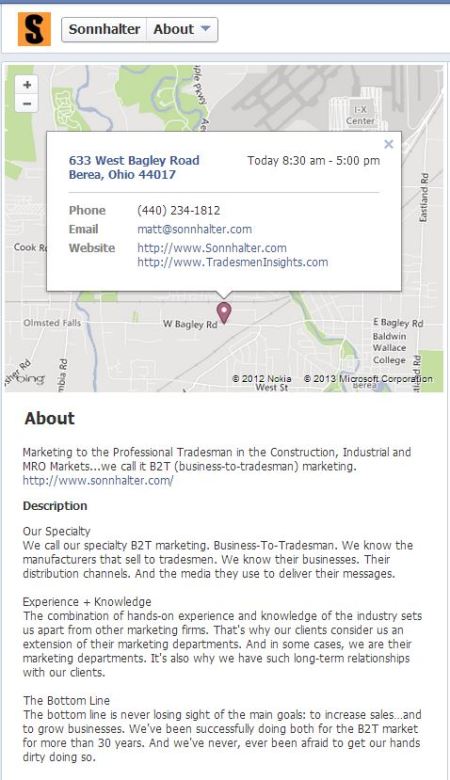
3. Is your profile complete? Fill out the boxes with information about your company. Make sure there isn’t a blank spot where an About section should be and make sure that you have links to your website and contact information on there. Here’s what the About Section on Sonnhalter’s Facebook Page looks like:
4. Don’t stand alone. If you only have one person in your company with the Facebook or LinkedIn admin rights or the passwords to your accounts, you’re in for some trouble. What happens if that person leaves your company, takes vacation or falls ill for an extended period of time? You may have one main point person on social media, but always have at least one other person in your organization with social access.
5. Approach the rest of the year with a plan. If you’re having trouble with content, consider setting up a schedule monthly, quarterly or annually with the general topics you want to address on your social media and recruit help if you need it.
You may also be getting overwhelmed on your personal social accounts because your connections are active. Here are just a few tips to save some personal sanity this spring:
- Take advantage of lists, circles, etc. to organize your connections into logical groups. That way you can easily check information from one group at a time (or find information you’re looking for).
- Change your email preferences so you don’t end the day with 50 Facebook email notifications or opt to receive daily or weekly digests from your LinkedIn groups.
- Use your readers. Put all of the blogs you read in one place to minimize jumping around from site to site. We’ve recommended a couple of options in a previous post.
by tradespeopleinsights | Apr 10, 2013 | Marketing Tips, Marketing Tools, Traditional Marketing
I don’t know why, but in some companies, sales and marketing hardly talk to each other, no less work together. Don’t they realize that they are on the same team? It’s a shame because by working together they can identify, qualify and close more sales. The answer is to open a two-way communication.
Marketing is (or should be) managing the conversations with potentials and helping move them through the sales funnel and then handing them off to sales for the close.
Ironically though, for marketing to move the prospect through, they need to address relevant issues and that’s where sales comes in. This will help build your credibility and hopefully shorten the selling cycle.
Sales are on the streets everyday talking to contractors and distributors. They know what’s keeping them up at night and can bring those issues back to you to develop content around. Sounds logical, doesn’t it?
I read an article by Mark Sherbin, Find Content Marketing Gold by Mining Your Sales Department that brought home some useful tips. Here are some highlights for marketing and sales to work together:
- Set up one-on-one and group meetings with sales
- Do your homework by reading CRM reports to see if there are valuable nuggets
- Send out an agenda prior to meeting so sales has time to think about responses
- Use “Go to meetings,” Google+ Hangouts or another service to get folks together
- Have regular meetings at least once a quarter
- Share content developed from the meetings with whole team
- Create files of new content that is accessible by sales
- Keep an open channel for communications
These are some good tips. What are you doing to ensure your sales and marketing teams are working together?



