by tradespeopleinsights | Nov 3, 2009 | Social Marketing, Traditional Marketing
Gee…who would you believe, the national news anchor or someone on one of your social networking sites?
According to the Harvard Business Review, “the American public assessment of the accuracy of the news media has reached a new low. 63% of American adults say news stories are often inaccurate, compared to 53% in 2007 and 34% in 1985. 70% say that the news media tries to cover up mistakes, and 27% describe the press as “not professional.” Right there is a pretty good reason no one is watching the nightly news. But come on, we do have options don’t we, or do we have to rely on someone pushing their agenda on us? How many times have you listened to the news and only got one side of the story?
According to The Sacred Heart University Polling Institute who released its 3rd survey on, Trust and satisfaction with the news media. Nearly two-fifths of all respondents, 38.1%, said they are reading newspapers less often than they did five years ago. And, nearly half, 45.0%, agreed that the internet is adequately covering for failing newspapers,
Now take social media. Do you think a national anchor would get away with some of the things they say on TV if they had to interact with the social media scene? Afraid not! They would have their head handed to them. Why, because social allows other people to have an opinion and they aren’t afraid to call you out if you’re wrong. Americans aren’t as dumb as the Networks think we are. People are relying more on social. Look at Twitter. You knew about the plane landing in the Hudson, along with photos, long before the mainstream media knew about it. If you really want to know what John Q Public is thinking, you need to get to the streets. Social literally has put “the man on the street” interview back in vogue. Only this time the man isn’t a staged prop.
75%-plus of us use the Internet when we’re looking to buy something and want to do research on it first. Yes, we might look at some manufacturers’ sites for features and benefits. What most people like is a site that has a place where people can leave comments and rate the product from a customer’s view. People trust other people’s experiences and views.
What are your thoughts?

by tradespeopleinsights | Oct 28, 2009 | Marketing Tips, Social Marketing
If you don’t measure it, you can’t improve it.
One of the main reasons folks should use social is, for the most part, easily trackable and you can see quickly your success/failure rates. I’m amazed when asking people who are using social tools how are they doing, they come back to me with some generalized statements like, “I’m doing really well.” If I press them for more details, I come to find out that they really don’t have a plan for measuring what they do and the time they spend at it. Metrics are an important component for the use of social media. Especially measuring for ROI in regards to the amount of time that must be invested. You would think this would be a no brainer. But according to a recent a survey by Mzinga and Babson Executive Education, a whopping 84% of professionals do not measure ROI for social media. It appears that hardly anyone is taking the time to measure the ROI for social.

Some additional insightful statistics from this survey:
- 86% of respondents to the survey of professionals from a variety of industries said they had adopted social technologies.
- 57% said they were using social media tools for marketing.
- More than four in 10 respondents did not even know whether the social tools they were using had ROI measurement capabilities.
- 3 in 10 reported using social media for customer service and support.
Click Here to download a copy of this report.
Here’s another post you might find interesting: How Do You Measure Social Media?
A great resource of social media articles and fresh reports comes from eMarketer. I found the original source of this survey through their eMarketer Daily Newsletter. I highly recommend it.

by tradespeopleinsights | Oct 27, 2009 | Marketing Tips, Social Marketing, Traditional Marketing
 This probably doesn’t come as a surprise to most, but most Industrial Marketing budgets have been cut this year. It’s also no surprise that Mar/Com departments are still charged with bringing in leads. But what I want to warn everyone about is, don’t be focused on just the number of leads (yeah, I’m assuming that they are ROI, qualified in some manner). You need to separate the suspects from the prospects from the shoppers. Shoppers are getting ready to buy, and these are the ones that need to be identified and passed on to the sales department. There is nothing wrong with the suspects or prospects, they just need to be nurtured along and up the customer development ladder. Matt Sonnhalter had an article in BtoB Magazine, pointing out that you need to make sure to look for the right decision maker.
Tough times make us focus more on ROI, but we should be doing that all along. I’ve listed several other articles that I thought might be of interest on this topic and I’d like to hear how you’re doing on your ROI.
Increase your sales revenue by 20% using existing inquiries
5 highlights from GlobalSpec marketing trends survey
Use social media to generate professional tradesmen leads
Industrial marketers focus on social media
Industrial community responds to online marketing
by tradespeopleinsights | Oct 21, 2009 | Marketing Trends, Social Marketing, Twitter
Social media as a whole continues to surpass growth estimates. eMarketer reported earlier this month that Twitter has over 18 million adults who access on at least a monthly basis. That’s a 200% increase over last year.

Universal McCann’s “Power to the people-social media tracker” also sees social networking continuing to increase. eMarketer estimates that 44.2% of all Internet users in the U.S. are social network users. Worldwide, 62.5% of active users ages 16-54 have a social networking profile in 2009. Worldwide, 62.5% of active Internet users ages 16-54 have a social network profile.
Users are looking to social networking sites that can consolidate multiple social media into one place. As noted above, despite consolidation, social media is not a one-stop shop. Universal McCann advises marketers to give consumers options when engaging them through social media. Allowing individuals to share and discuss on their platform of choice remains important.
by tradespeopleinsights | Oct 20, 2009 | Marketing Tools, Social Marketing
Another new tool that needs to be on your radar.
I don’t know if the world is ready for this, but it’s here and it’s from Google, so you know that there’s been a lot of thought behind it.
Google Sidewiki allows you to contribute helpful information next to any Web page or even critical information to a competitor’s Web site. Google Sidewiki appears as a browser sidebar, where you can read and write entries along the side of the page. Google uses an algorithm to display the most relevant and helpful posts up top.
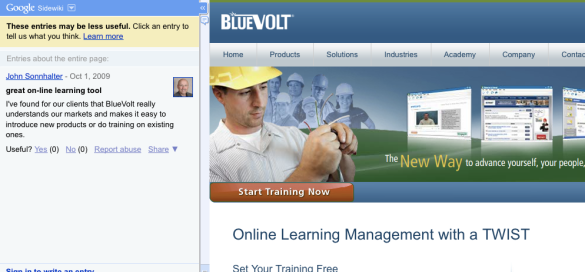
Click for detailed view
The key benefits:
- You can publish helpful information about any Web page from any browser
- Read insights in context from Sidewiki entries added by others
- Share Sidewiki entries through Blogger, Facebook, Twitter and Google profiles
Google could eventually put ads in the Sidewiki space – monetizing another company’s content.
As Jeremiah Owyang points out in a recent post, Google’s Sidewiki Shifts Power To Consumers – Away From Corporate Websites…
“There’s nothing stopping them from allowing advertisers to put ads on Sidewiki as “sponsored” information. For example, Coke could run their latest ads on the Pepsi.com Sidewiki area. HP could run ads on the Dell.com site. This ‘already’ happens in the search engine result pages on Google.com, why not in Sidewiki?”
I agree with Jason Falls‘ assessment of Sidewiki, “It will force every company in the world with a Web site to get hip to social media and do it now.”
If you’re ready to start exploring the Web with Google Sidewiki, visit google.com/sidewiki to download Google Toolbar with Sidewiki and contribute your own entries alongside pages on the Web.
So what are your thoughts on this new tool?
You might find this post by my mentor, Michael Gass, useful, How to keep up with social media.
by tradespeopleinsights | Oct 14, 2009 | Marketing Trends, Social Marketing, Twitter
The idea of marketers adopting social media by the boatloads is not a surprising statement. One of their biggest concerns has been will the consumer return the favor. Well some recent data shows that half of social networking users have became a fan or follower of a brand online. eMarketer recently published a report from Anderson Analytics that said, “52% of social network users had become a fan or follower of a company or brand, while 465 had said something good about the brand or company on a social networking site, double the percentage who had said something negative (23%).”

Another study from Penn State indicated that 20% of all tweets mention specific brand names or products. They studied over 500,ooo tweets and found both positive and negative comments about the brands or products.
Measuring social media success remains difficult for marketers. Many of the metrics that marketers can track on social networks today involve what is called “soft ROI”— which does not show up in the bottom line. But a study from the Altimeter Group and Wetpaint, along with a separate study from Razorfish, indicates that the stronger a brand’s social media presence, the better the brand performed—whether measured in conversations or in financial performance.
“Social networks are a constantly changing database of consumer sentiment, attitudes and information, and marketers today have only the earliest glimpse of the potential,” said Ms. Williamson, senior analyst at eMarketer. “Companies that want to maximize their presence on the social Web must take advantage of social networks in all stages of the purchase funnel, from awareness to learning to buying to loyalty.”
What does this mean to you and me? It means that you can’t just simply set up shop on social and sit back and wait for people to come. Users are seeking out their favorite brands whether it’s online or through other avenues and you must be there.
Maximize your social network marketing. Download the new eMarketer report, “Marketing on Social Networks: Branding, Buying and Beyond,” now.


