by tradespeopleinsights | May 24, 2016 | Marketing Tips, Marketing Tools
By John Sonnhalter, Rainmaker Journeyman, Sonnhalter
Building relationships with contractors is no different from building them with your friends. You build relationships with friends over time, but once they know, like and trust you, then they will do anything for you.
Building relationships with contractors is no different. It can’t be a one-way street when everything you talk about is trying to sell them something. You’d get a lot farther if you were looking out for their best interest and helping them solve problems or do things better so they can make more money.

A friend of mine once told me “contractors buy stories before they buy stuff.” Anyone who has spent time with contractors knows how true this is. Know what’s bothering them and keeping them up at night. So how are you going to find those things out? By talking with them and starting to build a relationship.
So if you’re a manufacturer looking to spend more meaningful time with contractors, I’ve written 8 tips on how to connect with contractors that you can get HERE.

The paper gives you tips on how to use relationship marketing and storytelling when dealing with contractors. You’ll also learn how to use training modules and mobile to stay connected and help them train their staffs.
by tradespeopleinsights | May 17, 2016 | Marketing Tools, Marketing Trends, Traditional Marketing
By John Sonnhalter, Rainmaker Journeyman, Sonnhalter
A recent study by email on acid reported that email marketing is going to remain a top priority for companies in 2016. Though we could have predicted this was the case, nearly three out of four companies (71.8 percent) say they are planning to spend more time on email production and more than four out of five (86.7 percent) report that they will increase email marketing budgets this year.
Here’s their interesting infographic.

To see the infographic clearly, please click here and download a copy.
by tradespeopleinsights | May 11, 2016 | Marketing Tools
By Sandy Bucher, Media Engineer, Sonnhalter
Many of our clients use the custom e-blast, or direct message tactic, to deliver their message to prospective customers. The definition of an e-blast (email blast) is a single sending of an electronic message to many people. The best type is the custom, targeted or direct e-blast sent to an opt-in list that you specify.
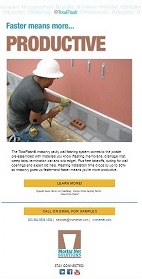
Here are some benefits of utilizing this type of marketing:
- The message is yours, and yours only; you’re not fighting for attention with other advertisers.
- You choose who will receive your message – selecting by job title, business or industry, geographic area, etc.
- The message can be varied; it can introduce a new product, or talk about several products, or announce a special offer.
- The message can direct the reader to a specific place like your website or specifically to a dedicated landing page on your website, where they can sign up for valuable content you could offer them, such as a white paper or an e-book.
- The contact information gathered from those interested parties could then be added to your database for follow-up action, building up your database.
- Using the opt-in email lists of specific trade publications is beneficial as opt-ins have agreed to receive marketing messages and promotions through email, and they will be more likely to read your message.
- Metrics – After your message is sent, the reporting will show you how many people opened and viewed the e-blast and how many people clicked on a particular link in your message.
- The cost is usually less expensive than sending out a printed direct mail piece, as you don’t have the cost of printing and postage to factor in.
So if you have a special offer or new product you want to tout, utilizing targeted, custom e-blasts with an opt-in email list is one way to accomplish your mission.
by tradespeopleinsights | May 10, 2016 | Marketing Tips, Marketing Tools, Marketing Trends, Social Marketing
By John Sonnhalter, Rainmaker Journeyman, Sonnhalter
We all want to be recognized as leaders in our respective fields and in today’s world the current mantra is to be that “Trusted Authority.” To be a recognized leader in your field is not an overnight sensation. It takes time and you need to deliver more than bells and whistles.
I recently read an article by Mark Buckshon from Construction Marketing Ideas where he discusses this very topic. He gave the example of Frank Lloyd Wright’s role in leading architecture to a new level in his day. He truly was considered a trusted authority, and if you wanted a second opinion, you’d just have to ask him. Not everyone agreed with him, but they respected him.

Frank Lloyd Wright’s Darwin D. Martin House, in Buffalo, NY. Courtesy of Dave Pape.
Time is one thing we have little of, yet it’s what it will take to position yourself and your company as the industry expert. Wisdom comes from experience and experience is gained over time. Lots of your credentialing will come from the school of hard knocks. But that’s OK. We should learn from our failures and missteps.
Learn to share your expertise and solve problems instead of trying to sell contractors stuff. With the advent of social media, we no longer control the message or where or when it will be delivered. You need to learn to share your experiences via story telling as opposed to a sales pitch. Show your expertise by telling contractors how you helped others solve a problem or gave them a better way of doing a job that resulted in them making more money.
To become a true authority you need to deliver results beyond the ordinary. If you do this, you’ll be able to grow your business through referrals and repeat business. Contractors are very loyal and they do talk among themselves, so let’s make sure what they are saying about your company is good.
It’s a never-ending battle. You need to keep being ahead of the curve and continue to wow contractors. Remember, everything you do at the contractor level should answer this one simple question, “What’s in it for me?”
by tradespeopleinsights | May 4, 2016 | Marketing Tools, Social Marketing
By John Sonnhalter, Rainmaker Journeyman, Sonnhalter

We all want to get our message in front of contractors. In order to get more out of your content, you need to tie it to your strategy.
We need to help them with solutions to their problems, a better technique or tool for the job. A different process that will save time and money. Online training for their workers.
We’re all concerned on getting the message out that we sometimes miss other opportunities to use the same content (message) and deliver it differently.
I read a post by John Jantsch, 10 Ways to Use One Piece of Content, that brings this into perspective. Contractors get their info in several formats. Have you tried any other ways of delivering your message?
Here are some highlights from John’s post:
- Turn your post into a series of videos that the sales folks can send out on an individual basis.
- Do a webinar and feature it on your website.
- Use a SlideShare deck that you can use both on SlideShare as well as on your LinkedIn profile.
- Develop an infographic and send it out in an e-blast.
- Testimonials. Get contractors who are already happy customers to give you testimonials, either written or on video.
John’s point is that it’s not the amount of content, but its intention.
What are you doing to maximize your content?
by tradespeopleinsights | May 3, 2016 | Marketing Tips, Marketing Tools, Marketing Trends, Traditional Marketing
By John Sonnhalter, Rainmaker Journeyman, Sonnhalter
We’ve had conversations here before about independent industrial distributors missing sales opportunities by not keeping up with the latest technology available.
I see that Industrial Distribution magazine is doing a webinar on this very subject on May 18th; you may want to sign up for it or suggest some of your independent distributors who are still lagging behind get in the game. Jon Eames from NH Bragg and Jack Templin from Affiliated Distributors will be contributors. Here’s what they will be covering:
Industrial customers are asking suppliers of all sizes to offer a highly functional e-commerce-enabled website. So how do smaller, independent distributorships take the first steps:
- Review ways independents can get in the game of e-commerce without breaking the bank.
- Hold true to their business objectives while developing an e-commerce strategy.
According to Forrester Consulting, a 2014 study shows that 52% of business buyers expect at least 50% of their purchases to be made online in 3 years’ time. This should be an eye opener for distribution, but some are ignoring the facts. The big boys like Grainger (40% of their sales are from the internet) and MSC Industrial (over 50% of their sales come from online) are certainly taking advantage. Shouldn’t that set the tone for the independents? Forrester forecasts that B-to-B e-commerce will exceed $1.1 trillion and comprise 12% of all B-to-B sales by 2020.
I’ve said in the past that for smaller industrial distributors to survive, they need to use the internet. They can’t count on the business model of contractors coming in at 7 in the morning or around lunch time to pick up what they need. Time is money, especially for them.
Industrial Distribution magazine recently released some research on The state of B2B e-commerce in Industrial Distribution. Here are some highlights:
- Independent distributors are slow-moving in implementing e-commerce programs.
- Technical challenges are making sites user-friendly, making it aesthetically appealing and staying ahead of the competition.
- Primary reasons of not engaging online was lack of demand, technical obstacles and lack of marketing/promotional resources.
Customer satisfaction and the customer experience are the key factors in developing an online presence. Ironically, that’s how the independent distributor built their business in the first place. Now they just need to transfer that to a different platform not only to keep existing business, but to grow additional revenue.

Source: Industrial Distribution
My worse fear is that the Amazons and the Alibabas of the world are going to make the independent extinct in a few years. I understand that the AD buying group has just instituted a new program to help members deal with some of these issues. It’s too early to tell if it’s making an impact, but at least they recognize the issue and are trying to help.
If you like this post, you may want to read:
What’s the future of small independent industrial distributors?
Are independent industrial distributors helping Amazon to succeed?
Distributor Strategy: What’s yours?


