Common Industrial Marketing Challenges
by Emma Jones, guest blogger
From populating email lists to leveraging automation, discover the most common industrial marketing challenges and how to overcome them.
As the pandemic slowly recedes and the marketing world takes a breath of relief, the manufacturing industry remains cautious. Perhaps rightly so; B2B salespeople have not been performing according to expectations, all things considered. In fact, just two days before this article was written, Deloitte released its 2022 manufacturing industry outlook corroborating this. It outlined surprising growth but found “optimism around revenue growth is held in check by caution from ongoing risks.” For this reason, risk mitigation and “business agility” will substantially inform the industry’s future, one could safely argue. So, to help you do so, let us explore the most common industrial marketing challenges that may lie ahead.
#1 Populating email lists
Starting with the lead generation phase, email lists remain notoriously hard to populate. It’s increasingly hard to populate them with meaningful, engaged leads. There are ample reasons for this, including diminishing audience trust, fragmented customer journeys, outdated business websites, etc. Simultaneously, the gradual eclipse of third-party cookies weighs on marketers of all industries, hampering audience data acquisition further.
The manufacturing industry is no exception to this, and in many ways, it may have it worse. As some manufacturers remain resistant to digitization and the Industry 4.0 movement calls for its own attention from those who embrace it, the lead acquisition may suffer in turn.
Solutions
As a mainstay among industrial marketing challenges, there are a few different measures against this issue. Here, let us outline the three most substantive ones for text economy:
- Avoid purchased lists at all costs. Such lists rarely perform or pay off at all, as your email recipients have not opted into them. In addition, using such lists carries serious risks with email carriers and may even come with legal ramifications.
- Engage in Landing Page Optimization (LPO). Instead, you may polish your landing pages via LPO to craft enticing signup forms. For B2B specifically, you may frame them with phase-appropriate offerings like case studies and industry reports to encourage signups.
- Constantly cleanse your lists. As you do, remember to discard leads that needlessly bloat your email lists. You should, of course, follow up with valuable leads manifold beforehand, but cleansing your lists will ensure they perform better.
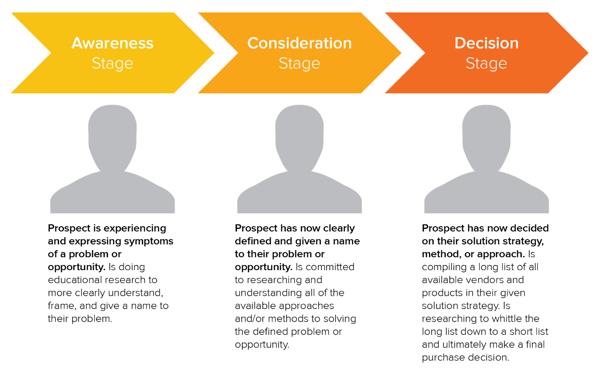
For a visual example of phase-appropriate offerings, we may cite the following graph by HubSpot:

Alt. tag: An illustration of the three customer journey stages by HubSpot.
#2 Taking up SEO
Similarly, still in the early lead generation phase but also beyond it, come industrial marketing challenges with adopting Search Engine Optimization (SEO). This set of practices allows your website and content to be visible in search engines by adhering to Google’s criteria. Needless to say, any marketer of any industry can reap tremendous benefits from higher Search Engine Results Pages (SERPs) rankings. Time and time again, research has shown that the top results get the vast majority of all clicks, and the same applies to its now-prominent local SEO subset. Ensuring such visibility can help your brand grow by raising brand awareness more effectively and expanding your reach.
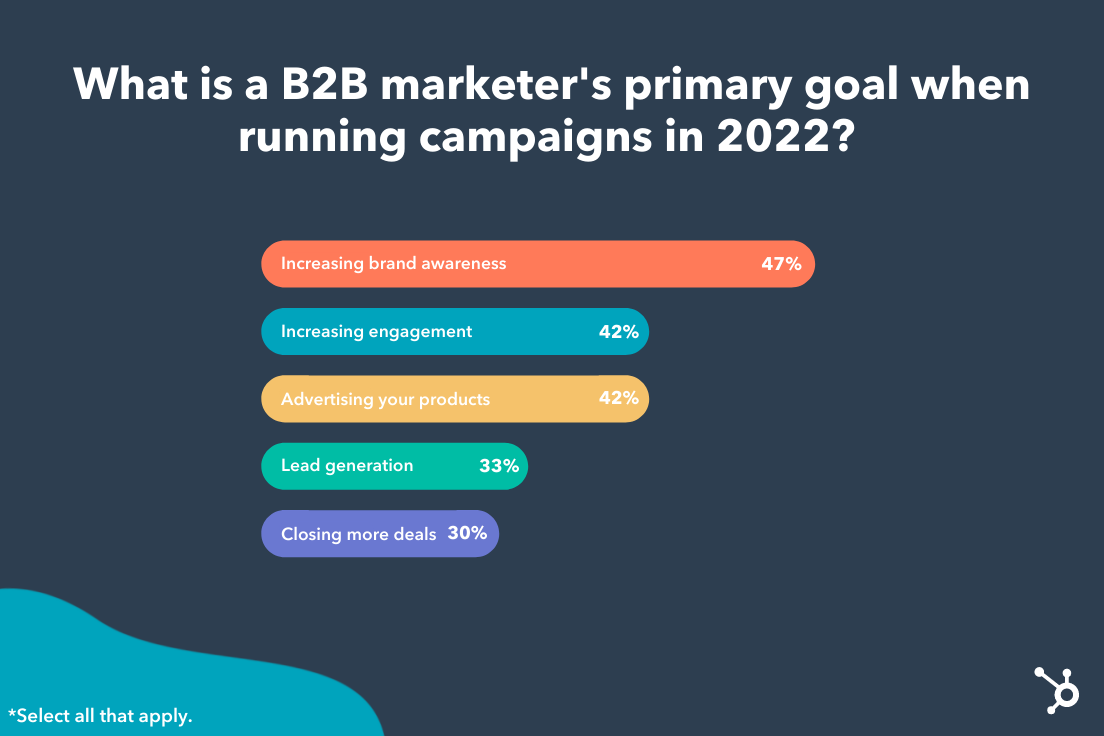
What’s more, contrary to the belief of some, SEO is far from a B2C mainstay alone. To cite HubSpot again, consider the following findings on B2B campaign goals:

Alt. tag: A graph on B2B marketers’ primary campaign goals by HubSpot.
Source: https://blog.hubspot.com/hs-fs/hubfs/what%20is%20a%20b2b%20marketers%20primary%20goal%20in%202022.png?width=1104&name=what%20is%20a%20b2b%20marketers%20primary%20goal%20in%202022.png
Not only is brand awareness the primary goal, but engagement, advertising, and lead generation all benefit from SEO as well. And yet, the manufacturing industry struggles to embrace SEO long-term. Some find its 200+ ranking factors too expansive, and others quit soon after seeing poor short-term results. Finally, some understandably lack the resources for it and choose to engage minimally, if at all.
Solutions
Such industrial marketing challenges are not easy to overcome, unfortunately. They often stem from deep-seated resistance to SEO, a lack of resources, and other understandable circumstances. Still, as initial steps, you may consider the following:
- Prioritize SEO subtypes. First, you may examine which SEO subtypes make the most sense for you, among on-page, off-page, technical, and local SEO. They all serve their purposes, and ideally, you should neglect none of them – but some prioritization may help ease the strain on your budget.
- Prioritize ranking factors. Similarly, Google’s 200+ ranking factors do not welcome SEO newcomers much. Again, you may best neglect none of them, especially not core ones like website speed and content optimizations. Still, starting with small and calculated steps may offer an easier route and a smoother learning curve.
- Adjust your expectations. Finally, SEO is a long-term commitment and a continuous process, and this should be clear throughout your company. Expecting quick results will only set you up for disappointment and possibly sway you from it.
#3 Modernizing websites and content marketing
Next, approaching the lead acquisition and conversion phases, we may explore deeper industrial marketing challenges that overlap with SEO. Namely, website and content modernizations that digital marketing mandates. The two primary challenges with both are resistance to change and resource allocation. Some manufacturing businesses may believe their B2B focus does not warrant website optimizations and instead rely on marketing outreach alone. Established ones may also find content marketing changes unappealing when their current approach has seemingly performed well enough so far.
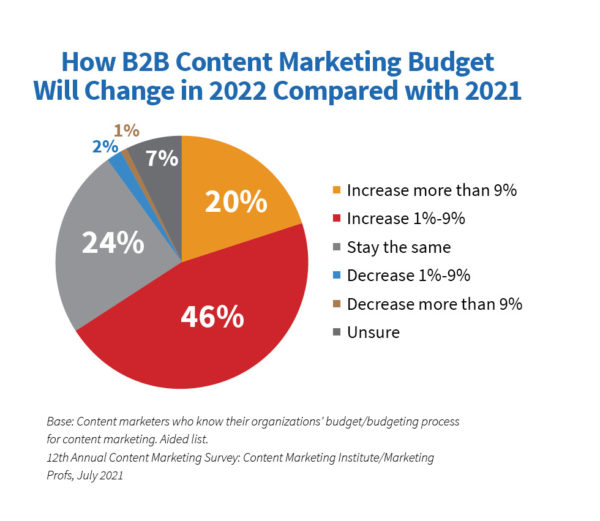
Thankfully, both are slowly diminishing. The industry has largely heeded Google’s warnings on bounce rates, and Content Marketing Institute finds B2B content marketing taking priority:

Alt. tag: A pie chart on B2B content marketing budget changes in 2022 by Content Marketing Institute.
Solutions
Still, the problem lies less in embracing change and more in how one can best implement change. Here, we may suggest the following fundamentals:
- Polish your website for first impressions. Loading speeds are crucial, but only one component of your leads’ first impression. Remember to polish your web design to denote professionalism, offer valid Name, Address, and Phone number (NAP) information, feature your mission statement and accreditations prominently, etc.
- Address the entire customer journey through content marketing. Remember that your content should frame the whole customer journey, from awareness to conversion. Craft logical, hierarchical journeys through website structure and internal links and cater to each stage with informative, valuable content.
- Always remember B2B’s focus on decision-makers. On that note, always remember you are targeting cautious decision-makers; B2C’s emotional responses won’t suffice for them. Frame your offerings with as much value as possible, and don’t shy away from moderate jargon to establish authoritativeness.
#4 Expanding marketing channels
Of course, after content marketing, we may delve into industrial marketing challenges that relate to marketing channels themselves. In this regard, too, digital marketers across all industries are slowly embracing the need for multichannel and omnichannel marketing. What many perceived as a primarily B2C-focused philosophy is now finding its way to B2B marketing, as the latter confidently expands to social media. Of course, B2B and B2C favor starkly different platforms, as research finds:

Alt. tag: A graph on popular social media channels among B2B marketers.
Thus, with marketing prioritization in mind, the manufacturing industry and B2B, on the whole, are turning to LinkedIn. With continuously flattering statistics substantiating its popularity, it’s arguably the most valuable marketing channel to begin expanding to in 2022.
Solutions
Here, the primary challenge lies more in leveraging LinkedIn effectively to secure a good Return on Investment (ROI). Here we may cover the fundamentals:
- Carefully define your goals. As with all new marketing channels, you should begin with a robust outline of your S.M.A.R.T. goals. Determine your campaign’s purpose, metrics to monitor performance, and strict time frames.
- Polish your company page and Showcase pages. Similarly, you may polish your company page just as you would your business website. It will inform your leads’ first impression, so it should immediately denote professionalism and inspire trust. You may also dedicate Showcase pages to specific products or services for more focused campaigns.
- Leverage sponsored content. Finally, LinkedIn’s sponsored ads, and InMail can serve to further augment your campaigns, just like how paid marketing can enhance your organic marketing efforts.
To further explore these industrial marketing challenges, you may also consult our article on LinkedIn best practices.
#5 Managing and monitoring marketing campaigns
Finally, the core challenge with such extensions comes in plain management and monitoring. The average B2B business of any industry will have to manage each qualified lead carefully. Doing so across multiple channels while managing SEO and monitoring paid ad campaigns can naturally overwhelm even seasoned marketers. Of course, this kind of expansion can also stretch budgets, resources, and teams too thin in the process.
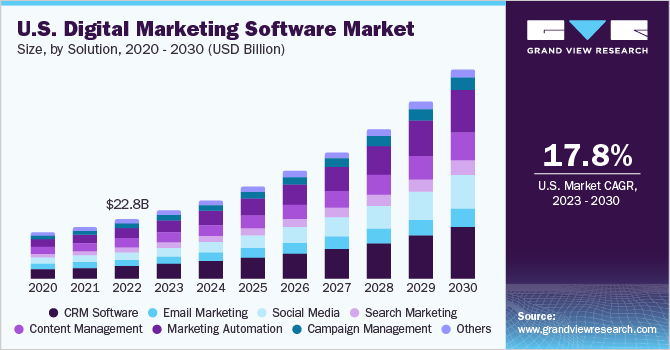
In this regard, the simple solution lies in marketing automation. The manufacturing industry continues to embrace it, thankfully, and this massive software industry continues to expand uninhibited – as GrandViewResearch finds:

Alt. tag: A graph on the expansion of the digital marketing software market in the US by GrandViewResearch.
Source: https://www.grandviewresearch.com/static/img/research/us-digital-marketing-software-market.png
And yet, there lies the primary challenge, too; only 1 in 5 marketers use such tools to their full potential. So the issue does not lie in finding solutions to manage and monitor campaigns but in using them effectively.
Solutions
To address this, one needs to address the exact shortcomings that inhibit automation adoption. To cover the three main ones from our aforelinked article, here we may touch on:
- The most fundamental challenge in adopting automation software of any kind comes in poor training and insufficient educational material. Customer Relationship Management (CRM) software notably suffers from this, as Nomalys’s aggregated research finds. Thus, remember to very carefully scrutinize your candidates as regards training courses and material, and keep an attentive eye on your onboarding process and continuous training alike.
- Management resources. Similarly crucial among industrial marketing challenges is a lack of management resources. This typically manifests in poor integration options and ongoing management support from software vendors. You may best address this proactively by carefully examining what your software candidates offer.
- Finally, strained budgets can also make automation software hard to maintain. Proactivity offers the best option here, too; conduct careful market research in advance, and don’t rule out downscaling. You may often find yourself paying for more features than you need, so opting for more compact, affordable solutions may let your budget breathe.
Conclusion
Industrial marketing challenges include both traditional mainstays and emerging ones as digitization advances. They span across all phases of the customer journey and often include internal resistance to change, budget constraints, and difficulties in adapting to new solutions and strategies. While only cursory, this article hopefully helped you pinpoint them early and adjust proactively, ensuring continued growth in 2022 despite the looming risks ahead.