by tradespeopleinsights | Nov 25, 2009 | Marketing Tools, Social Marketing
 Webinars are a good way to mix up the way you deliver your message to tradesmen. They allow you to set yourself apart as an expert, gives you visibility, credibility and immediate feedback on your topic. They take a lot of work, but if done right will reap you benefits for a long time. You can also repurpose them as webcasts and put them on your web site so the contractors can view them at their leisure. Here are some tips on how to make sure your Webinar is successful:
- Pick a timely subject – You want to not only be topical but timely with what you pick as a topic. Remember, one of your objectives is to be a thought leader.
- Make sure you address “what’s in it for them.” How will your new tool or process help them do their job better.
- Promote it both pre- and post-event – Make the most out of it by using Facebook, LinkedIn, Twitter and any groups you belong to, to generate interest and sign ups. Promote it to your customer and potential lists, as well as through any trade organization or association. After the event, convert it to a Webcast and put it on your web site.
- Keep it to no more than an hour. My rule of thumb is keep your presentation to ideally 30 minutes, but no more than 40, and leave the rest of the time for questions. Also, when appropriate, add some humor. Tell a joke or show a cartoon to help illustrate your point.
- Don’t try to put 10 lbs. into a 5 lb. bag – If you have that much info, break it up into 2 Webinars. Remember, people can only retain so much info, so make your point and then deliver on it.
- Keep audience engaged by taking little surveys throughout the presentation. This not only gives them a reason to stay engaged, it gives you a moment to get ready for the next point.
- Practice, Practice, Practice – This might be the most important point of all. Remember, you’re trying to come off as the “expert” and you don’t want to stumble through the presentation. Prepare and give it to some co-workers or friends and listen to their critiques. You need to be upbeat and engaging in order to keep the audience from clicking off.
Webinars are not hard to do, but they do take time. Don’t be intimidated. You can do a simple Power Point presentation. Remember, content is the important factor here, not some slick graphics or flash presentation.

by tradespeopleinsights | Nov 17, 2009 | Marketing Tools, Social Marketing, Twitter
 Some B-to-B marketers are having a hard time including Twitter in the marketing mix. You need to think of it as a relationship-building tool. Twitter should never be used as a stand-alone tactic. It should be used in conjunction with other social media as well as traditional tools like e-mail. Jon VanZile wrote an interesting post, Is B-to-B Ready For Twitter? that you might find interesting.
One of the concerns of B-to-B marketers is that “none of my customers or potentials are on Twitter.” While that may be true now, they will be soon. And how do you know unless you ask them? This week Twitter passed the 5 billion tweet mark. Somebody is using it! According to a study released this summer by Nielsen Co., Twitter growth has been phenomenal especially toward adults. According to Nielsen, Twitter reaches 11% of all Internet users. 80% of people who Tweet are over 25.
While you’re waiting for your customers to get in the game, Twitter still offers you some great free analytic tools you should be using to keep track of competitors as well as find conversations related to a post or article. Here are 5 good ones to start:
- Twitterstats Hour-by-hour and for any 24-hour period, track up to three keywords (think competitors) w/g/t click volume. Useful if, for example, there’s news being dropped during the same time period and/or an event/tradeshow and you want to compare message volume/activity around keywords or companies.
- Tweeps.info Nifty free tool that lets you track on individual Twitter accounts (think YOUR competitors). Inside look at #tweets per day, current and prominent keywords, to what degree the account is using hashtags, following snapshot. Also has a keyword search which is useful if you’re looking to build your follow list around a particular topic.
- BackTweets A real-time, conversational-tracking tool which allows for keyword and/or URL searches to find conversations related to a post or article; connects: WordPress, Blogger, TypePad, Twitter and Friendfeed. Useful for community buzz centralized listening, brand monitoring. An “alert” function.
- Twitteranalyzer Google Analytics for Twitter users. More than 50 statistical measures displayed with graphics and maps. Among the views: Reach, Subject Matter, Follower Growth, Follower Density Map, Follower Activity, Sharing Capability. Primarily a tool for Twitter users to analyze themselves or their friends.
- TwitterFriends A “reach/extended-reach” tracking tool that helps you discover information about the network behind your follower/their follower lists. Identifies meaningful users you should be talking to, or who are feeding you useful links. Capability to account search/compare (think comparing your company to your competitors, or thought leader accounts, etc.)

by tradespeopleinsights | Nov 11, 2009 | Marketing Tools, Traditional Marketing
Training Tradesmen – do you use a carrot or a stick?
This is the second part of a two-part series (Part 1) by Lisa Bordeaux from BlueVolt, an online marketing and learning platform that focuses on the professional tradesman.
Whether you are using the carrot or the stick to drive training participation, providing contractors resources for their folks to take advantage of can be a very real benefit to the tradesman in the field.
From a contractor’s perspective, having a manufacturer that’s committed to training is an obvious win. These guys are in the field and it’s a real challenge to corral folks into the office for formalized training. At the same time, the guys in the field need training to stay safe on the job, learn about new products, maintain their licensure or certification.
One of the reasons we started in the business was because we recognized there was a need for people in the field to have better access to information. When you sit at a desk, it’s different then when you work in the field. So early on – we thought it would be best to provide bite size information to folks that they could take on the fly.
Training with the Carrot –
The idea of incentivized training is not new. Tying a carrot to something that you want to deliver to the market is a very effective way to build an audience of learners who are open to the information. In fact, when we launch courses that have incentives, we see a 10X greater usage pattern then courses that don’t have incentives. If the information is not all product based and serves some more general purpose, manufacturers may actually charge for their courses and then offset the charge with a reward of equal or greater value.
Training with the Stick –
Individuals in the trade in many cases are training as a requirement of their job. This may be something like forklift safety which is regularly required or code related if the state requires code updates for license renewal. In this case, we see different usage trends – the majority of the training gets taken just at the point of need. So for instance, when we started our code change course in 2002, in Oregon there were 26,000 licensed electrical workers that were required to take 8 CEUs of code update. The deadline was October 1, and as of July 15, 17,000 of the license holders had yet to complete their code training. http://go.bluevolt.com/CoBrandTemplate/CourseCatalog.aspx?CategoryID=884
This becomes a real problem and the companies offering the code training in-person are flooded with calls they can’t satisfy. Online training really makes sense. The timeline creates a sense of urgency which can be a great driver of participation.
by tradespeopleinsights | Nov 10, 2009 | Marketing Tools, Traditional Marketing
Training – both product training and safety training – are important to professional tradesmen. That’s why several years ago we formed a strategic alliance with BlueVolt to help educate and inform our client’s customers (the professional tradesman). BlueVolt creates online marketing and learning platforms that are focused on the professional tradesmen. They have delivered over 535,000 courses to 50,000-plus registered users. We have the privilege of having Lisa Bordeaux, director of sales and partner development, here to share with you a two-part series on the benefits of online training. Enjoy her insights!
The most successful companies are the ones that not only offer training to individuals but they support them with online tools and resources, a community. In many cases, suppliers may or may not tie this to their website, they may work with associations or we may collaborate to syndicate their content. If done right, training can make it easier to engage with customers and develop a relationship that supports and fosters sales for years to come.
Training can be a great way to go to market. It’s a softer sell than advertising and it provides value to the customer while building brand affinity. BlueVolt works with a number of manufacturers, some have a strong history of training. In fact, one of them is so committed to training, they have one person in the marketing department, 7 people in the training department. Training is done both online and in-person and their training staff is teamed with sales people by territories. This fosters a tight relationship between sales opportunities and education.
Over the years I have come to think that in many cases, training is a Trojan horse for Marketing. I have seen this done to great effect in a number of cases. Here are three examples of efforts we have supported:
- Using education to generate sales. We have a number of examples in this case. Many manufacturers have fairly complex products either to operate or install. Providing training on a specific product can ensure that people prefer it over other products. We find offering training can provide a market of excited advocates and experts, doing it online provides an easy way to communicate and follow up with folks. The individual may pay for this training and the supplier most typically gives either a product or incentive to the individual to offset the cost of the training. http://www.bluevolt.com/case-studies/wright-tools
- Just in time training on new products. This is a big one for taking training online and we do it daily. When done right we significantly shorten the return on development for a new product. By delivering information to people online about new products either live, archived or even a simple PDF cut sheet that individuals many manufacturers leverage provide training just in time. This training is most often incentivized. That is, the individual receives some sort of reward for proving their knowledge. http://www.bluevolt.com/case-studies/uei
Building a market through education – this is an expensive proposition, but can be very effective. We undertook this with a large switch manufacturer who built a course to train home integrators so they could network devices in residential. They didn’t make any products in the space, but believed they would sell more switches and routers, if there were more integrated homes needing bandwidth. Through a series of partnerships, we built a community of training centers and hosted and tracked all the training online. This is typically a scenario where the individual would pay to participate in the training. As a manufacturer, you really need a long view and high level of commitment to improve the industry.
Next, you’ll learn which has more impact, a carrot or a stick?
by tradespeopleinsights | Oct 20, 2009 | Marketing Tools, Social Marketing
Another new tool that needs to be on your radar.
I don’t know if the world is ready for this, but it’s here and it’s from Google, so you know that there’s been a lot of thought behind it.
Google Sidewiki allows you to contribute helpful information next to any Web page or even critical information to a competitor’s Web site. Google Sidewiki appears as a browser sidebar, where you can read and write entries along the side of the page. Google uses an algorithm to display the most relevant and helpful posts up top.
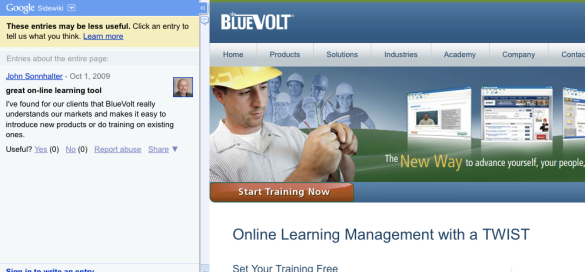
Click for detailed view
The key benefits:
- You can publish helpful information about any Web page from any browser
- Read insights in context from Sidewiki entries added by others
- Share Sidewiki entries through Blogger, Facebook, Twitter and Google profiles
Google could eventually put ads in the Sidewiki space – monetizing another company’s content.
As Jeremiah Owyang points out in a recent post, Google’s Sidewiki Shifts Power To Consumers – Away From Corporate Websites…
“There’s nothing stopping them from allowing advertisers to put ads on Sidewiki as “sponsored” information. For example, Coke could run their latest ads on the Pepsi.com Sidewiki area. HP could run ads on the Dell.com site. This ‘already’ happens in the search engine result pages on Google.com, why not in Sidewiki?”
I agree with Jason Falls‘ assessment of Sidewiki, “It will force every company in the world with a Web site to get hip to social media and do it now.”
If you’re ready to start exploring the Web with Google Sidewiki, visit google.com/sidewiki to download Google Toolbar with Sidewiki and contribute your own entries alongside pages on the Web.
So what are your thoughts on this new tool?
You might find this post by my mentor, Michael Gass, useful, How to keep up with social media.
by tradespeopleinsights | Oct 6, 2009 | Marketing Tips, Marketing Tools, Social Marketing, Traditional Marketing
Sales leads and what to do with them has been an age old problem. Today though, there are programs and processes available to help you monitor and mine those precious sales leads. I’ve been associated with Russ Hill from Ultimate Leads for over 20 years. He “gets” the closing the loop issue and I’m glad to share with you some of his thoughts.
According to the CMO Council/BPM Forum survey in Marketing Today, corporate officers who were polled in an online survey believe revenues at their companies could increase by more than 20 percent by improving their prospect cultivation and management techniques. Marketing and C-Level executives are dissatisfied with the way they generate new business, yet more than half lack formal process to correct the problem.
And my guess is that they are not alone. According to the Advertising Research Foundation, 67 percent of industrial product inquiries are from real prospects with real needs, yet 72 percent NEVER hear from a sales person.
Clearly these executives are onto something. Does this sound like your sales team?
Haley Marketing Group cites recent studies indicating that more than 50 percent of sales people stop working a prospect after the first call. The percentage grows to 65 percent after the second call and 80 percent after the third call.
A whopping 90 percent of sales people call it quits by the fourth call. Here is the troubling part – some 70 percent of prospects won’t make a decision until after the fifth call. Are these sales slipping through your fingers too?
To some degree these numbers are easy to understand. Most sales people are like gunfighters interested in the “quick kill.” The study suggests that while companies may be good at generating large volumes of business leads, most opportunities languish because sales people all too often focus on only closing the most promising and qualified short-term opportunities.
Marketing and C-level executives are dissatisfied with the way they generate new business, but still more than half lack a formal process to correct the matter.
Sales and Marketing teams often point fingers at each other as companies struggle with reaching their sales goals. Sale people complain about receiving too many or too few unqualified leads and marketing complains about poor follow-up, lack of feedback, and wasted dollars. In our 25-years-plus years of experience in sales lead management and CRM services, this lack of synergy can usually be traced back to three specific things:
1) A lack of training about each function’s role and challenges
2) Utilizing agreed upon methodology for generating, qualifying and following up on leads
3) Getting everyone to keep their “eye on the prize.”
If Marketing’s job is to identify target markets, communicate the “right” company message and generate viable sales opportunities, then it is Sales’ job to cultivate and sell those opportunities. Who qualifies a lead and when should it be handed off to sales is an important question. Sales and marketing need be in agreement to be successful. Failing to address this important issue can trap management in something I call “the Transition Zone.”

When marketing and sales management work together to establish mutually agreed upon processes and goals, then train their teams to continuously work to both improve practices and to work together, good things can happen – more business can be captured from existing opportunities, ROI improves…and that is good for everyone.
So, the next time you are considering where to look for new business, take a fresh look at your existing prospects and sales leads. Improving your opportunity management practices may be your first and best means of growing your business.

