by tradespeopleinsights | Apr 1, 2010 | Marketing Tools, Social Marketing
Guest post from Aylie Fifer, a Relationship Architect at Sonnhalter.
 There is a revolution starting in the world of mobile marketing and it isn’t just for B2C – it is for everyone, including B2B. According to a recent article in Mobile Marketer, B-to-B mobile marketing will go from 26 million in 2009 to 106 million in 2014 according to Forrester Research.
Every now and again a technology comes along that is a total game changer for humanity and shifts the paradigm of the world we live in. Harnessing electricity. The Assembly line. The Internet. The iPhone. With the recent influx of smart phones and smart phone technology, we are seeing a whole new world – the world of mobile marketing.
Two-thirds of the world’s population has a mobile phone subscription—4 billion people—and by the end of 2010 there will be 5 billion wireless subscribers worldwide, according to some estimates. And a majority of these phones are now moving to the smart phone platform. From the Apple iPhone to the Motorola Droid to Blackberrys…the trend for mobile is to go to a smart phone or lose market share.
As a result of this new use by consumers, no longer are we capturing people in context – the trade magazine, the TV show – not to say that these mediums are dead, but we now are faced with thinking differently. With smart phone usage on the rise, people check it at different parts of their day – not just at work or at home – but several different parts of their day. This has shifted the traditional approach to marketing as now we are faced with catching people’s attention throughout the day.
I would argue that advertising to your target and catching them at a time of day when they might not being thinking about work makes the message resonate even stronger because it IS out of context. For instance, if a carpenter goes out over the weekend and sees an ad through his phone about a certain type of tool, this stands out to him because it is unexpected – he is out socially and may not be in “work mode.”
People have become more immune to advertising, so one way to catch their attention – and make your brand stand out in their minds – is to catch them when they AREN’T thinking about work, and to do it in an entertaining way.
Mobile advertising has furthered this push and while I am a firm believer in a good segmentation strategy, it is also true that everyone is a consumer. When people hang up their clothes at the end of a hard day, they turn off their work mode and begin the “home” mode. Thus, I would argue that you can’t just segment into demographics or ethnographics, you now need an added dimension – what I call parallel-ographics.
You live your life in parallels – you may talk to your husband (or your wife) during the day and realize that you need to pick up diapers so you pick up your smart phone and you search for a coupon. In your work day, you are a plant manager, but through the use of mobile, you just dipped into your parallel life – that of mother and wife. And while you are at the store after work hours picking up those diapers, you get an email from work and you are instantly transferred into your parallel life – that of plant manager. Your context shifts constantly and instead of having separate times for work and home, this use of mobile and smart phones has made us increasingly blur that line and we run our work and home lives as parallels instead of separate.
As a salesperson for a B2B company, you may be able to show a product demo from your phone when you are out socializing and happen to meet a potential customer. The lines between social and work life have become even more blurred with the onset of mobile. Think of mobile as your portal to the Internet and the beyond – where you might have in the past only done on a laptop computer, you can now access – at any time – on a smart phone.
The onset of mobile marketing means that you never fully turn off your roles throughout your day, which changes the way a marketer catches you and keeps your interest. And as a marketer, to attack this new paradigm of living, you have to approach it from a parallel-ographic standpoint – knowing that the message needs to appear in multiple places, at multiple times and that yes, everyone is a consumer.
What are your thoughts on mobile marketing? Do you think it will be the next big thing?

by tradespeopleinsights | Mar 10, 2010 | Marketing Tips, Marketing Tools, Social Marketing
Manufacturers are missing the boat if they are not incorporating videos into their Web sites. According to Forrester Research, videos properly submitted are 53 times more likely to generate first page Google rankings. You heard me right, 53 times more likely. Other advantages are that results appear in days because Google is pushing video to the top. This is a great opportunity for B-to-B marketers.
Benjamin Wayne in a recent post, Search Engine Success: Getting Video SEO Right, outlines what needs to be done in order to get that first page placement. The key is submitting videos and pages in parallel and successfully indexing for each individual search engine.
Search engines can’t find video content on their own, so you need to get your submissions right in order to capitalize on this. Because the video search engine is complex, Benjamin offers these questions to your video platform provider:
- Will you index both the permalink pages as well as the videos?
- Will the links point back to my site?
- How often will feeds be updated?
- In which search engines will the results appear?
- How do I track click-throughs?
If you do this right, you can get great results in a relatively short period of time. If you’re going to do it, you may as well do it right.
by tradespeopleinsights | Mar 4, 2010 | Marketing Tips, Marketing Tools, Traditional Marketing
We’re all focused on generating more leads these days, but I find it ironic that most companies don’t do much with them once they get them. Simply fulfilling a request is not the answer, but yet many companies do just that. According to a recent survey of people who have requested info suggests that 80% of all sales are made on or after the third contact. The survey conducted by Marketing Best Practices, Inc. polled over 700 respondents with only 8% buying after the first call.
David Frey, the senior content editor of www.MarketingBestPractices.com and author of several marketing books advises, “An educated prospect is your best prospect, and if they haven’t become a customer it’s because you haven’t fully educated them on value of your product and developed a relationship of trust.”
Why do many businesses have a problem following up with their prospective customers? Mr. Frey explained, “The problem is not that small businesses don’t have the capacity to follow up with prospects, it’s that they don’t have the systems in place to do it well.” In his recent newsletter, “Follow-Up Marketing: How To Win More Sales With Less Effort,” Mr. Frey advised, “A good follow-up marketing system should have three attributes:
1. It should be systematic.
2. It should generate consistent, predictable results.
3. It should require minimal physical interaction to make it run.
This leads to a more pressing issue and that is, what is the difference between sales lead management and a CRM tool? According to Russ Hill, President of Ultimate Lead Systems:
Sales lead management is a sub-function within an overall CRM strategy. Traditional CRM programs like Salesforce.com, SalesLogix, ACT, Goldmine, Maximizer and others focus on the sales person entering and managing his own data and pushing it “up” to management.
Sales lead management starts with management generating and capturing leads from all sources, fulfilling information requests and delivering them to the sales channel and tracking follow-up and sales results to measure marketing return-on-investment.
Here are some other interesting facts:
INQUIRIES MEAN NEW BUSINESS!
67% of all inquiries are from legitimate prospects with real needs.
34% have current needs that must be satisfied within 6 months!
70% did not know the company made the product before seeing their ad
. . . making them NEW PROSPECTS!
A six year study* of nearly 60,000 inquiries conducted by Penton Media Company also found that:
43% of inquirers receive literature and information too late to be of use.
72% of inquirers are NEVER CONTACTED by a salesman.
25% of sales contacts are made at the inquirer’s request.
40% of inquirers purchase the advertised product, a competitive product or change their suppliers.
* NED Reader Action Reports
The key is to get a lead management system in place that can help your CRM convert those leads into sales.
by tradespeopleinsights | Feb 23, 2010 | Marketing Tips, Marketing Tools, Social Marketing
B-to-B marketers, especially those in the manufacturing sector who are targeting the professional tradesmen, are slow to adapt to new things and social media is one of them. I’ve seen it in our business that clients (manufacturers) are aware of social media, but don’t know how to use it to get business. Yes, social isn’t about getting business (short-term), it’s about branding and thought leadership roles, but in the real world and especially in this economic climate, companies are also identifying new potential customers and taking them through the selling cycle to see if they can be converted to a sale. If B2B folks would have a better understanding of how to use social, then it would be easier for them to incorporate it into their other marketing efforts.
I recently read a post by Kipp Bodnar from Social Media B2B, 7 steps to building a B2B social media lead generation pipeline. Kipp outlines ways to identify and take leads through a system just like any other lead. Here are some highlights from his post:
- Understanding online analytics – You need to understand what the data is so you know what to do with it. There are several tools available, both free and paid. Google Analytics is probably the most popular free one. But it’s important to have analytics across social platforms and a simple data collection tool like Bit.ly would work just fine for Twitter and the built-in Facebook Fan pages.
- Develop a strategy – I’ve said over and over that content is king. So you need to develop a strategy to communicate the type of information your target audience wants and then overlap its content distribution platforms like Twitter, LinkedIn, Facebook, Blogs and Forums.
- Build a mechanism to gather leads – What good is it to generate leads if there is no place to identify next steps? What do they want—literature, demo, a salesman to follow-up?
- Integrate leads into a CRM system – Leads don’t matter if you don’t get the right info to the right person. There are several out there and the one we use is called Ultimate Lead Systems. It can track leads by source, type of product or service they are interested in, and track any kind of correspondence you have. It also helps you monitor your sales forces activities as it relates to new business.
- Set up a social sales follow-up program – You need to find where a potential lead is in the selling cycle and then nurture them down the sales funnel. I wrote a post, Where do your prospects fall in the sales cycle, that will shed more light on the different stages.
A social media lead generation program isn’t really different from a traditional one other than the issue of speed. Responses can be immediate and you need to be able to support them appropriately.
These, by no means, are all the steps. What are ways you’re dealing with this issue?
by tradespeopleinsights | Feb 9, 2010 | Marketing Tips, Marketing Tools, Social Marketing
Manufacturers are missing an opportunity to build brand awareness and thought leadership if they don’t consider using a blog as part of their marketing mix. Contractors, plant engineers and maintenance workers are looking at ways to solve problems and learn quick tips on how to do their jobs better.
In a recent post on eMarketer, Bloggers and (personal) brand building, they cited a poll done by Technorati on the state of the blogosphere 2009 that showed that:
- Over 70% of those polled talked about products or brands on their blog.
- Nearly 60% said they were better known in their industry because of their blog.
- 63% had converted prospects to customers.
- 56% have seen their blog bring their company recognition as a thought leader.

So why aren’t you considering a blog for your business to reach your audience?


by tradespeopleinsights | Jan 13, 2010 | Marketing Tools, Social Marketing, Traditional Marketing
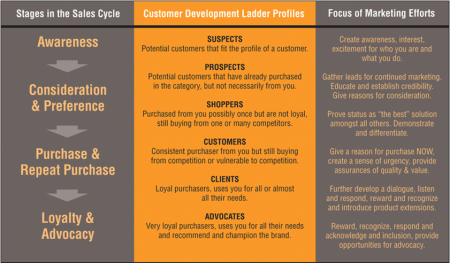 In an ideal world, every lead from every source would be waiting to hear from you so they can place an order. Please pinch yourself and wake up, this only happens in dreams! People respond for different reasons and it’s marketing’s job to sort out the wheat from the chaff in the lead generating process.
So many programs fail because the leads sent out to the sales force haven’t been qualified. The guys in the field are hunters and gatherers, and if someone isn’t ready to buy, then they are put in the dead file. Just because they aren’t ready to buy today doesn’t mean that they aren’t a prospect.
There are different stages in the selling cycle from awareness to loyalty and advocacy. Each stage requires a different message in order to move them up the development ladder. If you can identify what stage a lead is in, marketing can nurture leads along until they are ready to buy.

 There is a revolution starting in the world of mobile marketing and it isn’t just for B2C – it is for everyone, including B2B. According to a recent article in Mobile Marketer, B-to-B mobile marketing will go from 26 million in 2009 to 106 million in 2014 according to Forrester Research.
