Let’s face it, third-party cookies and Ad IDs have been a crutch for advertisers over the past decade.
Well now as data restrictions tighten and tech companies (i.e., Google and Apple) make it harder for advertisers to track users, everyone is scrambling to find alternatives to using cookies.
One alternative is using your first-party data which is the data you collect on your audience based on their activity within your website, app, email services or social media.
A new study from LiveIntent and Advertiser Perceptions lists the top ways advertisers plan to grow or enhance first-party data, with the Top 3 areas being:
1) Growing email lists via newsletters
Nine in 10 advertisers see newsletters as valuable in understanding your audience. The use of growing your email list will help businesses to activate their data and fully understand their audience. Newsletters will also allow businesses to personalize their communication efforts and see who they should be targeting. Lastly, they will also help to provide first-party data and show you relevant content that businesses can use to build a connection with consumers.
2) Site/app visitation behavior
Website and app visitation can provide important behavior that can be used to track their data. When users connect to your website, the website can collect your audience details. From websites or apps, you can gain users email address, name, mobile number, location based on shipping information and behavioral data. With all this data you can easily see what audience persona or following you have and market directly towards them.
3) Social media
Social media is a vital tool in collecting your audience’s data. Your audience will most likely be using social media way more than just typical Google. Especially in this day and age, people are constantly on a social media platform throughout the day. With social media, you can directly see who your audience is and can even focus on paid media to target and get more insights. With knowing your audience, you can also look for ways to improve on social media to try and expand your first-party data.
Data is very important in knowing who your audience is and seeing who you should be marketing towards.
What’s your company doing to increase their first-party data?
CLEVELAND – April 2023 – Sonnhalter, a communications firm marketing to the professional tradesman in the construction, industrial and MRO markets, announces NIBCO as one of its newest clients.
Founded in 1904, NIBCO is a leading provider of valves, fittings and flow control products for commercial, industrial and institutional construction, marine markets, as well as residential and irrigation markets. Headquartered in Elkhart, Indiana, NIBCO offers more than 56,000 SKUs to the plumbing industry.
“As NIBCO continues to grow and expand, Sonnhalter’s knowledge of the industry will help NIBCO to increase our brand awareness,” said Sally Boyer, marketing communications manager at NIBCO. “At NIBCO, we have a manufacturing history spanning over a century of producing high quality products, and with Sonnhalter we can continue to push boundaries.”
Sonnhalter will be assisting NIBCO in managing its earned media, social media, paid media and overall marcom strategy.
“NIBCO is a company with a rich history and expansive list of valves, fittings and flow control products,” said Matt Sonnhalter, vision architect at Sonnhalter. “We look forward to working together to enhance NIBCO’s brand leadership in the industry.”
About Sonnhalter
Established in 1976, Sonnhalter is the leading B2T marketing communications firm to companies that target professional tradesmen in construction, industrial and MRO markets. Sonnhalter is located in the historic Brownell Building in the heart of downtown Cleveland. Sonnhalter’s brand identity highlights its expertise in marketing to the professional tradesmen. Its tagline, “Not Afraid To Get Our Hands Dirty,” promotes the employees’ willingness to roll up their sleeves and dig deep into clients’ businesses, also, it refers to the market it targets: the tradesmen who work with – and dirty – their hands every day. Sonnhalter developed the acronym “B2T,” which stands for “business-to-tradesmen” to capture the essence of its specialty. For more information, visit the company website at Sonnhalter.com.
About NIBCO INC.
Founded in 1904, NIBCO INC. is a leading provider of valves, fittings, and flow control products for commercial, industrial and institutional construction, Navy marine markets, as well as residential and irrigation markets. NIBCO is headquartered in Elkhart, Ind., and has 13 manufacturing plants located throughout the United States and globally. Visit NIBCO.com for information on the complete line of NIBCO products.
By the time I reached Indianapolis for the NTEA Work Truck Week, my seventh trade show in just over 52 days, my battery/energy level was running close to empty! Luckily for me there were plenty of batteries and charging stations since electric vehicles were once again the hot topic of the show. You couldn’t walk 10-feet down any aisle without tripping over something EV-related.
As the industry’s transition to electric power accelerates, much of the news coming out of Work Truck Week was related to electric vehicles, including the launch of eight commercial EVs, as well as associated auxiliary power solutions, bodies and equipment.
The Green Truck Summit, NTEA’s full-day advanced fuels and vehicle technology conference, was also sold out for the second year in a row, with nearly 1,000 attendees.
And the overall attendance of the show returned to pre-pandemic levels with 14,885 industry professionals, setting a new record with a 17% increase over the 2022 event.
Here are just a few of the commercial electric vehicles which were unveiled at the show:
-Isuzu Commercial Truck of America and Hino Trucks both chose Work Truck Week 2023 to announce their first all-electric trucks, Isuzu’s N-Series EV and Hino’s M5e and L6e.
-Mack Trucks unveiled its first electric vehicle in the medium-duty segment, the Mack® MD Electric.
-Shyft Group revealed the new Blue Arc Class 5 All Electric Crew Cab, while Ideanomics and VIA Motors introduced the VTRUX® electric work truck.
-Workhorse Group pulled the silk from its new W56 zero-emission step van.
-JB Poindexter & Co business units announced several new products and developments, including Project ZEVX, an EAVX, Reading Truck and ZEVX electric concept, and an all-electric C250 postal truck demonstration vehicle developed by Morgan Olson for Canada Post.
-Ram Commercial showcased its new Ram 1500 Battery-electric Vehicle Concept, and Bollinger Motors provided updates on its new B4 all-electric fleet truck. Meanwhile, Ford Pro marked the one-year anniversary of the Ford E-Transit all-electric van.
And while the commercial EVs dominated the headlines at the show, there was one booth that caught my eye as I was walking the last day of the show. Loop Energy, an industry-leading developer, manufacturer and supplier of hydrogen fuel cell systems for vehicle OEMs and power generation system manufacturers. They were showcasing their newest commercial vehicle solution. Who knows…maybe hydrogen could be the next alternative fuel/power source in the decades to come. I guess maybe we are not that far away from flying vehicles:)
Well, that’s a wrap for the 1Q 2023 trade show season, time to rest up for the Fall trade show circuit!
Each month, Alan Sipe, a contributing editor for Professional Distributor magazine, writes a sales skill article targeted to the independent business people who own and operate the various branded tool trucks you see parked at automotive repair shops everywhere.
As a mobile jobber for a major brand, you either have a set number of technicians on your route or a set geographic boundary controlling your selling efforts. Being an independent mobile jobber, your efficiency, selling time, and logic determine the ground you can successfully cover. Major or independent, there are limits on the number of customer opportunities and realistic hours in the day you can sell.
It’s always easy to think that you only need a bigger territory or access to larger dealerships to be a Top 100 dealer (but this is probably not going to happen). You could wish for lower prices, higher margins, and fewer backorders (I guarantee that this is not going to happen). And finally, you can hope that one of your competitors drops out of the business since he is a price-cutting pain in your wallet!
So, if wishing, hoping, and praying are not going to help, there is only one thing remaining. You are going to have to accept the cards (aka, technicians) you’ve been dealt and make the most of it.
This month we’re looking at ways for you to look at your customer and prospect base and build your revenues with the opportunities you have.
I imagine you have a good idea of who are all the absolute Tool Nuts, Good Customers, Sporadic Customers, non-customer prospects, and Dead Beats (cash only) that work in your area. I’m guessing that you have some document/spreadsheet/program with all the names of the technicians and shop owners in your area.
Let’s start with the Dead Beats (cash only) in your area. No matter how bad at bill paying these technicians are, they still need tools to do their jobs. Granted they are probably buying many of their tools at Harbor Freight or some other discount location, but there are still some specialty products they can only get from a true automotive jobber — like you. Don’t ignore these people. You never know if their financial missteps are over or they are now somehow currently flush with cash. Talk to them, show them your new cool tools, and discuss a way for them to potentially get in your good credit graces. Maybe give them a plan that if they buy x amount from you for cash, you will start them out with a small credit line. Talk openly but discretely with them about their issues, it’s often surprising what a little open communication can accomplish. Think of it this way, anything you sell them is 100% plus business, and additionally, you will probably sell to these people at full-boat list price.
Your next target group should be the people who are buying from someone but not from you. These are your prospects. Continue dropping off your promotional brochures and eye-to-eye thank them for looking at it and while you at it mention that you would appreciate a shot at their business. I’m sure in some cases these non-customers are mad at you, your predecessor, or the brand that is on your truck, and these issues are what you need to get past. Sometimes a simple request like “how can I earn your business back” may crack the ice and open a conversation. This conversation may not be all peaches and cream at first.
When they regurgitate whatever the previous sin (in their eyes) was, honor their statement with “I’m sorry that happened, and I’ll do my best to meet your needs as we move forward.” Sure, the prospect may be a knucklehead and never forgive you for not taking back the broken lugnut socket that he had welded to a pry bar for busting loose frozen wheel nuts. Just keep asking. If this guy is that odd, he will sooner or later become unhappy with his current supplier and come back to you. The successful action in this instance is to keep talking to them and asking for their business. Again, anything you sell them is 100% plus business.
The hardest nut to crack is the sporadic buyer. Are they maxing out their credit with every mobile who calls on them? Are they trying to spread the wealth and keep everybody happy? Are you their primary, secondary, or almost-nothing supplier?
Firstly, try your best to figure out where you stand with this sporadic buyer. Are you number 1,2,3, or four on their purchase scheme? You can mention to them that if they were to consolidate their purchases with you, you could give them something in return. Better terms, cumulative discount, the first shot of what’s new and exclusive. Something to make them feel special. Setting them up on a try before you buy it, one-week loaner program is a good way to get someone’s interest. There is no need to give away the store, just make them feel wanted and special.
The” tool nuts” of which I am one, will buy almost anything new that hits the market. The challenge here is that except when a tool is new and exclusive to your brand it is probably new and available from you and all your competitors too. In this case, it is often true that the first mobile in the door with this cool new tool gets the business.
A great idea for your Tool Nuts is to develop an email or text group list of these technicians and the day you learn of or get your hands on a new tool communicate with this group immediately letting them know about the product and that you will be bringing it to them shortly. You can even give the recipients of this communique the option of hitting reply and pre-ordering this product from you. Anything you can do to get them committed to you is the objective.
And finally, there are your Good Customers. The acronym KDWYD (keep doing what you’re doing) is your first line of defense. Keep treating them like gold, telling them every week that you appreciate their business, and always, always ask if there’s anything else you can do for them. As corny as it sounds the motivational phrase “you’re best kept rose will soon wither and die if left unattended” fits your good customers perfectly.
There’s a ton of money to be made in the s!@t business…at least that’s what I reminded every year I attend the WWETT Show.
This show does a great job on their education sessions…and this year was no different, with over 100 sessions running over the four days. And I loved their “Button Wall” which was just outside the main entrance of the exhibit hall…the “straight outta toilet paper” and “septic” (which was orange, so obviously had to grab) were the two buttons I picked up.
The exhibit hall was packed (I believe there’s still a waiting list for companies that wish to exhibit at the show). Pipe re-lining and repair was a “hot topic” for this year’s show. It’s been at past shows, but I feel this year it was much more prevalent across the entire show.
One thing I took advantage of this year, which I hadn’t in the past, were the facility tours on the last day of the show. I signed up for the Belmont Wastewater Treatment Plant, Indianapolis’ largest wastewater treatment plant. And this was the first time I had toured a wastewater plant.
It was fascinating and the highlight of the show for me…here are just a couple of nuggets of wisdom I learned on the tour:
-they have a max daily capacity of running 330 million of gallons through the system (normally daily amount is 120M gallons)
-it only takes 12 hours for the untreated water to go through the entire system and when it is released into the water it’s actually cleaner than the actual water running in the river
-to help deal with surges and overflows from strong storms, they are currently building (scheduled for completion the end of 2025) the DigIndy Tunnel System that’s a 28-miles-long network of 18-foot diameter deep rock tunnels, 250 feet beneath the city, with a main trunk and five fingers which has a 250 million gallon capacity
-I think the gigantic ten screw pumps were my favorite part, followed by the UV light treatment
Typically this shows runs Monday-Thursday and tends to be in the mid/end of February, but the show organizers are shaking things up for 2023, which will now be happening at the end of January (January 24-27) and running Wednesday-Saturday. This 2023 show will also run up against AHR Expo in Chicago and coincide with the World of Concrete Show out in Vegas, so it will be interesting to see how this affects attendance.
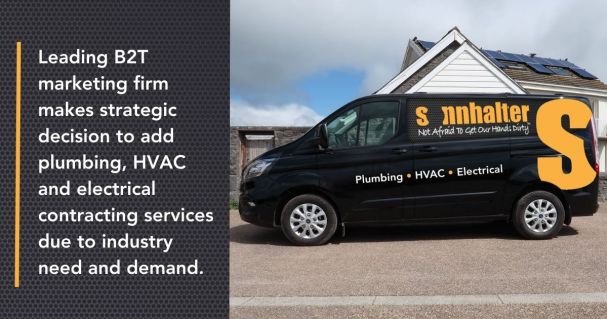
CLEVELAND – April 1, 2023 – Sonnhalter, a leading B2T communications firm marketing to the professional tradesman in the construction, industrial and MRO markets, has made the strategic decision to supplement its marketing offerings with plumbing, HVAC and electrical contracting services due to industry need and demand.
“After careful consideration we’ve made the decision to add plumbing, HVAC and electrical contracting services to our current business offerings, since there is a growing demand and potential for exponential growth,” said Matt Sonnhalter, vision architect, Sonnhalter Contracting.
“Our philosophy as a marketing firm was always ‘that we are not afraid to get our hands dirty,” explained Sonnhalter. “With more and more tradesmen retiring, the skills gap has become a more urgent crisis in the contracting arena. We feel Sonnhalter can do its part to address this need.”
Every day, the shortage in the skilled trades becomes more acute. Industry experts say the trades lost nearly a million skilled workers during the recession that have yet to be replaced, and as older workers retire, the crunch will get even tighter.
For more information on Sonnhalter’s contracting services, including plumbing, mechanical contracting, general contracting and electrical contracting, please contact: Matt Sonnhalter at [email protected].
Just kidding… APRIL FOOLS!!!
About Sonnhalter
Established in 1976, Sonnhalter is the leading B2T marketing communications firm to companies that target professional tradesmen in construction, industrial and MRO markets. Sonnhalter is located in the historic Brownell Building in the heart of downtown Cleveland. Sonnhalter’s brand identity highlights its expertise in marketing to the professional tradesmen. Its tagline, “Not Afraid To Get Our Hands Dirty,” promotes the employees’ willingness to roll up their sleeves and dig deep into clients’ businesses, also, it refers to the market it targets: the tradesmen who work with – and dirty – their hands every day. Sonnhalter developed the acronym “B2T,” which stands for “business-to-tradesmen” to capture the essence of its specialty. For more information, visit the company website at Sonnhalter.com.